
Käthe Kollwitz
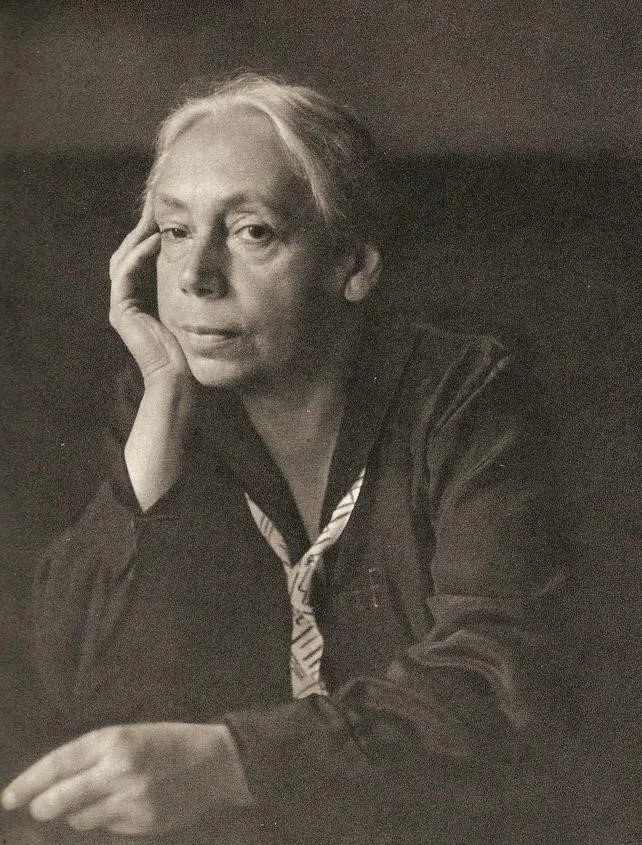
Image from Wikipedia
Image from Wikipedia
Käthe Kollwitz – The Great Storyteller of Suffering, Dignity, and Resistance
An artist biography balancing social conscience, graphic strength, and unforgettable visual language
Käthe Kollwitz, born Schmidt, is considered one of the most influential German women artists of the 20th century. Born on July 8, 1867, in Königsberg and died on April 22, 1945, in Moritzburg near Dresden, she developed a distinctive art between realism and expressionism that tells with radical clarity the stories of poverty, loss, war, and human vulnerability. Her graphics, etchings, lithographs, woodcuts, and sculptures possess an emotional intensity that continues to resonate today, making her one of the most internationally recognized German artists. ([kollwitz-moritzburg.de](https://kollwitz-moritzburg.de/kaethe-kollwitz/biographie/))
Early Influences: Background, Education, and Engagement with the Social Environment
Käthe Kollwitz's artistic development did not begin in an ivory tower, but rather in the tension between education, social observation, and personal experience. She studied at the School of Women Artists in Berlin in 1885/86 and again at a women's artist school in Munich in 1888/89; in 1891, she married the doctor Karl Kollwitz and moved with him to Berlin. There, she lived in an environment shaped by the daily lives of the working population, and this focus on social life would define her entire career, reminiscent of a consistent artistic evolution. ([kollwitz-moritzburg.de](https://kollwitz-moritzburg.de/kaethe-kollwitz/biographie/))
From an early age, she showed an interest in art that does not decorate but condenses and interrogates. Her engagement with historical subjects, theater, literature, and political debates led her to create series of images that do not merely depict scenes but analyze human conditions. During this period, her distinctive style emerged: serious, often shockingly realistic representations that do not cling to fashionable surfaces but aim for psychological and social truth. ([kollwitz-moritzburg.de](https://kollwitz-moritzburg.de/kaethe-kollwitz/biographie/))
The Breakthrough with "A Weavers' Revolt"
Kollwitz achieved her decisive artistic breakthrough with the cycle "A Weavers' Revolt." Inspired by Gerhart Hauptmann's play "The Weavers," she interrupted her work on etchings for Émile Zola's "Germinal" and developed a graphic cycle between 1893 and 1898 that translated the misery of workers into a compelling visual language. With this work, she achieved a breakthrough at the Great Berlin Art Exhibition in 1898, which instantly established her as an extraordinary graphic artist. ([kollwitz-moritzburg.de](https://kollwitz-moritzburg.de/kaethe-kollwitz/biographie/))
The success of this cycle can be attributed to its artistic coherence: Kollwitz does not idealize but sharpens. Her figures do not appear as allegories but as flesh-and-blood individuals trapped in a system of social harshness. It is this blend of formal discipline, emotional directness, and political stance that constitutes the appeal of her art and forms the foundation of her later international reputation. ([de.wikipedia.org](https://de.wikipedia.org/wiki/K%C3%A4the_Kollwitz))
Graphic Mastery: Etching, Lithography, and Woodcut as Means of Expression
Kollwitz worked with an extraordinary range of techniques. Her repertoire included lithographs, etchings, engravings, woodcuts, and later also three-dimensional works; she began sculpting in 1909. It was especially the graphic methods that allowed her the dramatic condensation for which her art became famous: stark light-dark contrasts, expressive lines, and a composition where every detail aims for emotional impact. ([kollwitz-moritzburg.de](https://kollwitz-moritzburg.de/kaethe-kollwitz/biographie/))
Her work on the etching cycle "Peasants' War" between 1902 and 1908 as well as on the woodcut series "War" from 1922 to 1924 further deepened this language. Today, MoMA documents numerous key works from this cosmos, including "Woman with Dead Child," "Mother and Dead Son," and sheets from "A Weavers’ Revolt" and "War." These works reveal Kollwitz as a precise chronicler of grief, violence, and maternal pain, whose visual language remains singular in art history. ([moma.org](https://www.moma.org/artists/3201-kathe-kollwitz))
War, Loss, and the Moral Center of Her Work
The death of her younger son Peter in World War I marked a profound turning point in her life and work. Kollwitz's art became even more deeply permeated by grief, loss, and anti-militaristic thinking. Her works after 1914, particularly after 1918, do not articulate an abstract program of pacifism, but rather an existential ethics of images: they portray the destroyed family, the wounded body, the silent despair, and the dignity of suffering. ([kollwitz-moritzburg.de](https://kollwitz-moritzburg.de/kaethe-kollwitz/biographie/))
Between 1919 and 1926, she engaged in numerous social and political movements; iconic posters such as "Never Again War!" were created during this time. In 1929, she became the first woman to be awarded the Pour le Mérite Order for Sciences and Arts; prior to this, she had already become the first female member of the Prussian Academy of Arts in 1919 and received the title of professor. These recognitions not only attest to her stature but also to her authority in the cultural life of the Weimar Republic. ([kaethe-kollwitz.berlin](https://www.kaethe-kollwitz.berlin/wp-content/uploads/2022/11/KKMB_Biografie_2022.pdf))
Style and Visual Language: Between Realism and Expressionism
The style of Käthe Kollwitz cannot be reduced to a single label. Her art integrates influences from expressionism and realism without wholly submitting to any movement. The figures are monumental, crowded, often arranged in dense pictorial spaces; their faces bear traces of exhaustion, worry, and inner tension. It is this reduction to the essential that makes her works so direct and compelling to this day. ([kollwitz-moritzburg.de](https://kollwitz-moritzburg.de/kaethe-kollwitz/biographie/))
Her later sculptural work also expands this approach to include physical presence and spatial weight. The memorial "Grieving Parents," erected in 1932 in a soldiers’ cemetery in Belgium, is among the most well-known sculptures of the 20th century and encapsulates the motives of her entire oeuvre: silent remembrance, maternal grief, and a formal language that avoids any pathos. It is in this concentration on human experience that Kollwitz's extraordinary artistic authority lies. ([kaethe-kollwitz.berlin](https://www.kaethe-kollwitz.berlin/wp-content/uploads/2022/11/KKMB_Biografie_2022.pdf))
Impact and Cultural Influence: An Artist of International Significance
The international importance of Käthe Kollwitz is undisputed. An overview article in the International Encyclopedia of the First World War identifies her as one of the most influential female artists of her generation; her works have been widely received as anti-war imagery and have become central reference points of a socially engaged modernity. MoMA also features her works in its collection and in several exhibitions, including a major presentation in 2024. ([encyclopedia.1914-1918-online.net](https://encyclopedia.1914-1918-online.net/wp-content/uploads/2023/01/ams/958966/pdf/1914-1918-Online-kollwitz_kathe-2017-06-02.pdf))
Her significance extends far beyond art history. Kollwitz shaped the image of the politically responsible artist, who does not shy away from social hardship or personal pain. When she was forced to leave the academy after the rise of the National Socialists and her works were removed from museums, the conflict between artistic freedom and political repression became evident. The fact that her works are nonetheless present worldwide today underscores their lasting relevance. ([kaethe-kollwitz.berlin](https://www.kaethe-kollwitz.berlin/wp-content/uploads/2022/11/KKMB_Biografie_2022.pdf))
Later Years, Diaries, and Lasting Legacy
Between 1908 and 1943, Kollwitz kept diaries that provide insight into her artistic doubts as well as her roles as a mother, grandmother, and wife. She left Berlin during the bombings, was evacuated first to Nordhausen and later to Moritzburg, where she died in 1945. Her urn was buried in the family grave in Berlin-Friedrichsfelde in the same year. This biographical endpoint amplifies the impression of a life entirely dedicated to an uncompromising art. ([kollwitz-moritzburg.de](https://kollwitz-moritzburg.de/kaethe-kollwitz/biographie/))
Her legacy lies in the combination of empathy and formal radicalism. Kollwitz gave a face to the invisible, a visual language to the victims, and a moral gravity to art that has become rare today. Those who engage with her work do not encounter a pleasing beauty, but rather an art of the greatest human depth, that endures because it prioritizes truth over effect. ([encyclopedia.1914-1918-online.net](https://encyclopedia.1914-1918-online.net/wp-content/uploads/2023/01/ams/958966/pdf/1914-1918-Online-kollwitz_kathe-2017-06-02.pdf))
Conclusion: Why Käthe Kollwitz Continues to Fascinate
Käthe Kollwitz is compelling because her art does not explain but hits home. She combines masterful graphics, clear composition, and deep humanity into a body of work that inseparably merges social reality and personal experience. Her images and sculptures are some of the strongest visual statements against war, poverty, and repression in European modernity. ([encyclopedia.1914-1918-online.net](https://encyclopedia.1914-1918-online.net/wp-content/uploads/2023/01/ams/958966/pdf/1914-1918-Online-kollwitz_kathe-2017-06-02.pdf))
Engaging with Käthe Kollwitz allows one to experience a female artist biography with immense emotional and historical weight. Her works unfold their power in museums as well as in quiet contemplation and invite a re-discovery of the entirety of her oeuvre. A live experience of her works remains an impressive cultural event. ([moma.org](https://www.moma.org/artists/3201-kathe-kollwitz))
Official Channels of Käthe Kollwitz:
- Instagram: no official profile found
- Facebook: no official profile found
- YouTube: no official profile found
- Spotify: no official profile found
- TikTok: no official profile found
Sources:
Upcoming Events
Lunch Break at the Museum: "Käthe Kollwitz in Self-Portrait" with Curator Dr. Lars Berg