Urban Transformation in Braunschweig: New Neighborhoods
Urban Transformation: New Neighborhoods & Projects in Braunschweig (Outlook)
In the coming years, several urban development areas will be in focus in Braunschweig: large conversion areas, targeted neighborhood renewal, and new forms of living, mobility, and climate adaptation. This article bundles the most important projects as a preview of future developments—with a view to what is planned, which goals are being pursued, and how progress can be recognized in everyday life.
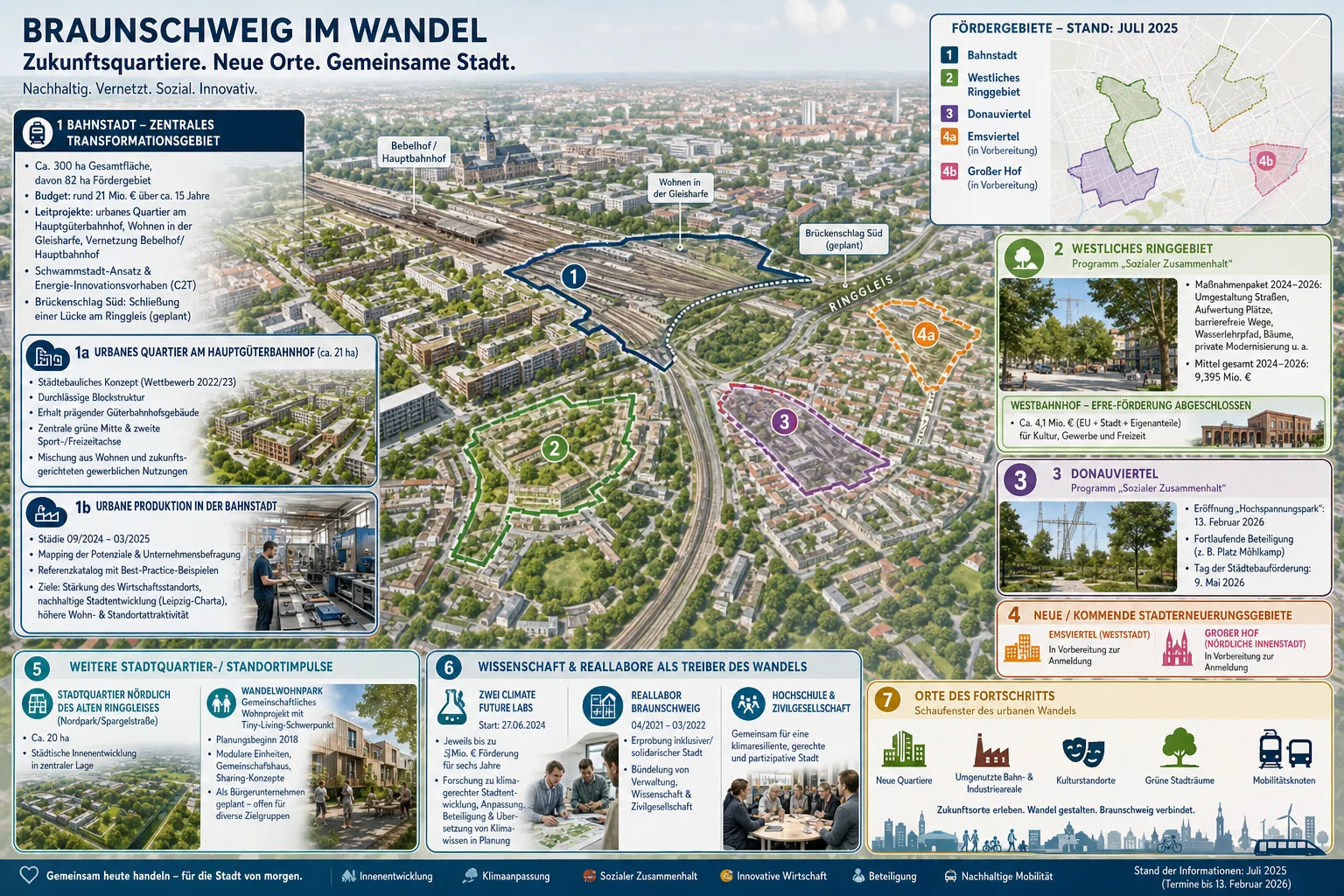
Bahnstadt Braunschweig: The Major Transformation Area
In the area around the main train station, railway facilities, and former railway or industrial sites, a comprehensive redesign is planned for the coming years. Under the term "Bahnstadt", several sub-projects are bundled, which aim to reorganize the areas and at the same time better connect adjacent neighborhoods.
The core is about inner development: Instead of designating new settlement areas on the outskirts, existing areas within the urban structure are to be gradually made usable for living, working, green and recreational spaces, as well as mobility axes. This makes Bahnstadt a long-term urban redevelopment project that explicitly considers stages, interim states, and learning processes.
Climate Adaptation, Ringgleis Connection, and Energy in the Neighborhood
A central goal of future planning is to build new neighborhoods climate-resilient. This includes concepts to better manage heavy rainfall and mitigate summer heat—for example, through more greenery, less sealed surfaces, rainwater retention, and shading in public spaces.
At the same time, solutions are being discussed and tested for the coming years on how neighborhoods can be supplied efficiently and climate-friendly with heat and electricity. Typically, renewable energies, load management, and networked control play a role—always with the aim of combining supply security and affordability with climate goals.
The connection with the Ringgleis also remains a recurring guiding principle: New pathways and better crossings are intended to strengthen the cycling and pedestrian network, so that new uses do not arise in isolation but are directly connected to existing everyday routes.
Urban Neighborhood at the Main Freight Station: Mixed Use as an Urban Building Block
A particularly striking project within Bahnstadt is the development of an urban neighborhood at the (former) main freight station. In the coming years, a district is to be created there that consciously combines living, working, and leisure—with short distances, mixed-use ground floors, and easily accessible public spaces.
For planning in such transformation areas, two aspects are typically decisive: First, the question of how existing structures can be sensibly reused (for example, distinctive buildings or historical traces). Second, how new open spaces are created that are not just "leftover areas" but function as meeting points, green corridors, and movement spaces.
Urban Production: Bringing Work Closer to Everyday Life
For the upcoming development stages, it is also relevant how urban production and new forms of work can be integrated into a residential environment—that is, small-scale, low-emission workshops, service businesses, creative production, or knowledge-based services that work in mixed neighborhoods.
The added value of such approaches lies in the perspective: If work and living are better interlinked, commuting distances can decrease, everyday services become more quickly accessible, and neighborhoods gain in vibrancy—provided that noise, logistics, and usage conflicts are addressed early in the planning process.
Neighborhood Renewal: Western Ring Area and Other Areas
In addition to large new construction and conversion areas, urban transformation in Braunschweig will also be visible in existing neighborhoods in the coming years. The focus is on measures that aim to improve everyday life, safety, and quality of stay in public spaces—for example, through more accessible paths, better crossings, new trees, upgraded squares, and reliably usable green spaces.
Westbahnhof Area: Place for Culture, Commerce, and Encounters
Around Westbahnhof, development in the coming years will continue to focus on a mixed profile of culture, small-scale commerce, and neighborhood offerings. It is crucial that connections for walking and cycling as well as usability for different age groups are considered, so that such a place is not only a destination but also part of daily life in the neighborhood.
Other Neighborhoods in Focus: Donauviertel, Emsviertel, and Großer Hof
Beyond the western part of the city, further renewal and development processes will also be relevant in the coming years. In neighborhoods such as Donauviertel, public open spaces and participation formats will likely continue to play a central role in coordinating uses on site and ensuring acceptance.
In addition, further urban renewal areas are being planned or prepared for Braunschweig. Such steps are usually accompanied by stock analyses, target concepts, and the prioritization of projects—with the aim of gradually improving infrastructure, green spaces, pathways, and social offerings.
New Neighborhoods, Inner Development, and More Compact Living
Another building block for the coming years is the development of new residential locations within the existing structure—that is, areas that already exist within the urban fabric and are suitable for additional housing. Such projects can be particularly convincing when they combine proximity to public transport, good cycling and walking connections, and residential open spaces.
Community Living and Tiny-Living: Opportunities and Limits
In the future housing debate, models that require less living space per person and instead rely on shared spaces and sharing offers are playing an increasing role. Tiny-living and community housing projects can help use space more efficiently and promote neighborhood interaction.
For such concepts to work in the long term, however, practical questions must be clarified in the next planning steps: reliable legal and development frameworks, social mix, accessible solutions, fire protection, parking or mobility concepts, and the permanent organization of shared resources.
Science, Real-World Laboratories, and "Places of Progress"
Urban transformation will become visible in the coming years not only on construction sites but also in cooperation between administration, science, business, and civil society. Research and real-world laboratory formats can help test new approaches for climate adaptation, participation, and socio-ecological transformation under real conditions—with the aim of transferring insights more quickly into planning and implementation.
"Places of Progress": Making Change Visible
As a guide for those interested, the concept of "Places of Progress" can serve in the coming years: locations where urban development is particularly visible—for example, new neighborhoods, repurposed railway and industrial areas, upgraded squares, green corridors, or mobility hubs.
Those who visit such places can recognize change by concrete features: more shade and greenery, more legible pathways, functioning crossings, diversity of uses in ground floors, spaces for culture and encounters, and offerings that actually reach different age groups.