Experience Citizens' Assemblies & City Politics in Braunschweig
Citizens' Assemblies & City Politics in Braunschweig: What to Expect at the Next Events
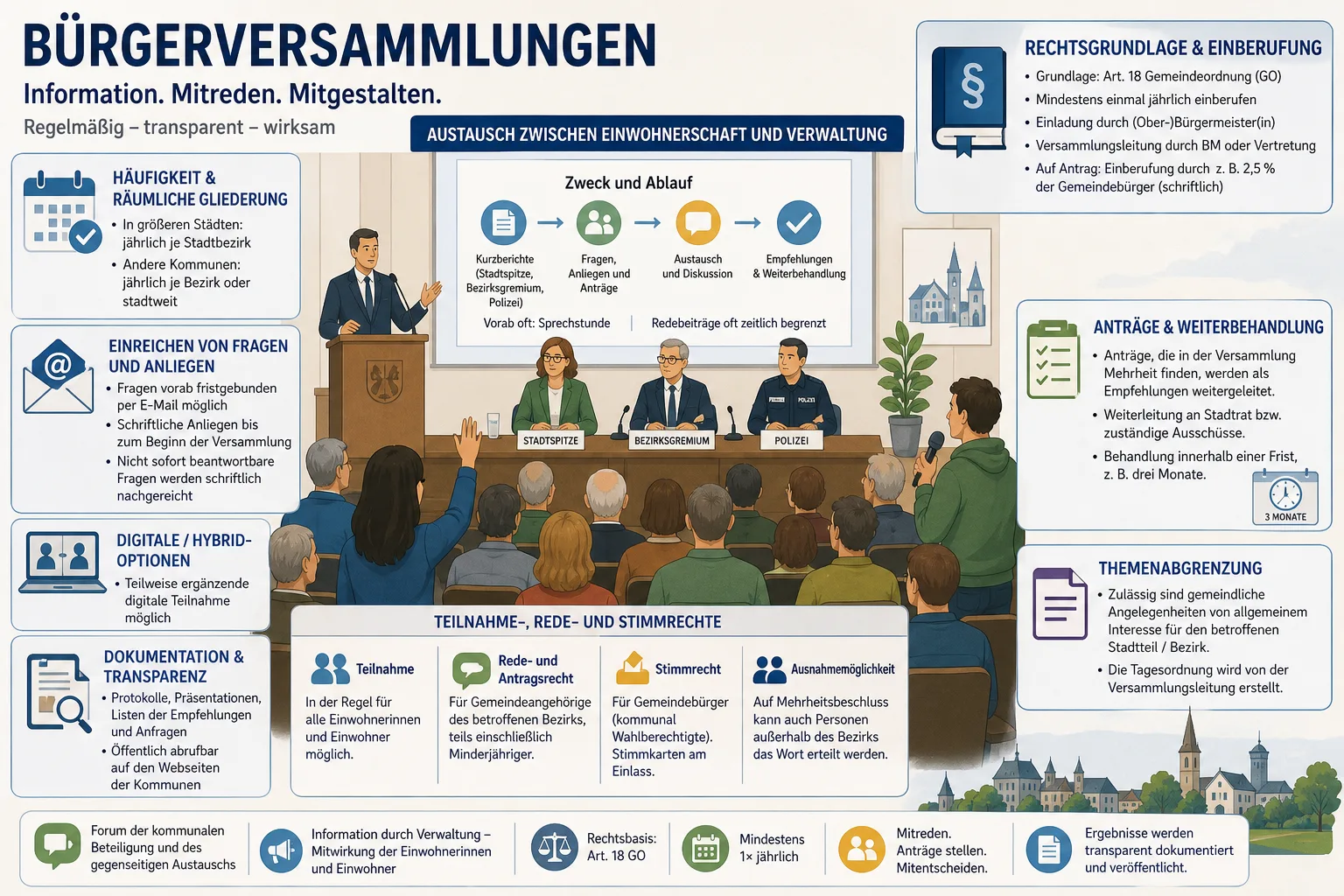
When citizens' assemblies take place again in Braunschweig in the coming months, they will be the most direct way for many people to bring topics from their own neighborhood into the municipal discussion. This article prepares you for how to orient yourself at the next assemblies, how to effectively formulate your concerns, and what will happen next in city politics.
What the Next Citizens' Assemblies Will Be About
The upcoming citizens' assemblies are expected to combine two goals:
- Information: The administration and, if applicable, other bodies will explain planned projects, developments, and responsibilities in the city district or neighborhood.
- Participation: Residents will ask questions, present concerns, and, in suitable cases, initiate motions that can then be further processed politically.
For you, this means: You will have the opportunity to place local topics so that they are addressed in the city's processing—not just as a conversation, but as documented input for further steps.
What the Procedure Will Likely Look Like
At the next citizens' assemblies, you can typically expect a clearly structured procedure that gives you orientation and at the same time allows many people to have their say:
- Opening and Classification: The assembly leadership will open the event, explain the framework, and set the main points (e.g., topic blocks, speaking order).
- Reports and Planned Projects: There will likely be short inputs on current or upcoming topics in the neighborhood (e.g., traffic, urban development, social infrastructure, public safety).
- Questions, Concerns, and Statements: Afterwards, you will be able to present your concern orally; often, follow-up questions will be asked or responsibilities named.
- Motions and Votes: If a concern is formulated as a motion, there may be a vote, which will be included as a recommendation in further political processing.
- Next Steps: At the end, it will usually become clear which points are clarified immediately and which will be further processed later in writing, in committees, or by specialist departments.
If you go well prepared, you will not just "let the process wash over you," but be able to specifically use the points where your topic is best placed.
Who Will Be Allowed to Participate — and How You Will Be Able to Speak
At the upcoming events, you can generally expect the event to be publicly accessible. To ensure the assembly remains workable, there will also be rules that structure participation fairly.
Practically, This Will Mean for You
- Participation: You will usually be able to participate without membership or party affiliation if you are interested in the neighborhood.
- Speaking: You will present your concern within a limited speaking time; the leadership will ensure that many people have their say.
- Votes: If there are votes, voting will usually be tied to certain requirements (e.g., municipal voting rights or affiliation with the affected area), as provided for by the respective arrangement.
Important for your planning: You will receive information on site (e.g., about the speaking order or how statements are collected). If you have a more complex concern, you will have the best chance of it being understood and correctly documented with a short, clear core statement.
This Is How Your Contribution Becomes a Topic That Will Be Further Processed
So that your concern does not "fizzle out" in the next phase, it will be important to formulate it so that it can be passed on as a task that can be examined and decided upon. At the upcoming citizens' assemblies, you will be able to use these levers in particular:
- Specific Location & Specific Effect: You will need to be more precise than "it's dangerous here." Name the street/section and which situation should be avoided in the future.
- Clear Demand: Formulate what should happen in the future (e.g., "improve crossing opportunity," "check signage," "add lighting," "initiate speed monitoring," "present planning transparently").
- Public Interest: Show why the topic is not just an isolated case (e.g., school route, public transport stop, frequently used square, accessibility).
- Realistic Responsibility: You will be more effective if you clearly stay within the municipal framework (city/districts, not federal politics).
A Practical Formulation You Will Use in the Future
"I request that the city examine the situation at [location] by [time period/quarter] and propose a feasible measure to reduce [specific risk/problem]. Please state responsibility, schedule, and how the decision status will be published."
With this structure, you will formulate your concern so that the administration and politics understand it as a task and can later document it in a comprehensible way.
Transparency: What You Can Expect After the Assembly
After the upcoming citizens' assemblies, you will mainly want to pay attention to three things to see how things proceed:
- Documentation: You will look for minutes, overviews, or published answers to ensure it remains clear what has been promised, examined, or forwarded.
- Forwarding to Committees: You will follow whether recommendations are included in the responsible committees or the city council and discussed there.
- Feedback: If points are not clarified immediately, you can expect a later, written response, provided the process provides for this.
For your own impact, it is crucial: You will follow up on your topic once after the assembly (e.g., via city publications or communication from the responsible bodies). This way, an evening becomes a longer-lasting impulse.
This Is How You Prepare for the Next Citizens' Assemblies in Braunschweig
- Check dates in time: You will keep an eye on the city's next announcements (location, time, district, main topics).
- Condense your concern to one minute: You will be strongest at the microphone if you clearly state the problem, location, affected parties, and desired measure in 60–90 seconds.
- Have a second, longer version ready: You will only provide details (data, observations, photos/sketches) if follow-up questions arise or you can submit them in writing.
- Coordinate allies: If several people present the same concern, you will increase the impact if each person covers a different aspect (safety, accessibility, children, public transport, delivery traffic).
- Remain respectful and solution-oriented: You will be taken more seriously if criticism is clear but objective—and you offer a concrete, verifiable solution.