
Braunschweig
38104 Braunschweig-Östliches Ringgebiet, Deutschland
Prinzenpark Braunschweig | Fitness Course & Trim-Yourself Path
The Prinzenpark, officially Prinz-Albrecht-Park, connects Braunschweig's city history, large green spaces, and practical movement in a surprisingly compact way. What is experienced today as a quiet local recreation area in the eastern ring area began in 1895 on a former drill ground and was later designed as a nature-friendly forest park. This tension arc makes the place so interesting: here old paths, grown trees, open meadows, and sports offerings come together, so that a walk can quickly turn into a small training round. Anyone looking for a trim-yourself path, a fitness course, or simply fresh air will find in the Prinzenpark not a staged event backdrop, but a real public space with movement quality. This is equally attractive for families, runners, walkers, children, and recreational athletes. The park is centrally located in the east of the city, is landscape-protected, and is one of the places where Braunschweig shows its green side particularly clearly. ([braunschweig.de](https://www.braunschweig.de/tourismus/ueber-braunschweig/sehenswuerdigkeiten/blik/ensembles/prinz-albrecht-park.php))
Fitness Course and Four Stations Along the Finnish Running Track
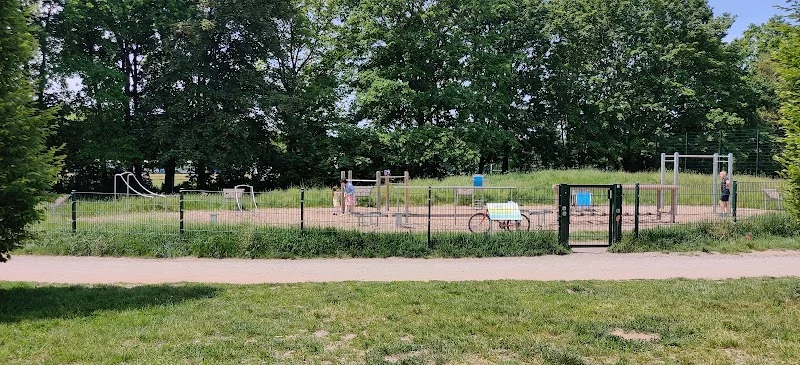
The modern fitness course in the Prinzenpark was opened for use in early 2019 and is designed as a complement to the existing Finnish running track. According to the city, there are four stations along the route, which are deliberately designed differently: one location is aimed at more athletically ambitious users, another offers a holistic training program for all generations, one station is focused on more demanding movements like calisthenics, and another promotes coordination and motor skills. This makes the facility interesting not only for classic strength training but also for playful movement units, mobilization, and short training sessions in everyday life. It is precisely this mix of simplicity and variety that makes the appeal of the course. You can stay at one station, combine several devices, or use the round as a small circuit. This is as sensible for beginners as it is for experienced athletes who want to work on their stability, body tension, and mobility outdoors. ([regionalheute.de](https://regionalheute.de/braunschweig/fitnessparcours-im-prinzenpark-ist-freigegeben/))
In terms of SEO, this versatility is crucial: those searching for fitness courses, trim-yourself paths, or outdoor training in Braunschweig will find here not an isolated single device, but a sensibly structured movement space. The stations are not located in an artificial sports backdrop, but in the open park space, allowing training, breaks, and walks to merge. This creates a low-threshold access because no membership or special equipment is required. At the same time, the place is well-suited for short running units, warm-up programs, mobility exercises, or strength endurance with one's own body weight. Because the park is publicly accessible, the character remains relaxed and flexible: those wanting to take a quick round in the morning will find peace; those out with the family in the afternoon can incorporate the course as a stopover. This everyday usability explains why the Prinzenpark works so well as a fitness location and why the search terms related to courses, movement, and free training reinforce each other here. ([regionalheute.de](https://regionalheute.de/braunschweig/fitnessparcours-im-prinzenpark-ist-freigegeben/))
Jogging, Walking, and the 2.1 Kilometer Long Finnish Running Track
A central argument for the Prinzenpark is the Finnish running track. Regional reports mention it as being about 2.1 kilometers long, making the course attractive for casual jogging, brisk walking, interval training, or Nordic walking. Those who like to run their rounds in a clear, manageable format will find a route that can be well planned and still remains varied. The combination of the running track, green spaces, and the four fitness stations allows for building a training session from several components: first warm up, then run, continue working at the devices, and finally return with a relaxed walk. This creates a pleasant change between activity and relaxation, especially in a park designated as a local recreation area. The distance is long enough to really get moving but short enough to be meaningfully usable even during a lunch break or after work. ([regionalheute.de](https://regionalheute.de/braunschweig/fitnessparcours-im-prinzenpark-ist-freigegeben/))
Historically, this running culture fits very well with the character of the Prinz-Albrecht-Park. The official park description mentions a circular path about 3.5 kilometers long and nine meters wide, originally designed for pedestrians, riders, and carriages. This shows that the network of paths was designed for movement from the very beginning and that the park was not only intended as a decorative or representative area. Today, runners and walkers, who appreciate the nature-friendly layout of the terrain, benefit from this. The wide sightlines, forest and meadow areas, and winding paths create a training feeling that has become rare in the city. Those wanting to combine the tranquility of a park with a clearly measurable round will find a good solution here. Thus, the term running track becomes not just a technical term but a real usage experience: being outdoors, finding rhythm step by step, perceiving the surroundings, and being able to stay in the green right after the round. ([braunschweig.de](https://www.braunschweig.de/tourismus/ueber-braunschweig/sehenswuerdigkeiten/blik/ensembles/prinz-albrecht-park.php))
From Drill Ground to Nature-Friendly Forest Park
The history of the Prinzenpark is closely linked to the urban development of Braunschweig. Until the beginning of the 19th century, the area was used for agriculture. In 1824, Duke Karl II had the Great Drill Ground established here, which was relocated to Salzdahlumer Straße in 1887. On the freed-up area, a park was created according to the plans of the ducal promenade inspector Friedrich Kreiß. The park, completed around 1900, was named after Prince Albrecht of Prussia, who was regent of the Duchy of Braunschweig from 1885 to 1906. With an area of around 58 hectares, it was intended from the beginning as a generous, nature-friendly forest park for the residents of the eastern ring area. This origin explains why the Prinzenpark still does not appear as a strictly designed urban facility but rather as an open, grown space with significant landscape depth. ([braunschweig.de](https://www.braunschweig.de/tourismus/ueber-braunschweig/sehenswuerdigkeiten/blik/ensembles/prinz-albrecht-park.php))
Also, the structural and functional changes are part of the park's identity. A memorial commemorates Prince Albrecht, and over time, new uses have been added. The historical description mentions, for example, that the representative entrance area was transformed into a fire pond in 1941 and repurposed as a roller skating rink in 1950. Later, further sports areas and infrastructure for the neighborhood followed. Despite all these changes, the fundamental character has been preserved: the Prinzenpark is a place of recreation but also a space for sporting activities. The city explicitly points to the park's popularity as a place for relaxation and numerous sporting events, including traditional bicycle races. This mix of history, public use, and grown park landscape makes the Prinzenpark more than just a green spot on the map. It is a piece of Braunschweig's city history that can still be experienced directly today while walking, running, or training. ([braunschweig.de](https://www.braunschweig.de/tourismus/ueber-braunschweig/sehenswuerdigkeiten/blik/ensembles/prinz-albrecht-park.php))
Directions, Address, and Orientation in Eastern Braunschweig
For orientation, the official address is helpful: Ebertallee, 38104 Braunschweig. This places the Prinzenpark clearly in the eastern Braunschweig city area and allows it to be well integrated into the neighborhood context of the eastern ring area. A city blog explicitly describes the park as very centrally located and mentions the large playground at Matthäuskirche, another playground towards Georg-Westermann-Allee, and the well-known roller skating rink in its vicinity. These orientation points are useful when visiting the park for the first time or when out with children. The proximity to the adjacent sports facilities around Franzsche Feld also helps with spatial orientation. Those using the Prinzenpark as a training location thus benefit from a clear urban location that still leads directly into the green. The charm arises precisely because you do not have to drive far out of the city to take a round outdoors. ([braunschweig.de](https://www.braunschweig.de/tourismus/ihr-besuch-in-braunschweig/sehenswuerdigkeiten/eintraege-sehenswuerdigkeiten/_prinzenpark.php?utm_source=openai))
Practically speaking, it is worthwhile to take a look at the city's park and map overview in advance. The city of Braunschweig provides its own overview that consolidates parks, parking garages, park-and-ride offers, and other mobility topics. For the Prinzenpark itself, the location page primarily mentions the address but does not provide a separate ticket office or a separate visitor parking lot, which fits well with the character of the place as a freely accessible park. Therefore, those arriving by car should check the current traffic situation and the available parking options in the vicinity; those coming on foot, by bike, or via public transport can utilize the location in the eastern ring area particularly easily. This urban integration is an advantage: the park remains open and low-threshold without requiring significant organizational effort. Thus, getting there becomes less of a hurdle and more a matter of personal habit and daily condition. ([braunschweig.de](https://www.braunschweig.de/plan/kartenuebersicht.php?utm_source=openai))
Family-Friendly Recreation, Skate Park, and Youth Area
The Prinzenpark is not only interesting for sporty adults but also for families with children. A contribution from city marketing describes that since 2019, a fitness course has been located in the park, which children can use under parental supervision when no one is training on it. In addition, there are several playgrounds, the roller skating rink or skate park, and even an ice cream truck at the entrance near Matthäuskirche in summer. This mix of movement, play, and small rewards in between makes the park particularly attractive for relaxed afternoons. Those coming with children can break the paths in the park into small stages, take breaks in between, and still remain active. The Prinzenpark thus acts as an open movement space for different age groups without being preachy or overloaded. This is one of the reasons why the place works so well in search queries related to walks, family outings, and outdoor fitness. ([loewenstadt.braunschweig.de](https://loewenstadt.braunschweig.de/mit-kindern-in-braunschweig-und-umgebung-spazieren/))
Additionally, there is the recent development of the former roller skating rink. An official status report from the city of Braunschweig describes that by the end of 2024, a barrier-free skate park with two basketball courts, LED lighting, seating tribune, Wi-Fi, and drinking fountains will be inaugurated on the former roller skating rink. In parallel, other city documents show that the modernization of the recreational sports facility has been pushed forward with a view to contemporary use. This strengthens the Prinzenpark as a meeting point for youth, recreational sports, and informal encounters in public space. Particularly interesting is that the park is not only a classic green space but is consciously evolving as a place for movement culture. So, anyone looking for calisthenics, a skate park, basketball, or a modern place to stay in the green will find in the Prinzenpark now significantly more than just running paths and trees. It connects old and new in a way that is very typical for Braunschweig: historical surroundings, current use, and a clear focus on public accessibility. ([ratsinfo.braunschweig.de](https://ratsinfo.braunschweig.de/public/wicket/resource/org.apache.wicket.Application/doc1798337.pdf?utm_source=openai))
Events, Tickets, and Free Use in the Prinzenpark
When it comes to the keyword events, it is important to properly classify the Prinzenpark: it is not a classic venue with a seating plan, box office, or seat categories, but a freely accessible park with movement offerings. This is why the search for tickets works differently here than at a concert or theater venue. Those using the fitness course do not need an admission ticket. The city describes the Prinzenpark as a landscape protection area and local recreation area, and the four fitness stations have been explicitly opened for use. This fits with a place intended for everyday use and not for a closed event format. The term events is still meaningful because the park plays a role in Braunschweig as a place for sports and community activities time and again. The historical description even mentions traditional bicycle races as examples of the area's sporting popularity. Thus, a place emerges that, while not a ticket location, is certainly a relevant component in the city's leisure and event life. ([regionalheute.de](https://regionalheute.de/braunschweig/fitnessparcours-im-prinzenpark-ist-freigegeben/))
For practical use, this means: the Prinzenpark is primarily a place for spontaneous movement. Those wanting to jog in the morning just go. Those out with children in the afternoon combine playgrounds, paths, and courses. Those wanting to train specifically can head to the four stations, run the 2.1 kilometers of the Finnish running track, and make a stop at the skate park or youth area at the end. Thus, the Prinzenpark fulfills exactly what modern outdoor locations are supposed to achieve: it is low-threshold, versatile, and reliable. At a place like this, it is not about overcoming an entry barrier but rather about sensibly using public space. This makes it strong for SEO, for users, and for the city alike. So, those looking for tickets will find in the Prinzenpark no ticket obligation but the simpler and often more attractive answer: free use, fresh air, and a historically grown area with real added value for everyday life. ([regionalheute.de](https://regionalheute.de/braunschweig/fitnessparcours-im-prinzenpark-ist-freigegeben/))
Sources:
Mehr anzeigenWeniger anzeigen
Prinzenpark Braunschweig | Fitness Course & Trim-Yourself Path
The Prinzenpark, officially Prinz-Albrecht-Park, connects Braunschweig's city history, large green spaces, and practical movement in a surprisingly compact way. What is experienced today as a quiet local recreation area in the eastern ring area began in 1895 on a former drill ground and was later designed as a nature-friendly forest park. This tension arc makes the place so interesting: here old paths, grown trees, open meadows, and sports offerings come together, so that a walk can quickly turn into a small training round. Anyone looking for a trim-yourself path, a fitness course, or simply fresh air will find in the Prinzenpark not a staged event backdrop, but a real public space with movement quality. This is equally attractive for families, runners, walkers, children, and recreational athletes. The park is centrally located in the east of the city, is landscape-protected, and is one of the places where Braunschweig shows its green side particularly clearly. ([braunschweig.de](https://www.braunschweig.de/tourismus/ueber-braunschweig/sehenswuerdigkeiten/blik/ensembles/prinz-albrecht-park.php))
Fitness Course and Four Stations Along the Finnish Running Track
The modern fitness course in the Prinzenpark was opened for use in early 2019 and is designed as a complement to the existing Finnish running track. According to the city, there are four stations along the route, which are deliberately designed differently: one location is aimed at more athletically ambitious users, another offers a holistic training program for all generations, one station is focused on more demanding movements like calisthenics, and another promotes coordination and motor skills. This makes the facility interesting not only for classic strength training but also for playful movement units, mobilization, and short training sessions in everyday life. It is precisely this mix of simplicity and variety that makes the appeal of the course. You can stay at one station, combine several devices, or use the round as a small circuit. This is as sensible for beginners as it is for experienced athletes who want to work on their stability, body tension, and mobility outdoors. ([regionalheute.de](https://regionalheute.de/braunschweig/fitnessparcours-im-prinzenpark-ist-freigegeben/))
In terms of SEO, this versatility is crucial: those searching for fitness courses, trim-yourself paths, or outdoor training in Braunschweig will find here not an isolated single device, but a sensibly structured movement space. The stations are not located in an artificial sports backdrop, but in the open park space, allowing training, breaks, and walks to merge. This creates a low-threshold access because no membership or special equipment is required. At the same time, the place is well-suited for short running units, warm-up programs, mobility exercises, or strength endurance with one's own body weight. Because the park is publicly accessible, the character remains relaxed and flexible: those wanting to take a quick round in the morning will find peace; those out with the family in the afternoon can incorporate the course as a stopover. This everyday usability explains why the Prinzenpark works so well as a fitness location and why the search terms related to courses, movement, and free training reinforce each other here. ([regionalheute.de](https://regionalheute.de/braunschweig/fitnessparcours-im-prinzenpark-ist-freigegeben/))
Jogging, Walking, and the 2.1 Kilometer Long Finnish Running Track
A central argument for the Prinzenpark is the Finnish running track. Regional reports mention it as being about 2.1 kilometers long, making the course attractive for casual jogging, brisk walking, interval training, or Nordic walking. Those who like to run their rounds in a clear, manageable format will find a route that can be well planned and still remains varied. The combination of the running track, green spaces, and the four fitness stations allows for building a training session from several components: first warm up, then run, continue working at the devices, and finally return with a relaxed walk. This creates a pleasant change between activity and relaxation, especially in a park designated as a local recreation area. The distance is long enough to really get moving but short enough to be meaningfully usable even during a lunch break or after work. ([regionalheute.de](https://regionalheute.de/braunschweig/fitnessparcours-im-prinzenpark-ist-freigegeben/))
Historically, this running culture fits very well with the character of the Prinz-Albrecht-Park. The official park description mentions a circular path about 3.5 kilometers long and nine meters wide, originally designed for pedestrians, riders, and carriages. This shows that the network of paths was designed for movement from the very beginning and that the park was not only intended as a decorative or representative area. Today, runners and walkers, who appreciate the nature-friendly layout of the terrain, benefit from this. The wide sightlines, forest and meadow areas, and winding paths create a training feeling that has become rare in the city. Those wanting to combine the tranquility of a park with a clearly measurable round will find a good solution here. Thus, the term running track becomes not just a technical term but a real usage experience: being outdoors, finding rhythm step by step, perceiving the surroundings, and being able to stay in the green right after the round. ([braunschweig.de](https://www.braunschweig.de/tourismus/ueber-braunschweig/sehenswuerdigkeiten/blik/ensembles/prinz-albrecht-park.php))
From Drill Ground to Nature-Friendly Forest Park
The history of the Prinzenpark is closely linked to the urban development of Braunschweig. Until the beginning of the 19th century, the area was used for agriculture. In 1824, Duke Karl II had the Great Drill Ground established here, which was relocated to Salzdahlumer Straße in 1887. On the freed-up area, a park was created according to the plans of the ducal promenade inspector Friedrich Kreiß. The park, completed around 1900, was named after Prince Albrecht of Prussia, who was regent of the Duchy of Braunschweig from 1885 to 1906. With an area of around 58 hectares, it was intended from the beginning as a generous, nature-friendly forest park for the residents of the eastern ring area. This origin explains why the Prinzenpark still does not appear as a strictly designed urban facility but rather as an open, grown space with significant landscape depth. ([braunschweig.de](https://www.braunschweig.de/tourismus/ueber-braunschweig/sehenswuerdigkeiten/blik/ensembles/prinz-albrecht-park.php))
Also, the structural and functional changes are part of the park's identity. A memorial commemorates Prince Albrecht, and over time, new uses have been added. The historical description mentions, for example, that the representative entrance area was transformed into a fire pond in 1941 and repurposed as a roller skating rink in 1950. Later, further sports areas and infrastructure for the neighborhood followed. Despite all these changes, the fundamental character has been preserved: the Prinzenpark is a place of recreation but also a space for sporting activities. The city explicitly points to the park's popularity as a place for relaxation and numerous sporting events, including traditional bicycle races. This mix of history, public use, and grown park landscape makes the Prinzenpark more than just a green spot on the map. It is a piece of Braunschweig's city history that can still be experienced directly today while walking, running, or training. ([braunschweig.de](https://www.braunschweig.de/tourismus/ueber-braunschweig/sehenswuerdigkeiten/blik/ensembles/prinz-albrecht-park.php))
Directions, Address, and Orientation in Eastern Braunschweig
For orientation, the official address is helpful: Ebertallee, 38104 Braunschweig. This places the Prinzenpark clearly in the eastern Braunschweig city area and allows it to be well integrated into the neighborhood context of the eastern ring area. A city blog explicitly describes the park as very centrally located and mentions the large playground at Matthäuskirche, another playground towards Georg-Westermann-Allee, and the well-known roller skating rink in its vicinity. These orientation points are useful when visiting the park for the first time or when out with children. The proximity to the adjacent sports facilities around Franzsche Feld also helps with spatial orientation. Those using the Prinzenpark as a training location thus benefit from a clear urban location that still leads directly into the green. The charm arises precisely because you do not have to drive far out of the city to take a round outdoors. ([braunschweig.de](https://www.braunschweig.de/tourismus/ihr-besuch-in-braunschweig/sehenswuerdigkeiten/eintraege-sehenswuerdigkeiten/_prinzenpark.php?utm_source=openai))
Practically speaking, it is worthwhile to take a look at the city's park and map overview in advance. The city of Braunschweig provides its own overview that consolidates parks, parking garages, park-and-ride offers, and other mobility topics. For the Prinzenpark itself, the location page primarily mentions the address but does not provide a separate ticket office or a separate visitor parking lot, which fits well with the character of the place as a freely accessible park. Therefore, those arriving by car should check the current traffic situation and the available parking options in the vicinity; those coming on foot, by bike, or via public transport can utilize the location in the eastern ring area particularly easily. This urban integration is an advantage: the park remains open and low-threshold without requiring significant organizational effort. Thus, getting there becomes less of a hurdle and more a matter of personal habit and daily condition. ([braunschweig.de](https://www.braunschweig.de/plan/kartenuebersicht.php?utm_source=openai))
Family-Friendly Recreation, Skate Park, and Youth Area
The Prinzenpark is not only interesting for sporty adults but also for families with children. A contribution from city marketing describes that since 2019, a fitness course has been located in the park, which children can use under parental supervision when no one is training on it. In addition, there are several playgrounds, the roller skating rink or skate park, and even an ice cream truck at the entrance near Matthäuskirche in summer. This mix of movement, play, and small rewards in between makes the park particularly attractive for relaxed afternoons. Those coming with children can break the paths in the park into small stages, take breaks in between, and still remain active. The Prinzenpark thus acts as an open movement space for different age groups without being preachy or overloaded. This is one of the reasons why the place works so well in search queries related to walks, family outings, and outdoor fitness. ([loewenstadt.braunschweig.de](https://loewenstadt.braunschweig.de/mit-kindern-in-braunschweig-und-umgebung-spazieren/))
Additionally, there is the recent development of the former roller skating rink. An official status report from the city of Braunschweig describes that by the end of 2024, a barrier-free skate park with two basketball courts, LED lighting, seating tribune, Wi-Fi, and drinking fountains will be inaugurated on the former roller skating rink. In parallel, other city documents show that the modernization of the recreational sports facility has been pushed forward with a view to contemporary use. This strengthens the Prinzenpark as a meeting point for youth, recreational sports, and informal encounters in public space. Particularly interesting is that the park is not only a classic green space but is consciously evolving as a place for movement culture. So, anyone looking for calisthenics, a skate park, basketball, or a modern place to stay in the green will find in the Prinzenpark now significantly more than just running paths and trees. It connects old and new in a way that is very typical for Braunschweig: historical surroundings, current use, and a clear focus on public accessibility. ([ratsinfo.braunschweig.de](https://ratsinfo.braunschweig.de/public/wicket/resource/org.apache.wicket.Application/doc1798337.pdf?utm_source=openai))
Events, Tickets, and Free Use in the Prinzenpark
When it comes to the keyword events, it is important to properly classify the Prinzenpark: it is not a classic venue with a seating plan, box office, or seat categories, but a freely accessible park with movement offerings. This is why the search for tickets works differently here than at a concert or theater venue. Those using the fitness course do not need an admission ticket. The city describes the Prinzenpark as a landscape protection area and local recreation area, and the four fitness stations have been explicitly opened for use. This fits with a place intended for everyday use and not for a closed event format. The term events is still meaningful because the park plays a role in Braunschweig as a place for sports and community activities time and again. The historical description even mentions traditional bicycle races as examples of the area's sporting popularity. Thus, a place emerges that, while not a ticket location, is certainly a relevant component in the city's leisure and event life. ([regionalheute.de](https://regionalheute.de/braunschweig/fitnessparcours-im-prinzenpark-ist-freigegeben/))
For practical use, this means: the Prinzenpark is primarily a place for spontaneous movement. Those wanting to jog in the morning just go. Those out with children in the afternoon combine playgrounds, paths, and courses. Those wanting to train specifically can head to the four stations, run the 2.1 kilometers of the Finnish running track, and make a stop at the skate park or youth area at the end. Thus, the Prinzenpark fulfills exactly what modern outdoor locations are supposed to achieve: it is low-threshold, versatile, and reliable. At a place like this, it is not about overcoming an entry barrier but rather about sensibly using public space. This makes it strong for SEO, for users, and for the city alike. So, those looking for tickets will find in the Prinzenpark no ticket obligation but the simpler and often more attractive answer: free use, fresh air, and a historically grown area with real added value for everyday life. ([regionalheute.de](https://regionalheute.de/braunschweig/fitnessparcours-im-prinzenpark-ist-freigegeben/))
Sources:
Prinzenpark Braunschweig | Fitness Course & Trim-Yourself Path
The Prinzenpark, officially Prinz-Albrecht-Park, connects Braunschweig's city history, large green spaces, and practical movement in a surprisingly compact way. What is experienced today as a quiet local recreation area in the eastern ring area began in 1895 on a former drill ground and was later designed as a nature-friendly forest park. This tension arc makes the place so interesting: here old paths, grown trees, open meadows, and sports offerings come together, so that a walk can quickly turn into a small training round. Anyone looking for a trim-yourself path, a fitness course, or simply fresh air will find in the Prinzenpark not a staged event backdrop, but a real public space with movement quality. This is equally attractive for families, runners, walkers, children, and recreational athletes. The park is centrally located in the east of the city, is landscape-protected, and is one of the places where Braunschweig shows its green side particularly clearly. ([braunschweig.de](https://www.braunschweig.de/tourismus/ueber-braunschweig/sehenswuerdigkeiten/blik/ensembles/prinz-albrecht-park.php))
Fitness Course and Four Stations Along the Finnish Running Track
The modern fitness course in the Prinzenpark was opened for use in early 2019 and is designed as a complement to the existing Finnish running track. According to the city, there are four stations along the route, which are deliberately designed differently: one location is aimed at more athletically ambitious users, another offers a holistic training program for all generations, one station is focused on more demanding movements like calisthenics, and another promotes coordination and motor skills. This makes the facility interesting not only for classic strength training but also for playful movement units, mobilization, and short training sessions in everyday life. It is precisely this mix of simplicity and variety that makes the appeal of the course. You can stay at one station, combine several devices, or use the round as a small circuit. This is as sensible for beginners as it is for experienced athletes who want to work on their stability, body tension, and mobility outdoors. ([regionalheute.de](https://regionalheute.de/braunschweig/fitnessparcours-im-prinzenpark-ist-freigegeben/))
In terms of SEO, this versatility is crucial: those searching for fitness courses, trim-yourself paths, or outdoor training in Braunschweig will find here not an isolated single device, but a sensibly structured movement space. The stations are not located in an artificial sports backdrop, but in the open park space, allowing training, breaks, and walks to merge. This creates a low-threshold access because no membership or special equipment is required. At the same time, the place is well-suited for short running units, warm-up programs, mobility exercises, or strength endurance with one's own body weight. Because the park is publicly accessible, the character remains relaxed and flexible: those wanting to take a quick round in the morning will find peace; those out with the family in the afternoon can incorporate the course as a stopover. This everyday usability explains why the Prinzenpark works so well as a fitness location and why the search terms related to courses, movement, and free training reinforce each other here. ([regionalheute.de](https://regionalheute.de/braunschweig/fitnessparcours-im-prinzenpark-ist-freigegeben/))
Jogging, Walking, and the 2.1 Kilometer Long Finnish Running Track
A central argument for the Prinzenpark is the Finnish running track. Regional reports mention it as being about 2.1 kilometers long, making the course attractive for casual jogging, brisk walking, interval training, or Nordic walking. Those who like to run their rounds in a clear, manageable format will find a route that can be well planned and still remains varied. The combination of the running track, green spaces, and the four fitness stations allows for building a training session from several components: first warm up, then run, continue working at the devices, and finally return with a relaxed walk. This creates a pleasant change between activity and relaxation, especially in a park designated as a local recreation area. The distance is long enough to really get moving but short enough to be meaningfully usable even during a lunch break or after work. ([regionalheute.de](https://regionalheute.de/braunschweig/fitnessparcours-im-prinzenpark-ist-freigegeben/))
Historically, this running culture fits very well with the character of the Prinz-Albrecht-Park. The official park description mentions a circular path about 3.5 kilometers long and nine meters wide, originally designed for pedestrians, riders, and carriages. This shows that the network of paths was designed for movement from the very beginning and that the park was not only intended as a decorative or representative area. Today, runners and walkers, who appreciate the nature-friendly layout of the terrain, benefit from this. The wide sightlines, forest and meadow areas, and winding paths create a training feeling that has become rare in the city. Those wanting to combine the tranquility of a park with a clearly measurable round will find a good solution here. Thus, the term running track becomes not just a technical term but a real usage experience: being outdoors, finding rhythm step by step, perceiving the surroundings, and being able to stay in the green right after the round. ([braunschweig.de](https://www.braunschweig.de/tourismus/ueber-braunschweig/sehenswuerdigkeiten/blik/ensembles/prinz-albrecht-park.php))
From Drill Ground to Nature-Friendly Forest Park
The history of the Prinzenpark is closely linked to the urban development of Braunschweig. Until the beginning of the 19th century, the area was used for agriculture. In 1824, Duke Karl II had the Great Drill Ground established here, which was relocated to Salzdahlumer Straße in 1887. On the freed-up area, a park was created according to the plans of the ducal promenade inspector Friedrich Kreiß. The park, completed around 1900, was named after Prince Albrecht of Prussia, who was regent of the Duchy of Braunschweig from 1885 to 1906. With an area of around 58 hectares, it was intended from the beginning as a generous, nature-friendly forest park for the residents of the eastern ring area. This origin explains why the Prinzenpark still does not appear as a strictly designed urban facility but rather as an open, grown space with significant landscape depth. ([braunschweig.de](https://www.braunschweig.de/tourismus/ueber-braunschweig/sehenswuerdigkeiten/blik/ensembles/prinz-albrecht-park.php))
Also, the structural and functional changes are part of the park's identity. A memorial commemorates Prince Albrecht, and over time, new uses have been added. The historical description mentions, for example, that the representative entrance area was transformed into a fire pond in 1941 and repurposed as a roller skating rink in 1950. Later, further sports areas and infrastructure for the neighborhood followed. Despite all these changes, the fundamental character has been preserved: the Prinzenpark is a place of recreation but also a space for sporting activities. The city explicitly points to the park's popularity as a place for relaxation and numerous sporting events, including traditional bicycle races. This mix of history, public use, and grown park landscape makes the Prinzenpark more than just a green spot on the map. It is a piece of Braunschweig's city history that can still be experienced directly today while walking, running, or training. ([braunschweig.de](https://www.braunschweig.de/tourismus/ueber-braunschweig/sehenswuerdigkeiten/blik/ensembles/prinz-albrecht-park.php))
Directions, Address, and Orientation in Eastern Braunschweig
For orientation, the official address is helpful: Ebertallee, 38104 Braunschweig. This places the Prinzenpark clearly in the eastern Braunschweig city area and allows it to be well integrated into the neighborhood context of the eastern ring area. A city blog explicitly describes the park as very centrally located and mentions the large playground at Matthäuskirche, another playground towards Georg-Westermann-Allee, and the well-known roller skating rink in its vicinity. These orientation points are useful when visiting the park for the first time or when out with children. The proximity to the adjacent sports facilities around Franzsche Feld also helps with spatial orientation. Those using the Prinzenpark as a training location thus benefit from a clear urban location that still leads directly into the green. The charm arises precisely because you do not have to drive far out of the city to take a round outdoors. ([braunschweig.de](https://www.braunschweig.de/tourismus/ihr-besuch-in-braunschweig/sehenswuerdigkeiten/eintraege-sehenswuerdigkeiten/_prinzenpark.php?utm_source=openai))
Practically speaking, it is worthwhile to take a look at the city's park and map overview in advance. The city of Braunschweig provides its own overview that consolidates parks, parking garages, park-and-ride offers, and other mobility topics. For the Prinzenpark itself, the location page primarily mentions the address but does not provide a separate ticket office or a separate visitor parking lot, which fits well with the character of the place as a freely accessible park. Therefore, those arriving by car should check the current traffic situation and the available parking options in the vicinity; those coming on foot, by bike, or via public transport can utilize the location in the eastern ring area particularly easily. This urban integration is an advantage: the park remains open and low-threshold without requiring significant organizational effort. Thus, getting there becomes less of a hurdle and more a matter of personal habit and daily condition. ([braunschweig.de](https://www.braunschweig.de/plan/kartenuebersicht.php?utm_source=openai))
Family-Friendly Recreation, Skate Park, and Youth Area
The Prinzenpark is not only interesting for sporty adults but also for families with children. A contribution from city marketing describes that since 2019, a fitness course has been located in the park, which children can use under parental supervision when no one is training on it. In addition, there are several playgrounds, the roller skating rink or skate park, and even an ice cream truck at the entrance near Matthäuskirche in summer. This mix of movement, play, and small rewards in between makes the park particularly attractive for relaxed afternoons. Those coming with children can break the paths in the park into small stages, take breaks in between, and still remain active. The Prinzenpark thus acts as an open movement space for different age groups without being preachy or overloaded. This is one of the reasons why the place works so well in search queries related to walks, family outings, and outdoor fitness. ([loewenstadt.braunschweig.de](https://loewenstadt.braunschweig.de/mit-kindern-in-braunschweig-und-umgebung-spazieren/))
Additionally, there is the recent development of the former roller skating rink. An official status report from the city of Braunschweig describes that by the end of 2024, a barrier-free skate park with two basketball courts, LED lighting, seating tribune, Wi-Fi, and drinking fountains will be inaugurated on the former roller skating rink. In parallel, other city documents show that the modernization of the recreational sports facility has been pushed forward with a view to contemporary use. This strengthens the Prinzenpark as a meeting point for youth, recreational sports, and informal encounters in public space. Particularly interesting is that the park is not only a classic green space but is consciously evolving as a place for movement culture. So, anyone looking for calisthenics, a skate park, basketball, or a modern place to stay in the green will find in the Prinzenpark now significantly more than just running paths and trees. It connects old and new in a way that is very typical for Braunschweig: historical surroundings, current use, and a clear focus on public accessibility. ([ratsinfo.braunschweig.de](https://ratsinfo.braunschweig.de/public/wicket/resource/org.apache.wicket.Application/doc1798337.pdf?utm_source=openai))
Events, Tickets, and Free Use in the Prinzenpark
When it comes to the keyword events, it is important to properly classify the Prinzenpark: it is not a classic venue with a seating plan, box office, or seat categories, but a freely accessible park with movement offerings. This is why the search for tickets works differently here than at a concert or theater venue. Those using the fitness course do not need an admission ticket. The city describes the Prinzenpark as a landscape protection area and local recreation area, and the four fitness stations have been explicitly opened for use. This fits with a place intended for everyday use and not for a closed event format. The term events is still meaningful because the park plays a role in Braunschweig as a place for sports and community activities time and again. The historical description even mentions traditional bicycle races as examples of the area's sporting popularity. Thus, a place emerges that, while not a ticket location, is certainly a relevant component in the city's leisure and event life. ([regionalheute.de](https://regionalheute.de/braunschweig/fitnessparcours-im-prinzenpark-ist-freigegeben/))
For practical use, this means: the Prinzenpark is primarily a place for spontaneous movement. Those wanting to jog in the morning just go. Those out with children in the afternoon combine playgrounds, paths, and courses. Those wanting to train specifically can head to the four stations, run the 2.1 kilometers of the Finnish running track, and make a stop at the skate park or youth area at the end. Thus, the Prinzenpark fulfills exactly what modern outdoor locations are supposed to achieve: it is low-threshold, versatile, and reliable. At a place like this, it is not about overcoming an entry barrier but rather about sensibly using public space. This makes it strong for SEO, for users, and for the city alike. So, those looking for tickets will find in the Prinzenpark no ticket obligation but the simpler and often more attractive answer: free use, fresh air, and a historically grown area with real added value for everyday life. ([regionalheute.de](https://regionalheute.de/braunschweig/fitnessparcours-im-prinzenpark-ist-freigegeben/))
Sources:
Upcoming Events
No events found
Frequently Asked Questions
Reviews
No reviews found