
Schloßpl. 1, Braunschweig
Schloßpl. 1, 38100 Braunschweig, Germany
Schlossmuseum Braunschweig | Opening Hours & Tickets
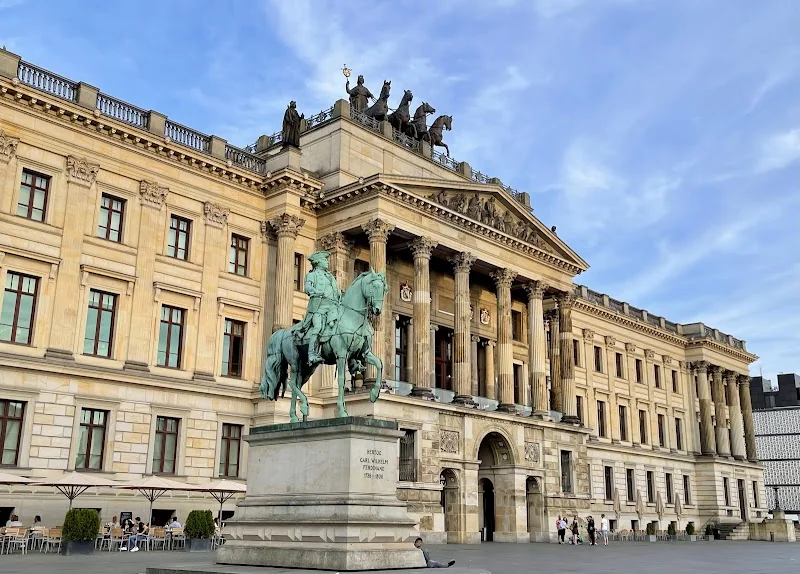
The Schlossmuseum Braunschweig is not an ordinary museum, but a place where the history of a city, a dynasty, and a rebuilt residence castle directly intersect. Those who open the large wooden doors on the northern, or left, side of the castle enter a time travel into the atmosphere of the former Braunschweig court, according to the museum. With around 800 square meters of exhibition space, original furniture, crafts, portraits, and media stations convey the world of the Welfs, the development of the residence castle, and the changing uses of the building over centuries. This is complemented by special exhibitions, guided tours, and events that continually reveal new aspects of the castle's history. Particularly defining are the throne room, the audience room, the study, and the music room, which are equipped with historical objects and make the splendor of the former residence palpable. Those who look up will discover the Quadriga on the roof, one of the most distinctive points of Braunschweig. The museum thus combines historical authenticity, cultural education, and a strong sense of place into a visit that is worthwhile for history enthusiasts as well as families and city visitors. ([schlossmuseum-braunschweig.de](https://www.schlossmuseum-braunschweig.de/das-museum/portrait?utm_source=openai))
Opening Hours, Admission, and Tickets at Schlossmuseum Braunschweig
The most important information for planning a visit can be summarized quickly: The Schlossmuseum Braunschweig is open from Tuesday to Sunday from 10 AM to 5 PM, and is closed on Mondays. The regular admission fee is 5 euros, and the reduced price is 2 euros. These prices are mentioned by the museum both on the homepage and in the service area. For people with a disability degree of 50 percent or more, the reduced admission price also applies. Those who frequently visit Braunschweig's museum landscape should also be aware of the Braunschweig Museum Card: It costs 22 euros, allows one-time free admission, and then a year of reduced admission to the participating institutions. This is particularly interesting for the Schlossmuseum if a visit is to be combined with other cultural stations in the city center. ([schlossmuseum-braunschweig.de](https://www.schlossmuseum-braunschweig.de/angebote/kalender))
Also regarding tickets and current offers, it is worthwhile to take a look at the museum's calendar. It shows that the Schlossmuseum not only operates a permanent exhibition but also regularly offers events that go beyond the normal museum visit. The program ranges from guided tours to themed evenings to family formats and is thus closely linked to the search intent around “tickets,” “program,” and “special exhibition.” For spontaneous visits, it is important to note: Admission for the permanent exhibition is clearly regulated, while individual events such as “Sparkling Wine and Collection” or special guided tours can be booked separately. The date page specifies that many offers require registration by phone or email, which shows that the museum consciously organizes its events to be planable and service-oriented. Therefore, anyone looking for a compact, historically rich cultural destination will find a well-structured mix of regular admission, reduced prices, and complementary event formats here. ([schlossmuseum-braunschweig.de](https://www.schlossmuseum-braunschweig.de/angebote/kalender))
Entrance, Directions, and Parking at Schlossmuseum Braunschweig
The Schlossmuseum is located in the center of Braunschweig at Schlossplatz 1, and thus in immediate proximity to several public transport stops. According to the service area, the museum is near the tram stops “Rathaus” and “Schloss.” The Rathaus stop is served by lines 1, 2, 3, 4, and 10, while the Schloss stop is served by lines 1, 2, 3, 5, and 10. Additionally, the Rathaus stop can also be reached by bus lines 230, 411, 413, 416, 418, 420, 422, 423, 450, 480, 560, 620, and 730. This is very convenient for travel, as the museum visit can easily be combined with a city stroll or an appointment in the city center. The barrier-free access is located at the side entrance to the left of the main entrance of the museum, at the entrance to the Red Hall. ([schlossmuseum-braunschweig.de](https://www.schlossmuseum-braunschweig.de/ihr-besuch/informationen-service))
Those arriving by car should know that the museum does not have its own parking spaces. However, there are several parking garages in the vicinity that are officially mentioned: the Schloss-Arkaden parking garage at Ritterbrunnen 1, the Schlosscarree parking garage at Ritterbrunnen 7, the Wilhelmstraße parking garage at Wilhelmstraße 98, and the Magni Braunschweig parking garage at Bohlweg 72. The stated opening hours of the parking garages help with planning, especially if a visit is combined with a guided tour or an evening event. This point is particularly important for the Schlossmuseum, as its location in the city center offers very good accessibility but also requires careful parking choices. Therefore, it can be clearly inferred from the official service information: It is best to drive to a nearby parking garage and plan the last meters on foot. This makes the visit relaxed and avoids unnecessary searching directly at Schlossplatz. ([schlossmuseum-braunschweig.de](https://www.schlossmuseum-braunschweig.de/ihr-besuch/informationen-service))
Program, Special Exhibitions, and Guided Tours in the Calendar
A central reason for the high search demand around the Schlossmuseum Braunschweig is the current program. The house not only presents a permanent exhibition but also regularly changing special exhibitions with accompanying formats. The current exhibition page currently features “New Here! Access to the Collection” from December 17, 2025, to April 12, 2026. The exhibition focuses on the museum's most recent acquisitions: objects that come from purchases, donations, and returns, enriching the collection and opening new connections to the castle's history. This is attractive for visitors because the exhibition not only shows well-known holdings but also presents newly acquired pieces in a museum context for the first time. Thus, the museum fulfills exactly what many users search for with terms like “program,” “special exhibition,” and “current”: a concrete, time-bound offer with real novelty value. ([schlossmuseum-braunschweig.de](https://www.schlossmuseum-braunschweig.de/ausstellungen/aktuell/neu-hier?utm_source=openai))
The calendar confirms this lively approach. There are formats such as “Sparkling Wine and Collection,” combined tours with the Kunstverein Braunschweig, tours on historical topics, family afternoons, and even a historical wine tour. For children, there is also a flashlight tour offered as part of a holiday program. The dates show that the museum builds its program palette specifically for target groups: adults receive tours with substantive depth and special context, families get participatory offers, and school classes can book special tours. Particularly important for planning is that many offers are tied to specific dates and often require registration. Therefore, anyone searching for “program” or a specific event idea will find in Schlossmuseum Braunschweig not a generic event calendar, but a carefully curated mix of exhibition tours, discussion formats, experience tours, and educational offers. This makes the visit flexible and simultaneously content-rich. ([schlossmuseum-braunschweig.de](https://www.schlossmuseum-braunschweig.de/angebote/kalender))
Photos, Audio Guide, and Accessibility in the Museum
The everyday questions of many visitors are also well answered at Schlossmuseum Braunschweig. In the permanent exhibition, private photos may be taken without flash and without a tripod. This is interesting for anyone who wants to document interiors, furniture, artworks, or the throne room without violating museum rules. For social media, the museum even explicitly points out that one can tag the official account. However, for special exhibitions, the on-site guidelines apply, so one should orient themselves there before taking photos. For search queries like “photos,” “Instagram,” or “entrance,” this is crucial because the museum is not only visually appealing but also communicates clear visiting rules. At the same time, this regulation shows that the focus is on a calm, respectful tour rather than a hectic rush through the rooms. ([schlossmuseum-braunschweig.de](https://www.schlossmuseum-braunschweig.de/ihr-besuch/informationen-service?utm_source=openai))
Additionally, there are audio guides and media stations that, according to the city and museum, invite a deeper visit. The permanent exhibition conveys the history of the place and its inhabitants not only through objects but also through digital and multimedia elements. A written tour description in easy language is available at the museum ticket office, which further facilitates access. The barrier-free entrance with an elevator is located at the side entrance to the left of the main entrance, that is, at the entrance to the Red Hall. For people with disabilities, it is also important that they receive the reduced admission price if they have a disability degree of 50 percent or more. Altogether, this results in a quite comprehensive visit offer: historical rooms, well-explained content, additional media, barrier-free access, and clear guidelines for photos. The Schlossmuseum is thus not only strong in content but also remarkably precise in its service approach. ([braunschweig.de](https://www.braunschweig.de/kultur/museen/schlossmuseum/index.html))
Castle History, Permanent Exhibition, and Quadriga
The history of the place is one of the greatest strengths of the Schlossmuseum Braunschweig. The current residence castle looks back on more than three centuries and three buildings. In 1717, Duke August Wilhelm had the existing building, the so-called Gray Court, converted into a city palace. In 1830, the castle was set on fire during the uprising against Duke Karl II. Later, Duke Wilhelm had a neoclassical castle built on the same site, which was demolished in 1960 after severe destruction in World War II. The museum's castle history also describes the changes in the 20th century: the end of monarchical use in 1918, various civilian uses in the 1920s, the conversions to the SS Junkers School starting in 1934, as well as the war destruction and the later debates about demolition and reconstruction. In 2003, the reconstruction of the castle was decided, in 2007 the construction was completed, in 2008 the Quadriga was inaugurated, and in 2011 the Schlossmuseum opened ceremoniously. This sequence makes it clear that the place itself is already an exhibition. ([schlossmuseum-braunschweig.de](https://www.schlossmuseum-braunschweig.de/das-museum/schlossgeschichte))
In the permanent exhibition, these historical lines come together again. The throne room, the audience room, the study, and the music room have been furnished with original furniture, paintings, and art objects, thus conveying an impression of the splendid life at the Braunschweig court. The special appeal lies in the combination of reconstruction and authenticity: the museum not only tells of courtly representation but also shows how much the place has been shaped by breaks, losses, and reconstruction. An additional highlight is the Quadriga on the roof. With a length of 9.5 meters, a width of 7.5 meters, and a height of 9.2 meters, it is considered the largest Quadriga in Europe with only one charioteer figure and is thus even larger than the Quadriga on the Brandenburg Gate. The platform is open daily from April to September from 10 AM to 8 PM and from October to March daily from 10 AM to 4:30 PM; the last admission is half an hour before closing. The ascent costs 2 euros and begins at the right entrance of the portico. Therefore, those who combine the Schlossmuseum and Quadriga not only get a museum but also an extraordinary view of Braunschweig from inside and above. ([braunschweig.de](https://www.braunschweig.de/kultur/museen/schlossmuseum/index.html))
In the end, it is precisely this mix that makes the visit so recommendable: The Schlossmuseum Braunschweig is as exciting for history enthusiasts as it is for city explorers, families, or guests simply looking for a well-told cultural site. The current special exhibition brings fresh perspectives, the program creates recurring reasons to visit, and the historical architecture anchors everything at an authentic location. Those who only have a short stay in Braunschweig can plan the museum as a concentrated cultural station; those who have more time can combine the visit with the Quadriga, a walk across Schlossplatz, and other sights in the city center. Especially because the house offers official opening hours, clear admission prices, barrier-free access, and changing thematic offers, it is a very well-planned destination for the next visit to Braunschweig. ([schlossmuseum-braunschweig.de](https://www.schlossmuseum-braunschweig.de/ihr-besuch/informationen-service))
Sources:
Show moreShow less
Schlossmuseum Braunschweig | Opening Hours & Tickets
The Schlossmuseum Braunschweig is not an ordinary museum, but a place where the history of a city, a dynasty, and a rebuilt residence castle directly intersect. Those who open the large wooden doors on the northern, or left, side of the castle enter a time travel into the atmosphere of the former Braunschweig court, according to the museum. With around 800 square meters of exhibition space, original furniture, crafts, portraits, and media stations convey the world of the Welfs, the development of the residence castle, and the changing uses of the building over centuries. This is complemented by special exhibitions, guided tours, and events that continually reveal new aspects of the castle's history. Particularly defining are the throne room, the audience room, the study, and the music room, which are equipped with historical objects and make the splendor of the former residence palpable. Those who look up will discover the Quadriga on the roof, one of the most distinctive points of Braunschweig. The museum thus combines historical authenticity, cultural education, and a strong sense of place into a visit that is worthwhile for history enthusiasts as well as families and city visitors. ([schlossmuseum-braunschweig.de](https://www.schlossmuseum-braunschweig.de/das-museum/portrait?utm_source=openai))
Opening Hours, Admission, and Tickets at Schlossmuseum Braunschweig
The most important information for planning a visit can be summarized quickly: The Schlossmuseum Braunschweig is open from Tuesday to Sunday from 10 AM to 5 PM, and is closed on Mondays. The regular admission fee is 5 euros, and the reduced price is 2 euros. These prices are mentioned by the museum both on the homepage and in the service area. For people with a disability degree of 50 percent or more, the reduced admission price also applies. Those who frequently visit Braunschweig's museum landscape should also be aware of the Braunschweig Museum Card: It costs 22 euros, allows one-time free admission, and then a year of reduced admission to the participating institutions. This is particularly interesting for the Schlossmuseum if a visit is to be combined with other cultural stations in the city center. ([schlossmuseum-braunschweig.de](https://www.schlossmuseum-braunschweig.de/angebote/kalender))
Also regarding tickets and current offers, it is worthwhile to take a look at the museum's calendar. It shows that the Schlossmuseum not only operates a permanent exhibition but also regularly offers events that go beyond the normal museum visit. The program ranges from guided tours to themed evenings to family formats and is thus closely linked to the search intent around “tickets,” “program,” and “special exhibition.” For spontaneous visits, it is important to note: Admission for the permanent exhibition is clearly regulated, while individual events such as “Sparkling Wine and Collection” or special guided tours can be booked separately. The date page specifies that many offers require registration by phone or email, which shows that the museum consciously organizes its events to be planable and service-oriented. Therefore, anyone looking for a compact, historically rich cultural destination will find a well-structured mix of regular admission, reduced prices, and complementary event formats here. ([schlossmuseum-braunschweig.de](https://www.schlossmuseum-braunschweig.de/angebote/kalender))
Entrance, Directions, and Parking at Schlossmuseum Braunschweig
The Schlossmuseum is located in the center of Braunschweig at Schlossplatz 1, and thus in immediate proximity to several public transport stops. According to the service area, the museum is near the tram stops “Rathaus” and “Schloss.” The Rathaus stop is served by lines 1, 2, 3, 4, and 10, while the Schloss stop is served by lines 1, 2, 3, 5, and 10. Additionally, the Rathaus stop can also be reached by bus lines 230, 411, 413, 416, 418, 420, 422, 423, 450, 480, 560, 620, and 730. This is very convenient for travel, as the museum visit can easily be combined with a city stroll or an appointment in the city center. The barrier-free access is located at the side entrance to the left of the main entrance of the museum, at the entrance to the Red Hall. ([schlossmuseum-braunschweig.de](https://www.schlossmuseum-braunschweig.de/ihr-besuch/informationen-service))
Those arriving by car should know that the museum does not have its own parking spaces. However, there are several parking garages in the vicinity that are officially mentioned: the Schloss-Arkaden parking garage at Ritterbrunnen 1, the Schlosscarree parking garage at Ritterbrunnen 7, the Wilhelmstraße parking garage at Wilhelmstraße 98, and the Magni Braunschweig parking garage at Bohlweg 72. The stated opening hours of the parking garages help with planning, especially if a visit is combined with a guided tour or an evening event. This point is particularly important for the Schlossmuseum, as its location in the city center offers very good accessibility but also requires careful parking choices. Therefore, it can be clearly inferred from the official service information: It is best to drive to a nearby parking garage and plan the last meters on foot. This makes the visit relaxed and avoids unnecessary searching directly at Schlossplatz. ([schlossmuseum-braunschweig.de](https://www.schlossmuseum-braunschweig.de/ihr-besuch/informationen-service))
Program, Special Exhibitions, and Guided Tours in the Calendar
A central reason for the high search demand around the Schlossmuseum Braunschweig is the current program. The house not only presents a permanent exhibition but also regularly changing special exhibitions with accompanying formats. The current exhibition page currently features “New Here! Access to the Collection” from December 17, 2025, to April 12, 2026. The exhibition focuses on the museum's most recent acquisitions: objects that come from purchases, donations, and returns, enriching the collection and opening new connections to the castle's history. This is attractive for visitors because the exhibition not only shows well-known holdings but also presents newly acquired pieces in a museum context for the first time. Thus, the museum fulfills exactly what many users search for with terms like “program,” “special exhibition,” and “current”: a concrete, time-bound offer with real novelty value. ([schlossmuseum-braunschweig.de](https://www.schlossmuseum-braunschweig.de/ausstellungen/aktuell/neu-hier?utm_source=openai))
The calendar confirms this lively approach. There are formats such as “Sparkling Wine and Collection,” combined tours with the Kunstverein Braunschweig, tours on historical topics, family afternoons, and even a historical wine tour. For children, there is also a flashlight tour offered as part of a holiday program. The dates show that the museum builds its program palette specifically for target groups: adults receive tours with substantive depth and special context, families get participatory offers, and school classes can book special tours. Particularly important for planning is that many offers are tied to specific dates and often require registration. Therefore, anyone searching for “program” or a specific event idea will find in Schlossmuseum Braunschweig not a generic event calendar, but a carefully curated mix of exhibition tours, discussion formats, experience tours, and educational offers. This makes the visit flexible and simultaneously content-rich. ([schlossmuseum-braunschweig.de](https://www.schlossmuseum-braunschweig.de/angebote/kalender))
Photos, Audio Guide, and Accessibility in the Museum
The everyday questions of many visitors are also well answered at Schlossmuseum Braunschweig. In the permanent exhibition, private photos may be taken without flash and without a tripod. This is interesting for anyone who wants to document interiors, furniture, artworks, or the throne room without violating museum rules. For social media, the museum even explicitly points out that one can tag the official account. However, for special exhibitions, the on-site guidelines apply, so one should orient themselves there before taking photos. For search queries like “photos,” “Instagram,” or “entrance,” this is crucial because the museum is not only visually appealing but also communicates clear visiting rules. At the same time, this regulation shows that the focus is on a calm, respectful tour rather than a hectic rush through the rooms. ([schlossmuseum-braunschweig.de](https://www.schlossmuseum-braunschweig.de/ihr-besuch/informationen-service?utm_source=openai))
Additionally, there are audio guides and media stations that, according to the city and museum, invite a deeper visit. The permanent exhibition conveys the history of the place and its inhabitants not only through objects but also through digital and multimedia elements. A written tour description in easy language is available at the museum ticket office, which further facilitates access. The barrier-free entrance with an elevator is located at the side entrance to the left of the main entrance, that is, at the entrance to the Red Hall. For people with disabilities, it is also important that they receive the reduced admission price if they have a disability degree of 50 percent or more. Altogether, this results in a quite comprehensive visit offer: historical rooms, well-explained content, additional media, barrier-free access, and clear guidelines for photos. The Schlossmuseum is thus not only strong in content but also remarkably precise in its service approach. ([braunschweig.de](https://www.braunschweig.de/kultur/museen/schlossmuseum/index.html))
Castle History, Permanent Exhibition, and Quadriga
The history of the place is one of the greatest strengths of the Schlossmuseum Braunschweig. The current residence castle looks back on more than three centuries and three buildings. In 1717, Duke August Wilhelm had the existing building, the so-called Gray Court, converted into a city palace. In 1830, the castle was set on fire during the uprising against Duke Karl II. Later, Duke Wilhelm had a neoclassical castle built on the same site, which was demolished in 1960 after severe destruction in World War II. The museum's castle history also describes the changes in the 20th century: the end of monarchical use in 1918, various civilian uses in the 1920s, the conversions to the SS Junkers School starting in 1934, as well as the war destruction and the later debates about demolition and reconstruction. In 2003, the reconstruction of the castle was decided, in 2007 the construction was completed, in 2008 the Quadriga was inaugurated, and in 2011 the Schlossmuseum opened ceremoniously. This sequence makes it clear that the place itself is already an exhibition. ([schlossmuseum-braunschweig.de](https://www.schlossmuseum-braunschweig.de/das-museum/schlossgeschichte))
In the permanent exhibition, these historical lines come together again. The throne room, the audience room, the study, and the music room have been furnished with original furniture, paintings, and art objects, thus conveying an impression of the splendid life at the Braunschweig court. The special appeal lies in the combination of reconstruction and authenticity: the museum not only tells of courtly representation but also shows how much the place has been shaped by breaks, losses, and reconstruction. An additional highlight is the Quadriga on the roof. With a length of 9.5 meters, a width of 7.5 meters, and a height of 9.2 meters, it is considered the largest Quadriga in Europe with only one charioteer figure and is thus even larger than the Quadriga on the Brandenburg Gate. The platform is open daily from April to September from 10 AM to 8 PM and from October to March daily from 10 AM to 4:30 PM; the last admission is half an hour before closing. The ascent costs 2 euros and begins at the right entrance of the portico. Therefore, those who combine the Schlossmuseum and Quadriga not only get a museum but also an extraordinary view of Braunschweig from inside and above. ([braunschweig.de](https://www.braunschweig.de/kultur/museen/schlossmuseum/index.html))
In the end, it is precisely this mix that makes the visit so recommendable: The Schlossmuseum Braunschweig is as exciting for history enthusiasts as it is for city explorers, families, or guests simply looking for a well-told cultural site. The current special exhibition brings fresh perspectives, the program creates recurring reasons to visit, and the historical architecture anchors everything at an authentic location. Those who only have a short stay in Braunschweig can plan the museum as a concentrated cultural station; those who have more time can combine the visit with the Quadriga, a walk across Schlossplatz, and other sights in the city center. Especially because the house offers official opening hours, clear admission prices, barrier-free access, and changing thematic offers, it is a very well-planned destination for the next visit to Braunschweig. ([schlossmuseum-braunschweig.de](https://www.schlossmuseum-braunschweig.de/ihr-besuch/informationen-service))
Sources:
Schlossmuseum Braunschweig | Opening Hours & Tickets
The Schlossmuseum Braunschweig is not an ordinary museum, but a place where the history of a city, a dynasty, and a rebuilt residence castle directly intersect. Those who open the large wooden doors on the northern, or left, side of the castle enter a time travel into the atmosphere of the former Braunschweig court, according to the museum. With around 800 square meters of exhibition space, original furniture, crafts, portraits, and media stations convey the world of the Welfs, the development of the residence castle, and the changing uses of the building over centuries. This is complemented by special exhibitions, guided tours, and events that continually reveal new aspects of the castle's history. Particularly defining are the throne room, the audience room, the study, and the music room, which are equipped with historical objects and make the splendor of the former residence palpable. Those who look up will discover the Quadriga on the roof, one of the most distinctive points of Braunschweig. The museum thus combines historical authenticity, cultural education, and a strong sense of place into a visit that is worthwhile for history enthusiasts as well as families and city visitors. ([schlossmuseum-braunschweig.de](https://www.schlossmuseum-braunschweig.de/das-museum/portrait?utm_source=openai))
Opening Hours, Admission, and Tickets at Schlossmuseum Braunschweig
The most important information for planning a visit can be summarized quickly: The Schlossmuseum Braunschweig is open from Tuesday to Sunday from 10 AM to 5 PM, and is closed on Mondays. The regular admission fee is 5 euros, and the reduced price is 2 euros. These prices are mentioned by the museum both on the homepage and in the service area. For people with a disability degree of 50 percent or more, the reduced admission price also applies. Those who frequently visit Braunschweig's museum landscape should also be aware of the Braunschweig Museum Card: It costs 22 euros, allows one-time free admission, and then a year of reduced admission to the participating institutions. This is particularly interesting for the Schlossmuseum if a visit is to be combined with other cultural stations in the city center. ([schlossmuseum-braunschweig.de](https://www.schlossmuseum-braunschweig.de/angebote/kalender))
Also regarding tickets and current offers, it is worthwhile to take a look at the museum's calendar. It shows that the Schlossmuseum not only operates a permanent exhibition but also regularly offers events that go beyond the normal museum visit. The program ranges from guided tours to themed evenings to family formats and is thus closely linked to the search intent around “tickets,” “program,” and “special exhibition.” For spontaneous visits, it is important to note: Admission for the permanent exhibition is clearly regulated, while individual events such as “Sparkling Wine and Collection” or special guided tours can be booked separately. The date page specifies that many offers require registration by phone or email, which shows that the museum consciously organizes its events to be planable and service-oriented. Therefore, anyone looking for a compact, historically rich cultural destination will find a well-structured mix of regular admission, reduced prices, and complementary event formats here. ([schlossmuseum-braunschweig.de](https://www.schlossmuseum-braunschweig.de/angebote/kalender))
Entrance, Directions, and Parking at Schlossmuseum Braunschweig
The Schlossmuseum is located in the center of Braunschweig at Schlossplatz 1, and thus in immediate proximity to several public transport stops. According to the service area, the museum is near the tram stops “Rathaus” and “Schloss.” The Rathaus stop is served by lines 1, 2, 3, 4, and 10, while the Schloss stop is served by lines 1, 2, 3, 5, and 10. Additionally, the Rathaus stop can also be reached by bus lines 230, 411, 413, 416, 418, 420, 422, 423, 450, 480, 560, 620, and 730. This is very convenient for travel, as the museum visit can easily be combined with a city stroll or an appointment in the city center. The barrier-free access is located at the side entrance to the left of the main entrance of the museum, at the entrance to the Red Hall. ([schlossmuseum-braunschweig.de](https://www.schlossmuseum-braunschweig.de/ihr-besuch/informationen-service))
Those arriving by car should know that the museum does not have its own parking spaces. However, there are several parking garages in the vicinity that are officially mentioned: the Schloss-Arkaden parking garage at Ritterbrunnen 1, the Schlosscarree parking garage at Ritterbrunnen 7, the Wilhelmstraße parking garage at Wilhelmstraße 98, and the Magni Braunschweig parking garage at Bohlweg 72. The stated opening hours of the parking garages help with planning, especially if a visit is combined with a guided tour or an evening event. This point is particularly important for the Schlossmuseum, as its location in the city center offers very good accessibility but also requires careful parking choices. Therefore, it can be clearly inferred from the official service information: It is best to drive to a nearby parking garage and plan the last meters on foot. This makes the visit relaxed and avoids unnecessary searching directly at Schlossplatz. ([schlossmuseum-braunschweig.de](https://www.schlossmuseum-braunschweig.de/ihr-besuch/informationen-service))
Program, Special Exhibitions, and Guided Tours in the Calendar
A central reason for the high search demand around the Schlossmuseum Braunschweig is the current program. The house not only presents a permanent exhibition but also regularly changing special exhibitions with accompanying formats. The current exhibition page currently features “New Here! Access to the Collection” from December 17, 2025, to April 12, 2026. The exhibition focuses on the museum's most recent acquisitions: objects that come from purchases, donations, and returns, enriching the collection and opening new connections to the castle's history. This is attractive for visitors because the exhibition not only shows well-known holdings but also presents newly acquired pieces in a museum context for the first time. Thus, the museum fulfills exactly what many users search for with terms like “program,” “special exhibition,” and “current”: a concrete, time-bound offer with real novelty value. ([schlossmuseum-braunschweig.de](https://www.schlossmuseum-braunschweig.de/ausstellungen/aktuell/neu-hier?utm_source=openai))
The calendar confirms this lively approach. There are formats such as “Sparkling Wine and Collection,” combined tours with the Kunstverein Braunschweig, tours on historical topics, family afternoons, and even a historical wine tour. For children, there is also a flashlight tour offered as part of a holiday program. The dates show that the museum builds its program palette specifically for target groups: adults receive tours with substantive depth and special context, families get participatory offers, and school classes can book special tours. Particularly important for planning is that many offers are tied to specific dates and often require registration. Therefore, anyone searching for “program” or a specific event idea will find in Schlossmuseum Braunschweig not a generic event calendar, but a carefully curated mix of exhibition tours, discussion formats, experience tours, and educational offers. This makes the visit flexible and simultaneously content-rich. ([schlossmuseum-braunschweig.de](https://www.schlossmuseum-braunschweig.de/angebote/kalender))
Photos, Audio Guide, and Accessibility in the Museum
The everyday questions of many visitors are also well answered at Schlossmuseum Braunschweig. In the permanent exhibition, private photos may be taken without flash and without a tripod. This is interesting for anyone who wants to document interiors, furniture, artworks, or the throne room without violating museum rules. For social media, the museum even explicitly points out that one can tag the official account. However, for special exhibitions, the on-site guidelines apply, so one should orient themselves there before taking photos. For search queries like “photos,” “Instagram,” or “entrance,” this is crucial because the museum is not only visually appealing but also communicates clear visiting rules. At the same time, this regulation shows that the focus is on a calm, respectful tour rather than a hectic rush through the rooms. ([schlossmuseum-braunschweig.de](https://www.schlossmuseum-braunschweig.de/ihr-besuch/informationen-service?utm_source=openai))
Additionally, there are audio guides and media stations that, according to the city and museum, invite a deeper visit. The permanent exhibition conveys the history of the place and its inhabitants not only through objects but also through digital and multimedia elements. A written tour description in easy language is available at the museum ticket office, which further facilitates access. The barrier-free entrance with an elevator is located at the side entrance to the left of the main entrance, that is, at the entrance to the Red Hall. For people with disabilities, it is also important that they receive the reduced admission price if they have a disability degree of 50 percent or more. Altogether, this results in a quite comprehensive visit offer: historical rooms, well-explained content, additional media, barrier-free access, and clear guidelines for photos. The Schlossmuseum is thus not only strong in content but also remarkably precise in its service approach. ([braunschweig.de](https://www.braunschweig.de/kultur/museen/schlossmuseum/index.html))
Castle History, Permanent Exhibition, and Quadriga
The history of the place is one of the greatest strengths of the Schlossmuseum Braunschweig. The current residence castle looks back on more than three centuries and three buildings. In 1717, Duke August Wilhelm had the existing building, the so-called Gray Court, converted into a city palace. In 1830, the castle was set on fire during the uprising against Duke Karl II. Later, Duke Wilhelm had a neoclassical castle built on the same site, which was demolished in 1960 after severe destruction in World War II. The museum's castle history also describes the changes in the 20th century: the end of monarchical use in 1918, various civilian uses in the 1920s, the conversions to the SS Junkers School starting in 1934, as well as the war destruction and the later debates about demolition and reconstruction. In 2003, the reconstruction of the castle was decided, in 2007 the construction was completed, in 2008 the Quadriga was inaugurated, and in 2011 the Schlossmuseum opened ceremoniously. This sequence makes it clear that the place itself is already an exhibition. ([schlossmuseum-braunschweig.de](https://www.schlossmuseum-braunschweig.de/das-museum/schlossgeschichte))
In the permanent exhibition, these historical lines come together again. The throne room, the audience room, the study, and the music room have been furnished with original furniture, paintings, and art objects, thus conveying an impression of the splendid life at the Braunschweig court. The special appeal lies in the combination of reconstruction and authenticity: the museum not only tells of courtly representation but also shows how much the place has been shaped by breaks, losses, and reconstruction. An additional highlight is the Quadriga on the roof. With a length of 9.5 meters, a width of 7.5 meters, and a height of 9.2 meters, it is considered the largest Quadriga in Europe with only one charioteer figure and is thus even larger than the Quadriga on the Brandenburg Gate. The platform is open daily from April to September from 10 AM to 8 PM and from October to March daily from 10 AM to 4:30 PM; the last admission is half an hour before closing. The ascent costs 2 euros and begins at the right entrance of the portico. Therefore, those who combine the Schlossmuseum and Quadriga not only get a museum but also an extraordinary view of Braunschweig from inside and above. ([braunschweig.de](https://www.braunschweig.de/kultur/museen/schlossmuseum/index.html))
In the end, it is precisely this mix that makes the visit so recommendable: The Schlossmuseum Braunschweig is as exciting for history enthusiasts as it is for city explorers, families, or guests simply looking for a well-told cultural site. The current special exhibition brings fresh perspectives, the program creates recurring reasons to visit, and the historical architecture anchors everything at an authentic location. Those who only have a short stay in Braunschweig can plan the museum as a concentrated cultural station; those who have more time can combine the visit with the Quadriga, a walk across Schlossplatz, and other sights in the city center. Especially because the house offers official opening hours, clear admission prices, barrier-free access, and changing thematic offers, it is a very well-planned destination for the next visit to Braunschweig. ([schlossmuseum-braunschweig.de](https://www.schlossmuseum-braunschweig.de/ihr-besuch/informationen-service))
Sources:
Upcoming Events
No events found
Frequently Asked Questions
Reviews
Julia Longeuay
28. September 2025
Worth a visit - lots of background knowledge and especially the throne room was very impressive.
Alex Bransby
4. July 2022
Truly lovely place and well worth a visit for people interested in history. Located in the Schloss at the left hand side, it’s free to enter until the end of September and also a free audioguide. They ask if you have your own earphones but if not they can give you some. The museum itself is not that big, only a few rooms. Lots of information and the audioguide is very informative. There’s information on the Schloss history with an interesting documentary in both German and English, and the audioguide explains the history of all the artwork and rooms. It’s interesting to learn about the various Dukes of Brunswick, and when learning about the last Duke; Ernst August, I strongly recommend listening to the interview of his wife, Victoria Louise. The story of what happened in 1918, first hand from the Duchess and only daughter of Kaiser Wilhelm II is fascinating. There are about three or so recreated rooms with original furniture and artwork which are very pretty, culminating in the magnificent throne room. The throne room is a beautiful, though smaller recreation of the west original, but the throne itself is original. Fascinating to learn about the history and detail of the furniture and artwork, this is where the audioguide comes in handy. As some other reviews have mentioned, the staff inside are very friendly and helpful. The lovely lady at the front desk explained exactly how to move through the museum and even pointed me in the direction of the Quadriga. Truly professional good at their job, they are an asset to the museum and make visitors feel very welcome!
Cynthia Lammertsma
23. March 2025
Limited viewing to four rooms, furnished in style. The entire building was demolished after WW II and rebuilt. Some history of the original building and grounds as they were in the early 18th century. Another section is dedicated to the last duchess that lived there before the war: Princess Louise Victoria daughter of Wilhelm II is highlighted in interviews with people who knew her.
Land Marker
19. August 2024
The Museum was good, but the behavior of the woman behind the desk near of door of Museum, was not good and that was very weak. I came from England for tour to Germany but, unfortunately it was a bad memorie for me. I am so sorry , but it's the reality.
Alba
1. August 2023
A pretty and affordable place to overview the citiy from above and get the rhythm of the area, guarded by the goddess and the lions beside her. I highly recommend the 2-euro visit to the roof.