
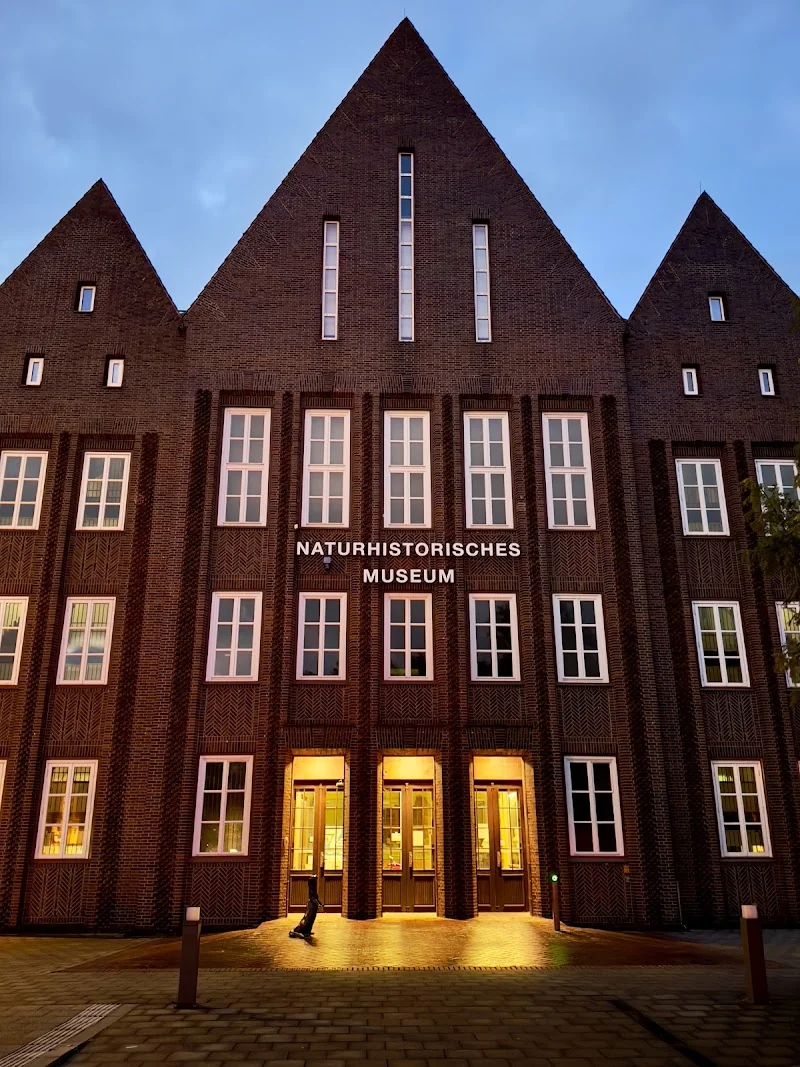
Pockelsstraße 10, Braunschweig-Nordstadt
Pockelsstraße 10, 38106 Braunschweig, Germany
National Museum of Natural History Braunschweig | Exhibitions & Tickets
The National Museum of Natural History in Braunschweig, officially the State Natural History Museum, is a destination for all who want to not only read about natural history but see, hear, and experience it. The building at Pockelsstraße 10 combines a long tradition of collection with a modern visitor experience spread over four floors. Downstairs, aquariums and terrariums with live animals await, above are historical dioramas, the treasure chamber, and the discovery room, and in the upper areas, themes such as insects, birds, dinosaur research, the Ice Age, and human evolution. At the same time, the museum shows how relevant natural history is today: With more than 440,000 objects, an exceptionally large bird collection, and changing special exhibitions, it is a place where research, education, and family visits come together. Those looking for exhibitions, tickets, opening hours, directions, or parking will find a location that works excellently for both spontaneous visits and planned museum days. This blend of tradition, diversity, and good accessibility makes visiting Braunschweig so attractive. ([3landesmuseen-braunschweig.de](https://3landesmuseen-braunschweig.de/en/staatliches-naturhistorisches-museum/the-museum/location))
Exhibitions and Current Highlights at the National Museum of Natural History Braunschweig
Currently, it is particularly worth taking a look at the special exhibitions. The official exhibition page lists the ongoing highlights as Easter Chicks 2026 and Wildlife Photographer of the Year 2025. The wildlife exhibition is a strong magnet for all who are looking for photos, nature images, and international motifs: It showcases the 100 best nature photographs of the year and is based on a competition with over 60,000 submissions. This makes nature tangible not as an abstract concept but as an immediate experience with animals, plants, fungi, and habitats. Easter Chicks 2026, on the other hand, brings a very personal, family-friendly spring format to the museum, where visitors can experience the freshly hatched chicks on-site. These time-limited formats particularly enhance visitor dynamics as they connect the classic museum day with a seasonal event. Therefore, those visiting the museum in the coming weeks will not only experience the historical permanent exhibitions but also a current occasion that brings natural history into the present. ([3landesmuseen-braunschweig.de](https://3landesmuseen-braunschweig.de/staatliches-naturhistorisches-museum/ausstellungen/aktuelle-ausstellungen))
The permanent exhibitions form the backbone of the museum and are so broadly structured that nearly every target group finds something. The official overview lists minerals, the bird hall, Braunschweig dioramas, aquariums and terrariums, the discovery room, the showcase magazine, the treasure chamber, the Braunschweig dinosaur, and the light hall. This range is strong in SEO and content-wise meaningful at the same time: Those searching for exhibits, history, dinosaurs, aquariums, or dioramas will not find a single niche here but a whole spectrum of natural history. The combination of live animals, historical specimens, fossils, and educational stations makes the visit varied. The museum is not a silent showcase but a location where various forms of learning can be experienced side by side: observing, comparing, marveling, and experimenting. Particularly strong is the fact that the themes do not overlap but act like building blocks of a larger picture of nature. ([3landesmuseen-braunschweig.de](https://3landesmuseen-braunschweig.de/staatliches-naturhistorisches-museum/ausstellungen/aktuelle-ausstellungen))
For social media and photography enthusiasts, the museum is also exciting, even though it is not a pure photography museum. The changing nature photographs of the current special exhibition provide strong motifs, while the permanent exhibitions offer very different visual languages with prepared animals, display cases, aquariums, and historical dioramas. This is interesting for visitors who not only want to consume content but also take impressions home. Particularly the combination of modern exhibition design and historical presentation forms creates contrasts that are visually easy to understand and keep the museum visit lively. This makes the tour not monotonous but feels like a sequence of well-placed scenes. This blend of knowledge transfer and visual impact is a significant advantage for families, school classes, cultural travelers, and anyone who enjoys variety during a museum visit. ([3landesmuseen-braunschweig.de](https://3landesmuseen-braunschweig.de/assets/user_upload/SNHM/Presseinformationen/2025-12-18_SNHM_PM_WPY.pdf))
Four Floors of Natural History: From Aquariums to Dinosaurs
The spatial structure is particularly important for visitor guidance: The museum distributes its content over four floors. In the basement, live amphibians, reptiles, and fish can be found in realistically designed terrariums and aquariums. The first and second floors show historical dioramas of animals in their natural habitats, while the first floor also includes the museum's history and the treasure chamber with particularly valuable pieces. The discovery room is also located there, offering a playful approach with interactive elements. On the second and third floors, insects, dinosaur excavations, the fossil and geological history of the Braunschweig region, birds, the Ice Age, extinct species, and human evolution follow. This clear distribution facilitates orientation and ensures that the visit does not feel jumpy but like a well-told tour through natural and earth history. One can consciously move from today's life forms to fossil evidence and back to the present. ([3landesmuseen-braunschweig.de](https://3landesmuseen-braunschweig.de/en/staatliches-naturhistorisches-museum/the-museum/location))
Within these floors, several rooms stand out. The bird hall has been redesigned and relies on more than 200 specimens and multimedia stations for a vivid narrative style. The collection includes more than 52,000 specimens and around 19,000 eggs; thus, it is the largest bird collection in Lower Saxony and one of the most significant in Germany. The Biodiversity Hall complements this spectrum with over 500 objects in atmospheric display cases that reach up to the ceiling and evoke the character of classical teaching collections. The discovery room then offers a conscious change of style: Here, participation, comparison, and observation are in the foreground, for example, regarding camouflage, sounds, tracks, and the lifestyle of the white stork. Therefore, those who visit the floors sequentially experience not only objects but also the development of museum education from the classic showcase collection to interactive knowledge transfer. This makes the house attractive for both adults and children, as each level opens a different access to nature. ([3landesmuseen-braunschweig.de](https://3landesmuseen-braunschweig.de/en/staatliches-naturhistorisches-museum/exhibitions/permanent-exhibitions/bird-hall))
The Insect Hall and the Light Hall consistently continue this diversity. The Insect Hall focuses on the enormous diversity of insect forms, water surfaces, social insects, and live bees. Enlarged models make movement and feeding forms visible that are hardly noticed in everyday life. The Light Hall, on the other hand, is the largest exhibition space in the house and was newly opened in 2003. It contains some of the most valuable and largest pieces in the museum, including the skeleton of the Steller's sea cow, themes on extinct birds, and additional areas related to the Ice Age. There are also representations of human evolution with scientifically reconstructed hominins. This combination of large-format exhibits, fossil evidence, and illustrative models ensures that the tour never remains abstract. Instead, a very concrete impression is created of how closely biodiversity, extinction, climate, and regional history are interconnected. ([3landesmuseen-braunschweig.de](https://3landesmuseen-braunschweig.de/en/staatliches-naturhistorisches-museum/exhibitions/permanent-exhibitions/insect-hall))
Tickets, Opening Hours, and Practical Visitor Information
For planning, the opening hours and ticket prices are simple and transparent. The museum is regularly open from Tuesday to Sunday from 9 AM to 5 PM, Wednesdays until 7 PM, and closed on Mondays. Admission costs 9.00 euros for adults, 7.00 euros reduced, and 4.00 euros for children aged 6 to 17. Family tickets and annual tickets complement the offer, and with the combo ticket for the paläon research museum, visitors receive free admission to the other museum within three months. Therefore, those specifically looking for tickets will find a family-friendly and price-attractive model that works particularly well for spontaneous outings. It is also particularly helpful that the house grants free admission for children under six years and that groups and certain eligible individuals receive reduced rates. For a museum with this range, this is a clear plus point, as the visit remains planable for larger families and school groups. ([3landesmuseen-braunschweig.de](https://3landesmuseen-braunschweig.de/en/staatliches-naturhistorisches-museum/visit/information))
Practical visitor information also includes holiday regulations. The museum is open on several public holidays, including Good Friday, Easter Sunday, Easter Monday, Pentecost Sunday, German Unity Day, Reformation Day, and the second Christmas holiday. However, it remains closed on New Year's Day, May 1, Ascension Day, Whit Monday, Christmas Eve, Christmas Day, and New Year's Eve. Therefore, especially during a city trip or holiday visits, it is worthwhile to take a quick look at the current opening hours to ensure the outing does not end on a rest day. For the special exhibition Easter Chicks 2026, extended opening hours also applied, demonstrating how flexibly the house responds to seasonal formats. This is particularly sensible as it allows visitor flows during holidays, weekends, and public holidays to be better distributed. Checking the opening hours in advance saves unnecessary trips and allows for a relaxed planning of the museum visit. ([3landesmuseen-braunschweig.de](https://3landesmuseen-braunschweig.de/en/staatliches-naturhistorisches-museum/visit/information))
For multiple visits or longer stays, the annual tickets are interesting: There is an annual ticket for the Natural History Museum, a family annual ticket, and a 3Landesmuseen annual ticket. This is practical if the visit is not to remain at a single appointment or if Braunschweig is to be targeted as a cultural destination multiple times. Especially in combination with changing special exhibitions and the various permanent rooms, the question of tickets quickly becomes relative, as one can often set a completely different focus on a second visit. Families particularly benefit from the clear and transparent pricing structure and the various types of accompaniment and group rates. The museum is thus not only a classic excursion destination but also a place that encourages return visits. So, if one only manages the lower floors on the first visit, they can later specifically catch up on the bird rooms, the Ice Age section, or the special exhibition. ([3landesmuseen-braunschweig.de](https://3landesmuseen-braunschweig.de/en/staatliches-naturhistorisches-museum/visit/information))
Directions, Parking, and Accessibility in Braunschweig
Regarding directions, the museum scores with its location in Braunschweig-Nordstadt and with good connections to public transport. There are no private parking spaces, but free public parking options are available in the vicinity on Pockelsstraße, Konstantin-Uhde-Straße, and in the surrounding streets, as well as charging spots for electric cars and disabled parking spaces. Additionally, the museum mentions two charging spots for electric cars and several disabled parking spaces. Those who prefer to come by bus or train can reach the nearest bus stop Pockelsstraße with lines 419, 426, 429, and 433; the next tram stop Mühlenpfordtstraße is accessible with lines 1 and 2. This makes the location well-planned for both drivers and public transport users. Especially for visitors who do not come from Braunschweig, this mix of public transport and parking options is a real argument for an uncomplicated day trip. ([3landesmuseen-braunschweig.de](https://3landesmuseen-braunschweig.de/en/staatliches-naturhistorisches-museum/visit/information))
In terms of accessibility, the house is clearly structured. The entrance to the exhibition halls is step-free, the door can be opened at the push of a button, and all floors are accessible by elevator. Assistance dogs are allowed with identification at the reception. Additionally, the museum offers a small café area on the first floor, a picnic room on the ground floor, free Wi-Fi, and lockers for jackets and bags. For photography, there is a practical rule: photographing without flash, tripod, or selfie stick is generally allowed in the exhibitions. Therefore, those looking for content for social media or private memory photos can document the visit easily without losing the character of the museum. The combination of accessibility, digital comfort, and clear visitor rules makes the house very practical for everyday use. ([3landesmuseen-braunschweig.de](https://3landesmuseen-braunschweig.de/en/staatliches-naturhistorisches-museum/visit/information))
Those traveling with bicycles or larger accompanying devices should also pay attention to the cloakroom notes. Larger hand carts and bicycle trailers should be parked at the bicycle racks in front of the museum due to space availability. This is a small detail but shows that the house is prepared for visitor flows while also wanting to maintain order and safety in the exhibition halls. Together with the lockers, free Wi-Fi usage, and clearly regulated photography behavior, a very practical visitor profile emerges. For families with strollers or groups with luggage, this structure is pleasant as the paths in the building are clearly regulated, and one does not have to search long for help. Thus, a museum visit quickly becomes a relaxed, well-organized outing, allowing the focus to be on the content. ([3landesmuseen-braunschweig.de](https://3landesmuseen-braunschweig.de/en/staatliches-naturhistorisches-museum/visit/information))
History of a Museum with Over 260 Years of Tradition
The history of the house is an essential part of its appeal. Officially, it dates back to 1754 when Carl I of Braunschweig-Lüneburg founded the ducal art and natural cabinet. Already in 1753/54, the collection was made accessible to the public, creating one of the first public museums in Germany in Braunschweig. After that, the museum moved several times: in 1765 to the armory, in 1857 it separated from the art and natural collection, in 1877 to the current Old Building of TU Braunschweig, and finally in 1937 to Pockelsstraße. This history explains why the location does not feel like a new building but like a grown house of knowledge with a long tradition. That the museum is over 260 years old and considers itself the oldest natural history museum in Germany is therefore not just a marketing slogan but a historically verifiable fact. The eventful development also shows how closely the museum is connected to the scientific history of Braunschweig. ([3landesmuseen-braunschweig.de](https://3landesmuseen-braunschweig.de/en/staatliches-naturhistorisches-museum/the-museum/history))
Individual objects also tell the long journeys of the collection. In the treasure chamber, one encounters, for example, the white-breasted raven from the Faroe Islands, a rare and extinct color morph of the raven, which was acquired as early as 1755. Additionally, pieces such as a Caspian turtle with a coat of arms on its shell, a sawfish, or gilded Venus clams trace back to the early collections in Bevern and Salzdahlum. This makes it clear that the museum consists not only of exhibition halls but of an ensemble of historical testimonies that document the rise of natural history from the princely wonder chamber to modern science. The treasure chamber thus provides more than just beautiful display cases: it makes the origin of the house visible and connects research history with museum aura. This is important for visitors because during the tour, one not only sees what was collected but also why this collection is culturally significant. ([3landesmuseen-braunschweig.de](https://3landesmuseen-braunschweig.de/en/staatliches-naturhistorisches-museum/exhibitions/permanent-exhibitions/treasury))
The collection itself is as impressive as the building history. The museum speaks of around 440,000 objects, including about 320,000 invertebrates, 75,000 vertebrates, and 45,000 fossils. Particularly important is the bird collection with more than 50,000 specimens; it is one of the largest and internationally significant collections in Germany. Additionally, numerous type specimens, i.e., pieces that are crucial for the scientific description of a species, are included. This scientific depth makes the museum more than just a classic showcase collection. It is a place of research, an archive of life, and an educational center in one. Therefore, those who want to experience natural history, research history, and museum development in one visit will find not just exhibition rooms here but a genuine scientific memory of the region and beyond. ([geopark-hblo.de](https://geopark-hblo.de/en/locations/information-centres/braunschweig-natural-history-museum/))
Who Should Particularly Visit
The museum is particularly strong where it combines classic display effects with interactive moments. The Braunschweig dioramas show animals in their habitats, many of which date back to the early 1950s and thus possess a museum character themselves. The discovery room, on the other hand, focuses on interaction and is deliberately modern in design so that children, school classes, and curious adults can directly grasp connections. In the Insect Hall, live bees, detailed nests, and enlarged models complement the collection with a vivid view of diversity and adaptation. Together with the birds, the treasure chamber, the aquariums, and the Ice Age hall, a visit is created that feels less like a mandatory tour and more like a discovery course. Particularly those visiting with children benefit from this mix, as the rooms not only inform but also surprise. ([3landesmuseen-braunschweig.de](https://3landesmuseen-braunschweig.de/en/staatliches-naturhistorisches-museum/exhibitions/permanent-exhibitions/insect-hall))
The Insect Hall and the Light Hall consistently continue this diversity. The Insect Hall focuses on the enormous diversity of insect forms, water surfaces, social insects, and live bees. Enlarged models make movement and feeding forms visible that are hardly noticed in everyday life. The Light Hall, on the other hand, is the largest exhibition space in the house and was newly opened in 2003. It contains some of the most valuable and largest pieces in the museum, including the skeleton of the Steller's sea cow, themes on extinct birds, and additional areas related to the Ice Age. There are also representations of human evolution with scientifically reconstructed hominins. This combination of large-format exhibits, fossil evidence, and illustrative models ensures that the tour never remains abstract. Instead, a very concrete impression is created of how closely biodiversity, extinction, climate, and regional history are interconnected. ([3landesmuseen-braunschweig.de](https://3landesmuseen-braunschweig.de/en/staatliches-naturhistorisches-museum/exhibitions/permanent-exhibitions/insect-hall))
Especially for families with children, the mix of real animals, large models, explanatory stations, and historical specimens is ideal. At the same time, adults also benefit because the museum continually makes references to research, species extinction, climate change, and regional earth history. Those interested in nature photography will find strong imagery in the special exhibition; those searching for dinosaurs will encounter fossils and paleoart; those enthusiastic about birds will meet an exceptionally deep collection. Thus, the house remains broadly accessible while never appearing arbitrary. Those who want to structure the visit meaningfully should ideally start with a current special exhibition, then take the discovery room for a playful introduction, and then work their way up through animals, display cases, and dioramas. This is not an official must-do sequence, but a good orientation for families and first-time visitors, as it allows modern, historical, and research-related content to mix ideally. This is precisely why the museum works for both short visits and longer museum days. ([geopark-hblo.de](https://geopark-hblo.de/en/locations/information-centres/braunschweig-natural-history-museum/))
For day visitors, school trips, and anyone looking for a weather-independent activity with substance in Braunschweig, the house is particularly attractive. It is large enough for a long museum afternoon but compact enough not to overwhelm. With changing highlights like Wildlife Photographer of the Year 2025 and Easter Chicks 2026, the offer remains current and seasonally exciting. Additionally, the rare combination of live animals, natural history research, historical display cases, and modern communication formats, as well as good accessibility by public transport and car, makes it a very strong address for those seeking a location that combines thirst for knowledge, family-friendliness, and cultural value. ([3landesmuseen-braunschweig.de](https://3landesmuseen-braunschweig.de/en/staatliches-naturhistorisches-museum/ausstellungen/aktuelle-ausstellungen))
Sources:
Show moreShow less
National Museum of Natural History Braunschweig | Exhibitions & Tickets
The National Museum of Natural History in Braunschweig, officially the State Natural History Museum, is a destination for all who want to not only read about natural history but see, hear, and experience it. The building at Pockelsstraße 10 combines a long tradition of collection with a modern visitor experience spread over four floors. Downstairs, aquariums and terrariums with live animals await, above are historical dioramas, the treasure chamber, and the discovery room, and in the upper areas, themes such as insects, birds, dinosaur research, the Ice Age, and human evolution. At the same time, the museum shows how relevant natural history is today: With more than 440,000 objects, an exceptionally large bird collection, and changing special exhibitions, it is a place where research, education, and family visits come together. Those looking for exhibitions, tickets, opening hours, directions, or parking will find a location that works excellently for both spontaneous visits and planned museum days. This blend of tradition, diversity, and good accessibility makes visiting Braunschweig so attractive. ([3landesmuseen-braunschweig.de](https://3landesmuseen-braunschweig.de/en/staatliches-naturhistorisches-museum/the-museum/location))
Exhibitions and Current Highlights at the National Museum of Natural History Braunschweig
Currently, it is particularly worth taking a look at the special exhibitions. The official exhibition page lists the ongoing highlights as Easter Chicks 2026 and Wildlife Photographer of the Year 2025. The wildlife exhibition is a strong magnet for all who are looking for photos, nature images, and international motifs: It showcases the 100 best nature photographs of the year and is based on a competition with over 60,000 submissions. This makes nature tangible not as an abstract concept but as an immediate experience with animals, plants, fungi, and habitats. Easter Chicks 2026, on the other hand, brings a very personal, family-friendly spring format to the museum, where visitors can experience the freshly hatched chicks on-site. These time-limited formats particularly enhance visitor dynamics as they connect the classic museum day with a seasonal event. Therefore, those visiting the museum in the coming weeks will not only experience the historical permanent exhibitions but also a current occasion that brings natural history into the present. ([3landesmuseen-braunschweig.de](https://3landesmuseen-braunschweig.de/staatliches-naturhistorisches-museum/ausstellungen/aktuelle-ausstellungen))
The permanent exhibitions form the backbone of the museum and are so broadly structured that nearly every target group finds something. The official overview lists minerals, the bird hall, Braunschweig dioramas, aquariums and terrariums, the discovery room, the showcase magazine, the treasure chamber, the Braunschweig dinosaur, and the light hall. This range is strong in SEO and content-wise meaningful at the same time: Those searching for exhibits, history, dinosaurs, aquariums, or dioramas will not find a single niche here but a whole spectrum of natural history. The combination of live animals, historical specimens, fossils, and educational stations makes the visit varied. The museum is not a silent showcase but a location where various forms of learning can be experienced side by side: observing, comparing, marveling, and experimenting. Particularly strong is the fact that the themes do not overlap but act like building blocks of a larger picture of nature. ([3landesmuseen-braunschweig.de](https://3landesmuseen-braunschweig.de/staatliches-naturhistorisches-museum/ausstellungen/aktuelle-ausstellungen))
For social media and photography enthusiasts, the museum is also exciting, even though it is not a pure photography museum. The changing nature photographs of the current special exhibition provide strong motifs, while the permanent exhibitions offer very different visual languages with prepared animals, display cases, aquariums, and historical dioramas. This is interesting for visitors who not only want to consume content but also take impressions home. Particularly the combination of modern exhibition design and historical presentation forms creates contrasts that are visually easy to understand and keep the museum visit lively. This makes the tour not monotonous but feels like a sequence of well-placed scenes. This blend of knowledge transfer and visual impact is a significant advantage for families, school classes, cultural travelers, and anyone who enjoys variety during a museum visit. ([3landesmuseen-braunschweig.de](https://3landesmuseen-braunschweig.de/assets/user_upload/SNHM/Presseinformationen/2025-12-18_SNHM_PM_WPY.pdf))
Four Floors of Natural History: From Aquariums to Dinosaurs
The spatial structure is particularly important for visitor guidance: The museum distributes its content over four floors. In the basement, live amphibians, reptiles, and fish can be found in realistically designed terrariums and aquariums. The first and second floors show historical dioramas of animals in their natural habitats, while the first floor also includes the museum's history and the treasure chamber with particularly valuable pieces. The discovery room is also located there, offering a playful approach with interactive elements. On the second and third floors, insects, dinosaur excavations, the fossil and geological history of the Braunschweig region, birds, the Ice Age, extinct species, and human evolution follow. This clear distribution facilitates orientation and ensures that the visit does not feel jumpy but like a well-told tour through natural and earth history. One can consciously move from today's life forms to fossil evidence and back to the present. ([3landesmuseen-braunschweig.de](https://3landesmuseen-braunschweig.de/en/staatliches-naturhistorisches-museum/the-museum/location))
Within these floors, several rooms stand out. The bird hall has been redesigned and relies on more than 200 specimens and multimedia stations for a vivid narrative style. The collection includes more than 52,000 specimens and around 19,000 eggs; thus, it is the largest bird collection in Lower Saxony and one of the most significant in Germany. The Biodiversity Hall complements this spectrum with over 500 objects in atmospheric display cases that reach up to the ceiling and evoke the character of classical teaching collections. The discovery room then offers a conscious change of style: Here, participation, comparison, and observation are in the foreground, for example, regarding camouflage, sounds, tracks, and the lifestyle of the white stork. Therefore, those who visit the floors sequentially experience not only objects but also the development of museum education from the classic showcase collection to interactive knowledge transfer. This makes the house attractive for both adults and children, as each level opens a different access to nature. ([3landesmuseen-braunschweig.de](https://3landesmuseen-braunschweig.de/en/staatliches-naturhistorisches-museum/exhibitions/permanent-exhibitions/bird-hall))
The Insect Hall and the Light Hall consistently continue this diversity. The Insect Hall focuses on the enormous diversity of insect forms, water surfaces, social insects, and live bees. Enlarged models make movement and feeding forms visible that are hardly noticed in everyday life. The Light Hall, on the other hand, is the largest exhibition space in the house and was newly opened in 2003. It contains some of the most valuable and largest pieces in the museum, including the skeleton of the Steller's sea cow, themes on extinct birds, and additional areas related to the Ice Age. There are also representations of human evolution with scientifically reconstructed hominins. This combination of large-format exhibits, fossil evidence, and illustrative models ensures that the tour never remains abstract. Instead, a very concrete impression is created of how closely biodiversity, extinction, climate, and regional history are interconnected. ([3landesmuseen-braunschweig.de](https://3landesmuseen-braunschweig.de/en/staatliches-naturhistorisches-museum/exhibitions/permanent-exhibitions/insect-hall))
Tickets, Opening Hours, and Practical Visitor Information
For planning, the opening hours and ticket prices are simple and transparent. The museum is regularly open from Tuesday to Sunday from 9 AM to 5 PM, Wednesdays until 7 PM, and closed on Mondays. Admission costs 9.00 euros for adults, 7.00 euros reduced, and 4.00 euros for children aged 6 to 17. Family tickets and annual tickets complement the offer, and with the combo ticket for the paläon research museum, visitors receive free admission to the other museum within three months. Therefore, those specifically looking for tickets will find a family-friendly and price-attractive model that works particularly well for spontaneous outings. It is also particularly helpful that the house grants free admission for children under six years and that groups and certain eligible individuals receive reduced rates. For a museum with this range, this is a clear plus point, as the visit remains planable for larger families and school groups. ([3landesmuseen-braunschweig.de](https://3landesmuseen-braunschweig.de/en/staatliches-naturhistorisches-museum/visit/information))
Practical visitor information also includes holiday regulations. The museum is open on several public holidays, including Good Friday, Easter Sunday, Easter Monday, Pentecost Sunday, German Unity Day, Reformation Day, and the second Christmas holiday. However, it remains closed on New Year's Day, May 1, Ascension Day, Whit Monday, Christmas Eve, Christmas Day, and New Year's Eve. Therefore, especially during a city trip or holiday visits, it is worthwhile to take a quick look at the current opening hours to ensure the outing does not end on a rest day. For the special exhibition Easter Chicks 2026, extended opening hours also applied, demonstrating how flexibly the house responds to seasonal formats. This is particularly sensible as it allows visitor flows during holidays, weekends, and public holidays to be better distributed. Checking the opening hours in advance saves unnecessary trips and allows for a relaxed planning of the museum visit. ([3landesmuseen-braunschweig.de](https://3landesmuseen-braunschweig.de/en/staatliches-naturhistorisches-museum/visit/information))
For multiple visits or longer stays, the annual tickets are interesting: There is an annual ticket for the Natural History Museum, a family annual ticket, and a 3Landesmuseen annual ticket. This is practical if the visit is not to remain at a single appointment or if Braunschweig is to be targeted as a cultural destination multiple times. Especially in combination with changing special exhibitions and the various permanent rooms, the question of tickets quickly becomes relative, as one can often set a completely different focus on a second visit. Families particularly benefit from the clear and transparent pricing structure and the various types of accompaniment and group rates. The museum is thus not only a classic excursion destination but also a place that encourages return visits. So, if one only manages the lower floors on the first visit, they can later specifically catch up on the bird rooms, the Ice Age section, or the special exhibition. ([3landesmuseen-braunschweig.de](https://3landesmuseen-braunschweig.de/en/staatliches-naturhistorisches-museum/visit/information))
Directions, Parking, and Accessibility in Braunschweig
Regarding directions, the museum scores with its location in Braunschweig-Nordstadt and with good connections to public transport. There are no private parking spaces, but free public parking options are available in the vicinity on Pockelsstraße, Konstantin-Uhde-Straße, and in the surrounding streets, as well as charging spots for electric cars and disabled parking spaces. Additionally, the museum mentions two charging spots for electric cars and several disabled parking spaces. Those who prefer to come by bus or train can reach the nearest bus stop Pockelsstraße with lines 419, 426, 429, and 433; the next tram stop Mühlenpfordtstraße is accessible with lines 1 and 2. This makes the location well-planned for both drivers and public transport users. Especially for visitors who do not come from Braunschweig, this mix of public transport and parking options is a real argument for an uncomplicated day trip. ([3landesmuseen-braunschweig.de](https://3landesmuseen-braunschweig.de/en/staatliches-naturhistorisches-museum/visit/information))
In terms of accessibility, the house is clearly structured. The entrance to the exhibition halls is step-free, the door can be opened at the push of a button, and all floors are accessible by elevator. Assistance dogs are allowed with identification at the reception. Additionally, the museum offers a small café area on the first floor, a picnic room on the ground floor, free Wi-Fi, and lockers for jackets and bags. For photography, there is a practical rule: photographing without flash, tripod, or selfie stick is generally allowed in the exhibitions. Therefore, those looking for content for social media or private memory photos can document the visit easily without losing the character of the museum. The combination of accessibility, digital comfort, and clear visitor rules makes the house very practical for everyday use. ([3landesmuseen-braunschweig.de](https://3landesmuseen-braunschweig.de/en/staatliches-naturhistorisches-museum/visit/information))
Those traveling with bicycles or larger accompanying devices should also pay attention to the cloakroom notes. Larger hand carts and bicycle trailers should be parked at the bicycle racks in front of the museum due to space availability. This is a small detail but shows that the house is prepared for visitor flows while also wanting to maintain order and safety in the exhibition halls. Together with the lockers, free Wi-Fi usage, and clearly regulated photography behavior, a very practical visitor profile emerges. For families with strollers or groups with luggage, this structure is pleasant as the paths in the building are clearly regulated, and one does not have to search long for help. Thus, a museum visit quickly becomes a relaxed, well-organized outing, allowing the focus to be on the content. ([3landesmuseen-braunschweig.de](https://3landesmuseen-braunschweig.de/en/staatliches-naturhistorisches-museum/visit/information))
History of a Museum with Over 260 Years of Tradition
The history of the house is an essential part of its appeal. Officially, it dates back to 1754 when Carl I of Braunschweig-Lüneburg founded the ducal art and natural cabinet. Already in 1753/54, the collection was made accessible to the public, creating one of the first public museums in Germany in Braunschweig. After that, the museum moved several times: in 1765 to the armory, in 1857 it separated from the art and natural collection, in 1877 to the current Old Building of TU Braunschweig, and finally in 1937 to Pockelsstraße. This history explains why the location does not feel like a new building but like a grown house of knowledge with a long tradition. That the museum is over 260 years old and considers itself the oldest natural history museum in Germany is therefore not just a marketing slogan but a historically verifiable fact. The eventful development also shows how closely the museum is connected to the scientific history of Braunschweig. ([3landesmuseen-braunschweig.de](https://3landesmuseen-braunschweig.de/en/staatliches-naturhistorisches-museum/the-museum/history))
Individual objects also tell the long journeys of the collection. In the treasure chamber, one encounters, for example, the white-breasted raven from the Faroe Islands, a rare and extinct color morph of the raven, which was acquired as early as 1755. Additionally, pieces such as a Caspian turtle with a coat of arms on its shell, a sawfish, or gilded Venus clams trace back to the early collections in Bevern and Salzdahlum. This makes it clear that the museum consists not only of exhibition halls but of an ensemble of historical testimonies that document the rise of natural history from the princely wonder chamber to modern science. The treasure chamber thus provides more than just beautiful display cases: it makes the origin of the house visible and connects research history with museum aura. This is important for visitors because during the tour, one not only sees what was collected but also why this collection is culturally significant. ([3landesmuseen-braunschweig.de](https://3landesmuseen-braunschweig.de/en/staatliches-naturhistorisches-museum/exhibitions/permanent-exhibitions/treasury))
The collection itself is as impressive as the building history. The museum speaks of around 440,000 objects, including about 320,000 invertebrates, 75,000 vertebrates, and 45,000 fossils. Particularly important is the bird collection with more than 50,000 specimens; it is one of the largest and internationally significant collections in Germany. Additionally, numerous type specimens, i.e., pieces that are crucial for the scientific description of a species, are included. This scientific depth makes the museum more than just a classic showcase collection. It is a place of research, an archive of life, and an educational center in one. Therefore, those who want to experience natural history, research history, and museum development in one visit will find not just exhibition rooms here but a genuine scientific memory of the region and beyond. ([geopark-hblo.de](https://geopark-hblo.de/en/locations/information-centres/braunschweig-natural-history-museum/))
Who Should Particularly Visit
The museum is particularly strong where it combines classic display effects with interactive moments. The Braunschweig dioramas show animals in their habitats, many of which date back to the early 1950s and thus possess a museum character themselves. The discovery room, on the other hand, focuses on interaction and is deliberately modern in design so that children, school classes, and curious adults can directly grasp connections. In the Insect Hall, live bees, detailed nests, and enlarged models complement the collection with a vivid view of diversity and adaptation. Together with the birds, the treasure chamber, the aquariums, and the Ice Age hall, a visit is created that feels less like a mandatory tour and more like a discovery course. Particularly those visiting with children benefit from this mix, as the rooms not only inform but also surprise. ([3landesmuseen-braunschweig.de](https://3landesmuseen-braunschweig.de/en/staatliches-naturhistorisches-museum/exhibitions/permanent-exhibitions/insect-hall))
The Insect Hall and the Light Hall consistently continue this diversity. The Insect Hall focuses on the enormous diversity of insect forms, water surfaces, social insects, and live bees. Enlarged models make movement and feeding forms visible that are hardly noticed in everyday life. The Light Hall, on the other hand, is the largest exhibition space in the house and was newly opened in 2003. It contains some of the most valuable and largest pieces in the museum, including the skeleton of the Steller's sea cow, themes on extinct birds, and additional areas related to the Ice Age. There are also representations of human evolution with scientifically reconstructed hominins. This combination of large-format exhibits, fossil evidence, and illustrative models ensures that the tour never remains abstract. Instead, a very concrete impression is created of how closely biodiversity, extinction, climate, and regional history are interconnected. ([3landesmuseen-braunschweig.de](https://3landesmuseen-braunschweig.de/en/staatliches-naturhistorisches-museum/exhibitions/permanent-exhibitions/insect-hall))
Especially for families with children, the mix of real animals, large models, explanatory stations, and historical specimens is ideal. At the same time, adults also benefit because the museum continually makes references to research, species extinction, climate change, and regional earth history. Those interested in nature photography will find strong imagery in the special exhibition; those searching for dinosaurs will encounter fossils and paleoart; those enthusiastic about birds will meet an exceptionally deep collection. Thus, the house remains broadly accessible while never appearing arbitrary. Those who want to structure the visit meaningfully should ideally start with a current special exhibition, then take the discovery room for a playful introduction, and then work their way up through animals, display cases, and dioramas. This is not an official must-do sequence, but a good orientation for families and first-time visitors, as it allows modern, historical, and research-related content to mix ideally. This is precisely why the museum works for both short visits and longer museum days. ([geopark-hblo.de](https://geopark-hblo.de/en/locations/information-centres/braunschweig-natural-history-museum/))
For day visitors, school trips, and anyone looking for a weather-independent activity with substance in Braunschweig, the house is particularly attractive. It is large enough for a long museum afternoon but compact enough not to overwhelm. With changing highlights like Wildlife Photographer of the Year 2025 and Easter Chicks 2026, the offer remains current and seasonally exciting. Additionally, the rare combination of live animals, natural history research, historical display cases, and modern communication formats, as well as good accessibility by public transport and car, makes it a very strong address for those seeking a location that combines thirst for knowledge, family-friendliness, and cultural value. ([3landesmuseen-braunschweig.de](https://3landesmuseen-braunschweig.de/en/staatliches-naturhistorisches-museum/ausstellungen/aktuelle-ausstellungen))
Sources:
National Museum of Natural History Braunschweig | Exhibitions & Tickets
The National Museum of Natural History in Braunschweig, officially the State Natural History Museum, is a destination for all who want to not only read about natural history but see, hear, and experience it. The building at Pockelsstraße 10 combines a long tradition of collection with a modern visitor experience spread over four floors. Downstairs, aquariums and terrariums with live animals await, above are historical dioramas, the treasure chamber, and the discovery room, and in the upper areas, themes such as insects, birds, dinosaur research, the Ice Age, and human evolution. At the same time, the museum shows how relevant natural history is today: With more than 440,000 objects, an exceptionally large bird collection, and changing special exhibitions, it is a place where research, education, and family visits come together. Those looking for exhibitions, tickets, opening hours, directions, or parking will find a location that works excellently for both spontaneous visits and planned museum days. This blend of tradition, diversity, and good accessibility makes visiting Braunschweig so attractive. ([3landesmuseen-braunschweig.de](https://3landesmuseen-braunschweig.de/en/staatliches-naturhistorisches-museum/the-museum/location))
Exhibitions and Current Highlights at the National Museum of Natural History Braunschweig
Currently, it is particularly worth taking a look at the special exhibitions. The official exhibition page lists the ongoing highlights as Easter Chicks 2026 and Wildlife Photographer of the Year 2025. The wildlife exhibition is a strong magnet for all who are looking for photos, nature images, and international motifs: It showcases the 100 best nature photographs of the year and is based on a competition with over 60,000 submissions. This makes nature tangible not as an abstract concept but as an immediate experience with animals, plants, fungi, and habitats. Easter Chicks 2026, on the other hand, brings a very personal, family-friendly spring format to the museum, where visitors can experience the freshly hatched chicks on-site. These time-limited formats particularly enhance visitor dynamics as they connect the classic museum day with a seasonal event. Therefore, those visiting the museum in the coming weeks will not only experience the historical permanent exhibitions but also a current occasion that brings natural history into the present. ([3landesmuseen-braunschweig.de](https://3landesmuseen-braunschweig.de/staatliches-naturhistorisches-museum/ausstellungen/aktuelle-ausstellungen))
The permanent exhibitions form the backbone of the museum and are so broadly structured that nearly every target group finds something. The official overview lists minerals, the bird hall, Braunschweig dioramas, aquariums and terrariums, the discovery room, the showcase magazine, the treasure chamber, the Braunschweig dinosaur, and the light hall. This range is strong in SEO and content-wise meaningful at the same time: Those searching for exhibits, history, dinosaurs, aquariums, or dioramas will not find a single niche here but a whole spectrum of natural history. The combination of live animals, historical specimens, fossils, and educational stations makes the visit varied. The museum is not a silent showcase but a location where various forms of learning can be experienced side by side: observing, comparing, marveling, and experimenting. Particularly strong is the fact that the themes do not overlap but act like building blocks of a larger picture of nature. ([3landesmuseen-braunschweig.de](https://3landesmuseen-braunschweig.de/staatliches-naturhistorisches-museum/ausstellungen/aktuelle-ausstellungen))
For social media and photography enthusiasts, the museum is also exciting, even though it is not a pure photography museum. The changing nature photographs of the current special exhibition provide strong motifs, while the permanent exhibitions offer very different visual languages with prepared animals, display cases, aquariums, and historical dioramas. This is interesting for visitors who not only want to consume content but also take impressions home. Particularly the combination of modern exhibition design and historical presentation forms creates contrasts that are visually easy to understand and keep the museum visit lively. This makes the tour not monotonous but feels like a sequence of well-placed scenes. This blend of knowledge transfer and visual impact is a significant advantage for families, school classes, cultural travelers, and anyone who enjoys variety during a museum visit. ([3landesmuseen-braunschweig.de](https://3landesmuseen-braunschweig.de/assets/user_upload/SNHM/Presseinformationen/2025-12-18_SNHM_PM_WPY.pdf))
Four Floors of Natural History: From Aquariums to Dinosaurs
The spatial structure is particularly important for visitor guidance: The museum distributes its content over four floors. In the basement, live amphibians, reptiles, and fish can be found in realistically designed terrariums and aquariums. The first and second floors show historical dioramas of animals in their natural habitats, while the first floor also includes the museum's history and the treasure chamber with particularly valuable pieces. The discovery room is also located there, offering a playful approach with interactive elements. On the second and third floors, insects, dinosaur excavations, the fossil and geological history of the Braunschweig region, birds, the Ice Age, extinct species, and human evolution follow. This clear distribution facilitates orientation and ensures that the visit does not feel jumpy but like a well-told tour through natural and earth history. One can consciously move from today's life forms to fossil evidence and back to the present. ([3landesmuseen-braunschweig.de](https://3landesmuseen-braunschweig.de/en/staatliches-naturhistorisches-museum/the-museum/location))
Within these floors, several rooms stand out. The bird hall has been redesigned and relies on more than 200 specimens and multimedia stations for a vivid narrative style. The collection includes more than 52,000 specimens and around 19,000 eggs; thus, it is the largest bird collection in Lower Saxony and one of the most significant in Germany. The Biodiversity Hall complements this spectrum with over 500 objects in atmospheric display cases that reach up to the ceiling and evoke the character of classical teaching collections. The discovery room then offers a conscious change of style: Here, participation, comparison, and observation are in the foreground, for example, regarding camouflage, sounds, tracks, and the lifestyle of the white stork. Therefore, those who visit the floors sequentially experience not only objects but also the development of museum education from the classic showcase collection to interactive knowledge transfer. This makes the house attractive for both adults and children, as each level opens a different access to nature. ([3landesmuseen-braunschweig.de](https://3landesmuseen-braunschweig.de/en/staatliches-naturhistorisches-museum/exhibitions/permanent-exhibitions/bird-hall))
The Insect Hall and the Light Hall consistently continue this diversity. The Insect Hall focuses on the enormous diversity of insect forms, water surfaces, social insects, and live bees. Enlarged models make movement and feeding forms visible that are hardly noticed in everyday life. The Light Hall, on the other hand, is the largest exhibition space in the house and was newly opened in 2003. It contains some of the most valuable and largest pieces in the museum, including the skeleton of the Steller's sea cow, themes on extinct birds, and additional areas related to the Ice Age. There are also representations of human evolution with scientifically reconstructed hominins. This combination of large-format exhibits, fossil evidence, and illustrative models ensures that the tour never remains abstract. Instead, a very concrete impression is created of how closely biodiversity, extinction, climate, and regional history are interconnected. ([3landesmuseen-braunschweig.de](https://3landesmuseen-braunschweig.de/en/staatliches-naturhistorisches-museum/exhibitions/permanent-exhibitions/insect-hall))
Tickets, Opening Hours, and Practical Visitor Information
For planning, the opening hours and ticket prices are simple and transparent. The museum is regularly open from Tuesday to Sunday from 9 AM to 5 PM, Wednesdays until 7 PM, and closed on Mondays. Admission costs 9.00 euros for adults, 7.00 euros reduced, and 4.00 euros for children aged 6 to 17. Family tickets and annual tickets complement the offer, and with the combo ticket for the paläon research museum, visitors receive free admission to the other museum within three months. Therefore, those specifically looking for tickets will find a family-friendly and price-attractive model that works particularly well for spontaneous outings. It is also particularly helpful that the house grants free admission for children under six years and that groups and certain eligible individuals receive reduced rates. For a museum with this range, this is a clear plus point, as the visit remains planable for larger families and school groups. ([3landesmuseen-braunschweig.de](https://3landesmuseen-braunschweig.de/en/staatliches-naturhistorisches-museum/visit/information))
Practical visitor information also includes holiday regulations. The museum is open on several public holidays, including Good Friday, Easter Sunday, Easter Monday, Pentecost Sunday, German Unity Day, Reformation Day, and the second Christmas holiday. However, it remains closed on New Year's Day, May 1, Ascension Day, Whit Monday, Christmas Eve, Christmas Day, and New Year's Eve. Therefore, especially during a city trip or holiday visits, it is worthwhile to take a quick look at the current opening hours to ensure the outing does not end on a rest day. For the special exhibition Easter Chicks 2026, extended opening hours also applied, demonstrating how flexibly the house responds to seasonal formats. This is particularly sensible as it allows visitor flows during holidays, weekends, and public holidays to be better distributed. Checking the opening hours in advance saves unnecessary trips and allows for a relaxed planning of the museum visit. ([3landesmuseen-braunschweig.de](https://3landesmuseen-braunschweig.de/en/staatliches-naturhistorisches-museum/visit/information))
For multiple visits or longer stays, the annual tickets are interesting: There is an annual ticket for the Natural History Museum, a family annual ticket, and a 3Landesmuseen annual ticket. This is practical if the visit is not to remain at a single appointment or if Braunschweig is to be targeted as a cultural destination multiple times. Especially in combination with changing special exhibitions and the various permanent rooms, the question of tickets quickly becomes relative, as one can often set a completely different focus on a second visit. Families particularly benefit from the clear and transparent pricing structure and the various types of accompaniment and group rates. The museum is thus not only a classic excursion destination but also a place that encourages return visits. So, if one only manages the lower floors on the first visit, they can later specifically catch up on the bird rooms, the Ice Age section, or the special exhibition. ([3landesmuseen-braunschweig.de](https://3landesmuseen-braunschweig.de/en/staatliches-naturhistorisches-museum/visit/information))
Directions, Parking, and Accessibility in Braunschweig
Regarding directions, the museum scores with its location in Braunschweig-Nordstadt and with good connections to public transport. There are no private parking spaces, but free public parking options are available in the vicinity on Pockelsstraße, Konstantin-Uhde-Straße, and in the surrounding streets, as well as charging spots for electric cars and disabled parking spaces. Additionally, the museum mentions two charging spots for electric cars and several disabled parking spaces. Those who prefer to come by bus or train can reach the nearest bus stop Pockelsstraße with lines 419, 426, 429, and 433; the next tram stop Mühlenpfordtstraße is accessible with lines 1 and 2. This makes the location well-planned for both drivers and public transport users. Especially for visitors who do not come from Braunschweig, this mix of public transport and parking options is a real argument for an uncomplicated day trip. ([3landesmuseen-braunschweig.de](https://3landesmuseen-braunschweig.de/en/staatliches-naturhistorisches-museum/visit/information))
In terms of accessibility, the house is clearly structured. The entrance to the exhibition halls is step-free, the door can be opened at the push of a button, and all floors are accessible by elevator. Assistance dogs are allowed with identification at the reception. Additionally, the museum offers a small café area on the first floor, a picnic room on the ground floor, free Wi-Fi, and lockers for jackets and bags. For photography, there is a practical rule: photographing without flash, tripod, or selfie stick is generally allowed in the exhibitions. Therefore, those looking for content for social media or private memory photos can document the visit easily without losing the character of the museum. The combination of accessibility, digital comfort, and clear visitor rules makes the house very practical for everyday use. ([3landesmuseen-braunschweig.de](https://3landesmuseen-braunschweig.de/en/staatliches-naturhistorisches-museum/visit/information))
Those traveling with bicycles or larger accompanying devices should also pay attention to the cloakroom notes. Larger hand carts and bicycle trailers should be parked at the bicycle racks in front of the museum due to space availability. This is a small detail but shows that the house is prepared for visitor flows while also wanting to maintain order and safety in the exhibition halls. Together with the lockers, free Wi-Fi usage, and clearly regulated photography behavior, a very practical visitor profile emerges. For families with strollers or groups with luggage, this structure is pleasant as the paths in the building are clearly regulated, and one does not have to search long for help. Thus, a museum visit quickly becomes a relaxed, well-organized outing, allowing the focus to be on the content. ([3landesmuseen-braunschweig.de](https://3landesmuseen-braunschweig.de/en/staatliches-naturhistorisches-museum/visit/information))
History of a Museum with Over 260 Years of Tradition
The history of the house is an essential part of its appeal. Officially, it dates back to 1754 when Carl I of Braunschweig-Lüneburg founded the ducal art and natural cabinet. Already in 1753/54, the collection was made accessible to the public, creating one of the first public museums in Germany in Braunschweig. After that, the museum moved several times: in 1765 to the armory, in 1857 it separated from the art and natural collection, in 1877 to the current Old Building of TU Braunschweig, and finally in 1937 to Pockelsstraße. This history explains why the location does not feel like a new building but like a grown house of knowledge with a long tradition. That the museum is over 260 years old and considers itself the oldest natural history museum in Germany is therefore not just a marketing slogan but a historically verifiable fact. The eventful development also shows how closely the museum is connected to the scientific history of Braunschweig. ([3landesmuseen-braunschweig.de](https://3landesmuseen-braunschweig.de/en/staatliches-naturhistorisches-museum/the-museum/history))
Individual objects also tell the long journeys of the collection. In the treasure chamber, one encounters, for example, the white-breasted raven from the Faroe Islands, a rare and extinct color morph of the raven, which was acquired as early as 1755. Additionally, pieces such as a Caspian turtle with a coat of arms on its shell, a sawfish, or gilded Venus clams trace back to the early collections in Bevern and Salzdahlum. This makes it clear that the museum consists not only of exhibition halls but of an ensemble of historical testimonies that document the rise of natural history from the princely wonder chamber to modern science. The treasure chamber thus provides more than just beautiful display cases: it makes the origin of the house visible and connects research history with museum aura. This is important for visitors because during the tour, one not only sees what was collected but also why this collection is culturally significant. ([3landesmuseen-braunschweig.de](https://3landesmuseen-braunschweig.de/en/staatliches-naturhistorisches-museum/exhibitions/permanent-exhibitions/treasury))
The collection itself is as impressive as the building history. The museum speaks of around 440,000 objects, including about 320,000 invertebrates, 75,000 vertebrates, and 45,000 fossils. Particularly important is the bird collection with more than 50,000 specimens; it is one of the largest and internationally significant collections in Germany. Additionally, numerous type specimens, i.e., pieces that are crucial for the scientific description of a species, are included. This scientific depth makes the museum more than just a classic showcase collection. It is a place of research, an archive of life, and an educational center in one. Therefore, those who want to experience natural history, research history, and museum development in one visit will find not just exhibition rooms here but a genuine scientific memory of the region and beyond. ([geopark-hblo.de](https://geopark-hblo.de/en/locations/information-centres/braunschweig-natural-history-museum/))
Who Should Particularly Visit
The museum is particularly strong where it combines classic display effects with interactive moments. The Braunschweig dioramas show animals in their habitats, many of which date back to the early 1950s and thus possess a museum character themselves. The discovery room, on the other hand, focuses on interaction and is deliberately modern in design so that children, school classes, and curious adults can directly grasp connections. In the Insect Hall, live bees, detailed nests, and enlarged models complement the collection with a vivid view of diversity and adaptation. Together with the birds, the treasure chamber, the aquariums, and the Ice Age hall, a visit is created that feels less like a mandatory tour and more like a discovery course. Particularly those visiting with children benefit from this mix, as the rooms not only inform but also surprise. ([3landesmuseen-braunschweig.de](https://3landesmuseen-braunschweig.de/en/staatliches-naturhistorisches-museum/exhibitions/permanent-exhibitions/insect-hall))
The Insect Hall and the Light Hall consistently continue this diversity. The Insect Hall focuses on the enormous diversity of insect forms, water surfaces, social insects, and live bees. Enlarged models make movement and feeding forms visible that are hardly noticed in everyday life. The Light Hall, on the other hand, is the largest exhibition space in the house and was newly opened in 2003. It contains some of the most valuable and largest pieces in the museum, including the skeleton of the Steller's sea cow, themes on extinct birds, and additional areas related to the Ice Age. There are also representations of human evolution with scientifically reconstructed hominins. This combination of large-format exhibits, fossil evidence, and illustrative models ensures that the tour never remains abstract. Instead, a very concrete impression is created of how closely biodiversity, extinction, climate, and regional history are interconnected. ([3landesmuseen-braunschweig.de](https://3landesmuseen-braunschweig.de/en/staatliches-naturhistorisches-museum/exhibitions/permanent-exhibitions/insect-hall))
Especially for families with children, the mix of real animals, large models, explanatory stations, and historical specimens is ideal. At the same time, adults also benefit because the museum continually makes references to research, species extinction, climate change, and regional earth history. Those interested in nature photography will find strong imagery in the special exhibition; those searching for dinosaurs will encounter fossils and paleoart; those enthusiastic about birds will meet an exceptionally deep collection. Thus, the house remains broadly accessible while never appearing arbitrary. Those who want to structure the visit meaningfully should ideally start with a current special exhibition, then take the discovery room for a playful introduction, and then work their way up through animals, display cases, and dioramas. This is not an official must-do sequence, but a good orientation for families and first-time visitors, as it allows modern, historical, and research-related content to mix ideally. This is precisely why the museum works for both short visits and longer museum days. ([geopark-hblo.de](https://geopark-hblo.de/en/locations/information-centres/braunschweig-natural-history-museum/))
For day visitors, school trips, and anyone looking for a weather-independent activity with substance in Braunschweig, the house is particularly attractive. It is large enough for a long museum afternoon but compact enough not to overwhelm. With changing highlights like Wildlife Photographer of the Year 2025 and Easter Chicks 2026, the offer remains current and seasonally exciting. Additionally, the rare combination of live animals, natural history research, historical display cases, and modern communication formats, as well as good accessibility by public transport and car, makes it a very strong address for those seeking a location that combines thirst for knowledge, family-friendliness, and cultural value. ([3landesmuseen-braunschweig.de](https://3landesmuseen-braunschweig.de/en/staatliches-naturhistorisches-museum/ausstellungen/aktuelle-ausstellungen))
Sources:
Upcoming Events
No events found
Frequently Asked Questions
Reviews
Sara daydream
30. September 2025
Beautiful museum, 3 floors, the staff are nice and the place is clean and organized. It doesn’t hold too many things but still very fun and informative.
Jakob Bach Jensen
15. July 2023
Very interesting museum with some astonishing recreations of various animals. There were many exhibitions, as well as a special exhibition with a focus on the present “plastic age”. Although almost all of the signs/information boards were written on German, and the fact that many of the animations were old and outdated, I would still very much recommend the museum to anyone visiting. The low ticket price is also a big factor here.
Vadim Sv
16. April 2023
I recently visited the National Museum of Nature and was impressed by the variety of exhibits and natural wonders on display. The museum is spread out over several floors, and each one offers something unique and interesting. One of the highlights for me was seeing different species of animals displayed in their natural habitats. I also enjoyed learning about dinosaurs through the fossils on display and the history of humans through archaeological exhibits. A nice touch was the display of an asteroid found in the area. The aquarium with its beautiful fish was also a treat. Overall, I had a great time at the museum and would highly recommend it, especially for families with kids. There's so much to see and learn, and it's a fantastic way to spend a day.
yazeed alazzeh
10. January 2022
Really amazing place to discover. What is inside this museum is definitely much more than expectations. The details, and professionalism put in this project is just perfect! You can discover real pieces and even dead animals since thousands of years. It is a good place for family and kids.
edwinCSBG
6. June 2021
Really nice place but definitely too few dinosaur fossils, but in the main room there is a floor full of big sauropod fossils. Things I didn't like were the big fishes and too many fishes in too small aquariums.