
Braunschweig
Pockelsstraße 11, 38106 Braunschweig-Nordstadt, Deutschland
House of Science Braunschweig | Photos & Address
The House of Science Braunschweig is much more than just an event location at Pockelsstraße 11. The official website describes it as a place for a permanent dialogue between science, society, economy, and culture, founded in 2007 as a non-profit organization. At the same time, it is a building with a distinctive presence in the Braunschweig university district: a house with public events, flexible conference rooms, a restaurant in the building, and a clear focus on scientific communication. For visitors, the location is particularly convenient, as the offices are located on the first floor, the building is open from Monday to Saturday, and the connection to bus and tram is explained directly on the contact page. Therefore, those who come here encounter a mix of event venue, workplace, and scientific meeting point that consciously targets people who want to inform themselves, exchange ideas, or organize something themselves. The location information, opening hours, and directions to the house come directly from the official pages of the House of Science Braunschweig. ([hausderwissenschaft.org](https://www.hausderwissenschaft.org/hintergrund/unser-auftrag.html))
Photos and First Impression of the House of Science Braunschweig
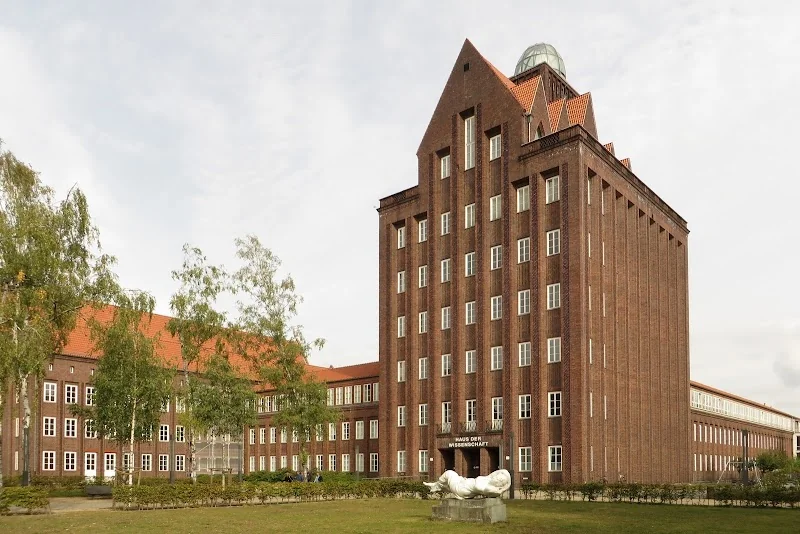
Those looking for photos of the House of Science Braunschweig quickly encounter the characteristic architecture of the building: the tower structure, the glass dome, and the bright, open event areas. The official website uses image motifs at several points that show the place not just as a mere address but as a visually striking location. Particularly, the history of the building makes the first impression exciting, as the house combines historical substance with modern use. Since 2011, a illuminated glass dome crowns the building at night, and since September 2016, there has been a permanent exhibition on the history of the house in the south stairwell. This mix of architecture, light, and scientific communication ensures that photos here are not just an addition but a central part of the location experience. This is particularly interesting for event planners: a house with recognition value appears much stronger on invitations, social media, and press photos than a neutral conference venue. The rooms themselves are also described as flooded with light, which further enhances the visual impression and makes the location attractive for presentations, workshops, and representative occasions. ([hausderwissenschaft.org](https://www.hausderwissenschaft.org/hintergrund/geschichte-des-gebaeudes.html?ADMCMD_editIcons=516&cHash=289f34ef745f3436f830c190867fc5a8))
The visual added value is evident not only on the facade but also in the event spaces inside. The room documents describe the house as a place with a wide view over Braunschweig and plenty of space for new ideas, while the conference rooms on the fifth floor are presented as particularly suitable for meetings, seminars, and workshops. In addition, there is the view over the city, the restaurant LaCupola in the house, and the combination of monument character and modern repurposing. This mix makes the photos of the house so valuable: they convey not only the optical quality but also the atmosphere of a place that brings together education, encounters, and urban identity. Those looking for images for a contribution, an event announcement, or a corporate event can therefore use the location as a stage-like backdrop for science and dialogue. The house appears in pictures as factual, open, and representative, without seeming cold. This impression is no coincidence but part of the positioning of the house as a place for the public and research. ([hausderwissenschaft.org](https://www.hausderwissenschaft.org/en/raum-vermietung/translate-to-english-raumvermietung.html))
Address, Directions, and Opening Hours at Pockelsstraße 11
The address of the house is clear: House of Science Braunschweig GmbH, Pockelsstraße 11, 38106 Braunschweig. According to the official contact page, the building is open from Monday to Saturday until 10:30 PM, but closed on Sundays. Public transport is mainly recommended for getting there, as the Pockelsstraße stop is located nearby. Those coming by bus can use lines 419 or 429; the tram stop Mühlenpfordtstraße is about a five-minute walk away, and the Botanischer Garten stop is about eight minutes away. This makes the house particularly accessible for visitors from the Braunschweig urban area as well as for guests from the main train station vicinity. The official website not only lists the address but also explains very specifically how to cover the last meters, which is often crucial for event planning. Those expecting participants can describe the route precisely in the invitation, thereby reducing inquiries on-site. ([hausderwissenschaft.org](https://www.hausderwissenschaft.org/kontakt.html?ADMCMD_editIcons=598&cHash=2af2b53a41aabb56dac4b4b9d5568a37))
The arrival by car is also officially described. The contact page mentions a route from Hanover and Berlin that leads via the Braunschweig Nord motorway interchange to the A391, then to the A392, and finally via Hamburger Straße, Rebenring, and into Pockelsstraße. Additionally, the room rental mentions free parking spaces in Pockelsstraße in front of the house and in the side streets, as well as several barrier-free parking spaces directly in front of the entrance. There is also provision for electric mobility: across from the house, there is a charging station with 24-hour access; according to the contact page, charging there was free until further notice, and Type-2 and CCS connections are mentioned. This mix of public transport connections, car access, parking options, and charging infrastructure makes the location quite comfortable in everyday life. Especially for conferences, evening events, or formats with changing target groups, this is a real plus, as the house remains functional for both regional guests and visitors traveling from afar. ([hausderwissenschaft.org](https://www.hausderwissenschaft.org/kontakt.html?ADMCMD_editIcons=598&cHash=2af2b53a41aabb56dac4b4b9d5568a37))
Events, Science Slam, and Salon of Science
The event page of the house clearly shows what the place stands for: science-related formats, exchange, and publicly accessible content from the research region Braunschweig. The homepage highlights events from the region, highlights from past years, and formats such as Science Slam. On behalf of the house, it is also emphasized that it aims to keep the appetite for research and science alive and to provide a permanent home for the dialogue between the public, politics, economy, and culture. This explains why such diverse formats coexist in the house: from children’s and youth projects to panel discussions to networking formats and scientific short lectures. The Science Slam is one of the most well-known formats; according to the official page, presenters have ten minutes to entertainingly present their topic. The platform thus connects science and stage in a way that remains easily accessible while still having substantive content. Therefore, those looking for events in the House of Science will not find a rigid cultural program but a vibrant network of research, education, and the public. ([hausderwissenschaft.org](https://www.hausderwissenschaft.org/hintergrund/unser-auftrag.html))
Particularly exciting is the Salon of Science. This format is described by the official website as an innovative event format developed, designed, and organized by the House of Science Braunschweig. Instead of classic lectures, it focuses on open discussions between citizens and researchers from the region, thus bringing science to direct touch and inquiry. The portfolio is complemented by podcasts, hackathons, WissensWelle, and other projects that show that the house not only provides a space but also creates content. This is important for SEO and user intent: those searching for events, programs, or scientific events in Braunschweig usually want not just a calendar but a sense of what makes the place special. The House of Science delivers exactly that with its mix of format diversity and regional anchoring. It is less a classic hall for mass audiences and more a flexible stage for conversations, experiments, education, and discussion. This makes the house particularly suitable for visitors who want to not just consume science but experience it. ([hausderwissenschaft.org](https://www.hausderwissenschaft.org/projektvielfalt/salon-der-wissenschaft.html?utm_source=openai))
Room Rental, Conferences, and Hybrid Events
For companies, associations, universities, and initiatives, room rental is a central topic. The official website describes the rooms as flooded with light, flexible, and with a wide view over Braunschweig, making them suitable for conferences, workshops, seminars, and meetings. The current room information lists the idea room, the wide view, and the combined area; together they offer 145 square meters and space for up to 100 people. Additionally, there is an auditorium with 220 square meters and up to 190 seats, as well as a gallery on the fourth floor with 60 seats. This range is interesting for organizers because smaller expert groups can be accommodated just as well as larger lectures or festive formats. Economically, room rental is also attractive, as scientifically oriented events receive a discount. At the same time, the website points out that ideological, party-political, and similar events are not permitted. This clearly shows what kind of use the house wants to promote: fact-based, open, and science-related content. ([hausderwissenschaft.org](https://www.hausderwissenschaft.org/en/raum-vermietung/translate-to-english-raumvermietung.html))
In addition, there is a very practical service aspect. The room documents mention sound systems, projectors, flip charts, partition walls, and support for the desired seating plan. Advice is also offered for digital and hybrid formats, and the room rental refers to individual technical solutions with experienced service providers. Especially after the last few years, this is an important point for companies and institutions that need to be present both on-site and online. The House of Science positions itself here not just as a mere landlord but as a partner in planning, organizing, and executing. This also fits the environment: the house houses the restaurant LaCupola, which according to documents is located on the sixth floor and offers a wide view over Braunschweig. Therefore, those planning conferences, lectures, or internal meetings find an environment that fits in terms of content, technology, and atmosphere. The location thus appears professional but not anonymous, and that makes it particularly interesting for organizers. ([hausderwissenschaft.org](https://www.hausderwissenschaft.org/en/raum-vermietung/translate-to-english-raumvermietung.html))
History of the Building and Architectural Features
The history of the House of Science is a crucial part of its profile. According to the official building page, the complex was planned and built in the 1930s; architecturally, it is based on North German brick Gothic. Even in the planning phase, the house received a new purpose as an independent university for teacher education, and the inauguration took place on May 23, 1937, as Bernhard-Rust-Hochschule. The entire complex then consisted of six buildings with institute and administrative areas, a building for the Natural History Museum, a gymnasium, and the tower building as a lecture hall with an observatory. After World War II, the facility was hardly destroyed, allowing the lecture operation to resume as early as November 1945. Later, the building became known as Kant-Hochschule and remained important for teacher education. This historical depth makes the place particularly interesting for visitors, as it is not only a modern science address but a place where Braunschweig's urban and educational history becomes visible. ([hausderwissenschaft.org](https://www.hausderwissenschaft.org/hintergrund/geschichte-des-gebaeudes.html?ADMCMD_editIcons=516&cHash=289f34ef745f3436f830c190867fc5a8))
Since 1978, the building has belonged to the Technical University of Braunschweig; since 2009, the Study Service Center and the House of Science Braunschweig GmbH have also been located there. As part of the comprehensive renovation and redesign in 2008 and 2009, new conference rooms were created on the fifth floor, and since 2011, the illuminated glass dome has shaped the appearance of the house. Additionally, since September 2016, there has been a permanent exhibition on the history of the building in the south stairwell, which is freely accessible. For SEO considerations, these facts are valuable as they explain the mix of historical significance, modern use, and architectural recognizability. Those searching for history, special architecture, or glass domes will not find an arbitrary event location here but a house with a substantial biography. This history builds trust and makes the location significantly more attractive for photos, press reports, and event announcements. It is not just a backdrop but part of the message itself. ([hausderwissenschaft.org](https://www.hausderwissenschaft.org/hintergrund/geschichte-des-gebaeudes.html?ADMCMD_editIcons=516&cHash=289f34ef745f3436f830c190867fc5a8))
Practical Information for Visits, Accessibility, and Service
Another plus point of the house is the practical visitor service. The official room documents mention several barrier-free parking spaces in front of the building, barrier-free access through the main entrance, and barrier-free toilets on the first floor. There are also two elevators: the left one goes up to the fifth floor, and the right one goes up to the sixth floor with direct access to LaCupola. This is very important for guests with limited mobility, for older visitors, or for larger groups, as it significantly facilitates the overall use of the house. The room management is also clearly structured: the offices are located on the first floor in rooms 101 to 103, and there are fixed telephone availability times for room bookings and a dedicated contact team. This makes the house feel less like an anonymous institution and more like a well-organized event address with personal support. Such details are often crucial for search intent, as users not only want to know what a place is but also how smoothly it can be used. ([hausderwissenschaft.org](https://www.hausderwissenschaft.org/fileadmin/user_upload/FreiRaum/EN_2024_Informationen_Raumvermietung_LL.pptx__1_.pdf))
The content orientation also matches the service quality. The house aims to make science understandable, bring current topics into the lives of guests, and develop formats that go beyond classic lectures. Therefore, events for different target groups are conceivable: from networking meetings and expert discussions to children’s and youth formats to scientific panels. Additionally, it is useful for visitors that the permanent exhibition in the south stairwell is freely accessible from Monday to Saturday, providing a reason to visit independently of individual events. Those planning an appointment, a conference, or a tour can thus experience the house as a versatile place where infrastructure, science communication, and urban location come together. This combination makes the House of Science Braunschweig a location that is in high demand for both photos and real events, access topics, and room rentals. The official information on opening hours, routes, rooms, and services shows that not only the content but also the visit process has been carefully considered. ([hausderwissenschaft.org](https://www.hausderwissenschaft.org/hintergrund/geschichte-des-gebaeudes.html?ADMCMD_editIcons=516&cHash=289f34ef745f3436f830c190867fc5a8))
Sources:
Show moreShow less
House of Science Braunschweig | Photos & Address
The House of Science Braunschweig is much more than just an event location at Pockelsstraße 11. The official website describes it as a place for a permanent dialogue between science, society, economy, and culture, founded in 2007 as a non-profit organization. At the same time, it is a building with a distinctive presence in the Braunschweig university district: a house with public events, flexible conference rooms, a restaurant in the building, and a clear focus on scientific communication. For visitors, the location is particularly convenient, as the offices are located on the first floor, the building is open from Monday to Saturday, and the connection to bus and tram is explained directly on the contact page. Therefore, those who come here encounter a mix of event venue, workplace, and scientific meeting point that consciously targets people who want to inform themselves, exchange ideas, or organize something themselves. The location information, opening hours, and directions to the house come directly from the official pages of the House of Science Braunschweig. ([hausderwissenschaft.org](https://www.hausderwissenschaft.org/hintergrund/unser-auftrag.html))
Photos and First Impression of the House of Science Braunschweig
Those looking for photos of the House of Science Braunschweig quickly encounter the characteristic architecture of the building: the tower structure, the glass dome, and the bright, open event areas. The official website uses image motifs at several points that show the place not just as a mere address but as a visually striking location. Particularly, the history of the building makes the first impression exciting, as the house combines historical substance with modern use. Since 2011, a illuminated glass dome crowns the building at night, and since September 2016, there has been a permanent exhibition on the history of the house in the south stairwell. This mix of architecture, light, and scientific communication ensures that photos here are not just an addition but a central part of the location experience. This is particularly interesting for event planners: a house with recognition value appears much stronger on invitations, social media, and press photos than a neutral conference venue. The rooms themselves are also described as flooded with light, which further enhances the visual impression and makes the location attractive for presentations, workshops, and representative occasions. ([hausderwissenschaft.org](https://www.hausderwissenschaft.org/hintergrund/geschichte-des-gebaeudes.html?ADMCMD_editIcons=516&cHash=289f34ef745f3436f830c190867fc5a8))
The visual added value is evident not only on the facade but also in the event spaces inside. The room documents describe the house as a place with a wide view over Braunschweig and plenty of space for new ideas, while the conference rooms on the fifth floor are presented as particularly suitable for meetings, seminars, and workshops. In addition, there is the view over the city, the restaurant LaCupola in the house, and the combination of monument character and modern repurposing. This mix makes the photos of the house so valuable: they convey not only the optical quality but also the atmosphere of a place that brings together education, encounters, and urban identity. Those looking for images for a contribution, an event announcement, or a corporate event can therefore use the location as a stage-like backdrop for science and dialogue. The house appears in pictures as factual, open, and representative, without seeming cold. This impression is no coincidence but part of the positioning of the house as a place for the public and research. ([hausderwissenschaft.org](https://www.hausderwissenschaft.org/en/raum-vermietung/translate-to-english-raumvermietung.html))
Address, Directions, and Opening Hours at Pockelsstraße 11
The address of the house is clear: House of Science Braunschweig GmbH, Pockelsstraße 11, 38106 Braunschweig. According to the official contact page, the building is open from Monday to Saturday until 10:30 PM, but closed on Sundays. Public transport is mainly recommended for getting there, as the Pockelsstraße stop is located nearby. Those coming by bus can use lines 419 or 429; the tram stop Mühlenpfordtstraße is about a five-minute walk away, and the Botanischer Garten stop is about eight minutes away. This makes the house particularly accessible for visitors from the Braunschweig urban area as well as for guests from the main train station vicinity. The official website not only lists the address but also explains very specifically how to cover the last meters, which is often crucial for event planning. Those expecting participants can describe the route precisely in the invitation, thereby reducing inquiries on-site. ([hausderwissenschaft.org](https://www.hausderwissenschaft.org/kontakt.html?ADMCMD_editIcons=598&cHash=2af2b53a41aabb56dac4b4b9d5568a37))
The arrival by car is also officially described. The contact page mentions a route from Hanover and Berlin that leads via the Braunschweig Nord motorway interchange to the A391, then to the A392, and finally via Hamburger Straße, Rebenring, and into Pockelsstraße. Additionally, the room rental mentions free parking spaces in Pockelsstraße in front of the house and in the side streets, as well as several barrier-free parking spaces directly in front of the entrance. There is also provision for electric mobility: across from the house, there is a charging station with 24-hour access; according to the contact page, charging there was free until further notice, and Type-2 and CCS connections are mentioned. This mix of public transport connections, car access, parking options, and charging infrastructure makes the location quite comfortable in everyday life. Especially for conferences, evening events, or formats with changing target groups, this is a real plus, as the house remains functional for both regional guests and visitors traveling from afar. ([hausderwissenschaft.org](https://www.hausderwissenschaft.org/kontakt.html?ADMCMD_editIcons=598&cHash=2af2b53a41aabb56dac4b4b9d5568a37))
Events, Science Slam, and Salon of Science
The event page of the house clearly shows what the place stands for: science-related formats, exchange, and publicly accessible content from the research region Braunschweig. The homepage highlights events from the region, highlights from past years, and formats such as Science Slam. On behalf of the house, it is also emphasized that it aims to keep the appetite for research and science alive and to provide a permanent home for the dialogue between the public, politics, economy, and culture. This explains why such diverse formats coexist in the house: from children’s and youth projects to panel discussions to networking formats and scientific short lectures. The Science Slam is one of the most well-known formats; according to the official page, presenters have ten minutes to entertainingly present their topic. The platform thus connects science and stage in a way that remains easily accessible while still having substantive content. Therefore, those looking for events in the House of Science will not find a rigid cultural program but a vibrant network of research, education, and the public. ([hausderwissenschaft.org](https://www.hausderwissenschaft.org/hintergrund/unser-auftrag.html))
Particularly exciting is the Salon of Science. This format is described by the official website as an innovative event format developed, designed, and organized by the House of Science Braunschweig. Instead of classic lectures, it focuses on open discussions between citizens and researchers from the region, thus bringing science to direct touch and inquiry. The portfolio is complemented by podcasts, hackathons, WissensWelle, and other projects that show that the house not only provides a space but also creates content. This is important for SEO and user intent: those searching for events, programs, or scientific events in Braunschweig usually want not just a calendar but a sense of what makes the place special. The House of Science delivers exactly that with its mix of format diversity and regional anchoring. It is less a classic hall for mass audiences and more a flexible stage for conversations, experiments, education, and discussion. This makes the house particularly suitable for visitors who want to not just consume science but experience it. ([hausderwissenschaft.org](https://www.hausderwissenschaft.org/projektvielfalt/salon-der-wissenschaft.html?utm_source=openai))
Room Rental, Conferences, and Hybrid Events
For companies, associations, universities, and initiatives, room rental is a central topic. The official website describes the rooms as flooded with light, flexible, and with a wide view over Braunschweig, making them suitable for conferences, workshops, seminars, and meetings. The current room information lists the idea room, the wide view, and the combined area; together they offer 145 square meters and space for up to 100 people. Additionally, there is an auditorium with 220 square meters and up to 190 seats, as well as a gallery on the fourth floor with 60 seats. This range is interesting for organizers because smaller expert groups can be accommodated just as well as larger lectures or festive formats. Economically, room rental is also attractive, as scientifically oriented events receive a discount. At the same time, the website points out that ideological, party-political, and similar events are not permitted. This clearly shows what kind of use the house wants to promote: fact-based, open, and science-related content. ([hausderwissenschaft.org](https://www.hausderwissenschaft.org/en/raum-vermietung/translate-to-english-raumvermietung.html))
In addition, there is a very practical service aspect. The room documents mention sound systems, projectors, flip charts, partition walls, and support for the desired seating plan. Advice is also offered for digital and hybrid formats, and the room rental refers to individual technical solutions with experienced service providers. Especially after the last few years, this is an important point for companies and institutions that need to be present both on-site and online. The House of Science positions itself here not just as a mere landlord but as a partner in planning, organizing, and executing. This also fits the environment: the house houses the restaurant LaCupola, which according to documents is located on the sixth floor and offers a wide view over Braunschweig. Therefore, those planning conferences, lectures, or internal meetings find an environment that fits in terms of content, technology, and atmosphere. The location thus appears professional but not anonymous, and that makes it particularly interesting for organizers. ([hausderwissenschaft.org](https://www.hausderwissenschaft.org/en/raum-vermietung/translate-to-english-raumvermietung.html))
History of the Building and Architectural Features
The history of the House of Science is a crucial part of its profile. According to the official building page, the complex was planned and built in the 1930s; architecturally, it is based on North German brick Gothic. Even in the planning phase, the house received a new purpose as an independent university for teacher education, and the inauguration took place on May 23, 1937, as Bernhard-Rust-Hochschule. The entire complex then consisted of six buildings with institute and administrative areas, a building for the Natural History Museum, a gymnasium, and the tower building as a lecture hall with an observatory. After World War II, the facility was hardly destroyed, allowing the lecture operation to resume as early as November 1945. Later, the building became known as Kant-Hochschule and remained important for teacher education. This historical depth makes the place particularly interesting for visitors, as it is not only a modern science address but a place where Braunschweig's urban and educational history becomes visible. ([hausderwissenschaft.org](https://www.hausderwissenschaft.org/hintergrund/geschichte-des-gebaeudes.html?ADMCMD_editIcons=516&cHash=289f34ef745f3436f830c190867fc5a8))
Since 1978, the building has belonged to the Technical University of Braunschweig; since 2009, the Study Service Center and the House of Science Braunschweig GmbH have also been located there. As part of the comprehensive renovation and redesign in 2008 and 2009, new conference rooms were created on the fifth floor, and since 2011, the illuminated glass dome has shaped the appearance of the house. Additionally, since September 2016, there has been a permanent exhibition on the history of the building in the south stairwell, which is freely accessible. For SEO considerations, these facts are valuable as they explain the mix of historical significance, modern use, and architectural recognizability. Those searching for history, special architecture, or glass domes will not find an arbitrary event location here but a house with a substantial biography. This history builds trust and makes the location significantly more attractive for photos, press reports, and event announcements. It is not just a backdrop but part of the message itself. ([hausderwissenschaft.org](https://www.hausderwissenschaft.org/hintergrund/geschichte-des-gebaeudes.html?ADMCMD_editIcons=516&cHash=289f34ef745f3436f830c190867fc5a8))
Practical Information for Visits, Accessibility, and Service
Another plus point of the house is the practical visitor service. The official room documents mention several barrier-free parking spaces in front of the building, barrier-free access through the main entrance, and barrier-free toilets on the first floor. There are also two elevators: the left one goes up to the fifth floor, and the right one goes up to the sixth floor with direct access to LaCupola. This is very important for guests with limited mobility, for older visitors, or for larger groups, as it significantly facilitates the overall use of the house. The room management is also clearly structured: the offices are located on the first floor in rooms 101 to 103, and there are fixed telephone availability times for room bookings and a dedicated contact team. This makes the house feel less like an anonymous institution and more like a well-organized event address with personal support. Such details are often crucial for search intent, as users not only want to know what a place is but also how smoothly it can be used. ([hausderwissenschaft.org](https://www.hausderwissenschaft.org/fileadmin/user_upload/FreiRaum/EN_2024_Informationen_Raumvermietung_LL.pptx__1_.pdf))
The content orientation also matches the service quality. The house aims to make science understandable, bring current topics into the lives of guests, and develop formats that go beyond classic lectures. Therefore, events for different target groups are conceivable: from networking meetings and expert discussions to children’s and youth formats to scientific panels. Additionally, it is useful for visitors that the permanent exhibition in the south stairwell is freely accessible from Monday to Saturday, providing a reason to visit independently of individual events. Those planning an appointment, a conference, or a tour can thus experience the house as a versatile place where infrastructure, science communication, and urban location come together. This combination makes the House of Science Braunschweig a location that is in high demand for both photos and real events, access topics, and room rentals. The official information on opening hours, routes, rooms, and services shows that not only the content but also the visit process has been carefully considered. ([hausderwissenschaft.org](https://www.hausderwissenschaft.org/hintergrund/geschichte-des-gebaeudes.html?ADMCMD_editIcons=516&cHash=289f34ef745f3436f830c190867fc5a8))
Sources:
House of Science Braunschweig | Photos & Address
The House of Science Braunschweig is much more than just an event location at Pockelsstraße 11. The official website describes it as a place for a permanent dialogue between science, society, economy, and culture, founded in 2007 as a non-profit organization. At the same time, it is a building with a distinctive presence in the Braunschweig university district: a house with public events, flexible conference rooms, a restaurant in the building, and a clear focus on scientific communication. For visitors, the location is particularly convenient, as the offices are located on the first floor, the building is open from Monday to Saturday, and the connection to bus and tram is explained directly on the contact page. Therefore, those who come here encounter a mix of event venue, workplace, and scientific meeting point that consciously targets people who want to inform themselves, exchange ideas, or organize something themselves. The location information, opening hours, and directions to the house come directly from the official pages of the House of Science Braunschweig. ([hausderwissenschaft.org](https://www.hausderwissenschaft.org/hintergrund/unser-auftrag.html))
Photos and First Impression of the House of Science Braunschweig
Those looking for photos of the House of Science Braunschweig quickly encounter the characteristic architecture of the building: the tower structure, the glass dome, and the bright, open event areas. The official website uses image motifs at several points that show the place not just as a mere address but as a visually striking location. Particularly, the history of the building makes the first impression exciting, as the house combines historical substance with modern use. Since 2011, a illuminated glass dome crowns the building at night, and since September 2016, there has been a permanent exhibition on the history of the house in the south stairwell. This mix of architecture, light, and scientific communication ensures that photos here are not just an addition but a central part of the location experience. This is particularly interesting for event planners: a house with recognition value appears much stronger on invitations, social media, and press photos than a neutral conference venue. The rooms themselves are also described as flooded with light, which further enhances the visual impression and makes the location attractive for presentations, workshops, and representative occasions. ([hausderwissenschaft.org](https://www.hausderwissenschaft.org/hintergrund/geschichte-des-gebaeudes.html?ADMCMD_editIcons=516&cHash=289f34ef745f3436f830c190867fc5a8))
The visual added value is evident not only on the facade but also in the event spaces inside. The room documents describe the house as a place with a wide view over Braunschweig and plenty of space for new ideas, while the conference rooms on the fifth floor are presented as particularly suitable for meetings, seminars, and workshops. In addition, there is the view over the city, the restaurant LaCupola in the house, and the combination of monument character and modern repurposing. This mix makes the photos of the house so valuable: they convey not only the optical quality but also the atmosphere of a place that brings together education, encounters, and urban identity. Those looking for images for a contribution, an event announcement, or a corporate event can therefore use the location as a stage-like backdrop for science and dialogue. The house appears in pictures as factual, open, and representative, without seeming cold. This impression is no coincidence but part of the positioning of the house as a place for the public and research. ([hausderwissenschaft.org](https://www.hausderwissenschaft.org/en/raum-vermietung/translate-to-english-raumvermietung.html))
Address, Directions, and Opening Hours at Pockelsstraße 11
The address of the house is clear: House of Science Braunschweig GmbH, Pockelsstraße 11, 38106 Braunschweig. According to the official contact page, the building is open from Monday to Saturday until 10:30 PM, but closed on Sundays. Public transport is mainly recommended for getting there, as the Pockelsstraße stop is located nearby. Those coming by bus can use lines 419 or 429; the tram stop Mühlenpfordtstraße is about a five-minute walk away, and the Botanischer Garten stop is about eight minutes away. This makes the house particularly accessible for visitors from the Braunschweig urban area as well as for guests from the main train station vicinity. The official website not only lists the address but also explains very specifically how to cover the last meters, which is often crucial for event planning. Those expecting participants can describe the route precisely in the invitation, thereby reducing inquiries on-site. ([hausderwissenschaft.org](https://www.hausderwissenschaft.org/kontakt.html?ADMCMD_editIcons=598&cHash=2af2b53a41aabb56dac4b4b9d5568a37))
The arrival by car is also officially described. The contact page mentions a route from Hanover and Berlin that leads via the Braunschweig Nord motorway interchange to the A391, then to the A392, and finally via Hamburger Straße, Rebenring, and into Pockelsstraße. Additionally, the room rental mentions free parking spaces in Pockelsstraße in front of the house and in the side streets, as well as several barrier-free parking spaces directly in front of the entrance. There is also provision for electric mobility: across from the house, there is a charging station with 24-hour access; according to the contact page, charging there was free until further notice, and Type-2 and CCS connections are mentioned. This mix of public transport connections, car access, parking options, and charging infrastructure makes the location quite comfortable in everyday life. Especially for conferences, evening events, or formats with changing target groups, this is a real plus, as the house remains functional for both regional guests and visitors traveling from afar. ([hausderwissenschaft.org](https://www.hausderwissenschaft.org/kontakt.html?ADMCMD_editIcons=598&cHash=2af2b53a41aabb56dac4b4b9d5568a37))
Events, Science Slam, and Salon of Science
The event page of the house clearly shows what the place stands for: science-related formats, exchange, and publicly accessible content from the research region Braunschweig. The homepage highlights events from the region, highlights from past years, and formats such as Science Slam. On behalf of the house, it is also emphasized that it aims to keep the appetite for research and science alive and to provide a permanent home for the dialogue between the public, politics, economy, and culture. This explains why such diverse formats coexist in the house: from children’s and youth projects to panel discussions to networking formats and scientific short lectures. The Science Slam is one of the most well-known formats; according to the official page, presenters have ten minutes to entertainingly present their topic. The platform thus connects science and stage in a way that remains easily accessible while still having substantive content. Therefore, those looking for events in the House of Science will not find a rigid cultural program but a vibrant network of research, education, and the public. ([hausderwissenschaft.org](https://www.hausderwissenschaft.org/hintergrund/unser-auftrag.html))
Particularly exciting is the Salon of Science. This format is described by the official website as an innovative event format developed, designed, and organized by the House of Science Braunschweig. Instead of classic lectures, it focuses on open discussions between citizens and researchers from the region, thus bringing science to direct touch and inquiry. The portfolio is complemented by podcasts, hackathons, WissensWelle, and other projects that show that the house not only provides a space but also creates content. This is important for SEO and user intent: those searching for events, programs, or scientific events in Braunschweig usually want not just a calendar but a sense of what makes the place special. The House of Science delivers exactly that with its mix of format diversity and regional anchoring. It is less a classic hall for mass audiences and more a flexible stage for conversations, experiments, education, and discussion. This makes the house particularly suitable for visitors who want to not just consume science but experience it. ([hausderwissenschaft.org](https://www.hausderwissenschaft.org/projektvielfalt/salon-der-wissenschaft.html?utm_source=openai))
Room Rental, Conferences, and Hybrid Events
For companies, associations, universities, and initiatives, room rental is a central topic. The official website describes the rooms as flooded with light, flexible, and with a wide view over Braunschweig, making them suitable for conferences, workshops, seminars, and meetings. The current room information lists the idea room, the wide view, and the combined area; together they offer 145 square meters and space for up to 100 people. Additionally, there is an auditorium with 220 square meters and up to 190 seats, as well as a gallery on the fourth floor with 60 seats. This range is interesting for organizers because smaller expert groups can be accommodated just as well as larger lectures or festive formats. Economically, room rental is also attractive, as scientifically oriented events receive a discount. At the same time, the website points out that ideological, party-political, and similar events are not permitted. This clearly shows what kind of use the house wants to promote: fact-based, open, and science-related content. ([hausderwissenschaft.org](https://www.hausderwissenschaft.org/en/raum-vermietung/translate-to-english-raumvermietung.html))
In addition, there is a very practical service aspect. The room documents mention sound systems, projectors, flip charts, partition walls, and support for the desired seating plan. Advice is also offered for digital and hybrid formats, and the room rental refers to individual technical solutions with experienced service providers. Especially after the last few years, this is an important point for companies and institutions that need to be present both on-site and online. The House of Science positions itself here not just as a mere landlord but as a partner in planning, organizing, and executing. This also fits the environment: the house houses the restaurant LaCupola, which according to documents is located on the sixth floor and offers a wide view over Braunschweig. Therefore, those planning conferences, lectures, or internal meetings find an environment that fits in terms of content, technology, and atmosphere. The location thus appears professional but not anonymous, and that makes it particularly interesting for organizers. ([hausderwissenschaft.org](https://www.hausderwissenschaft.org/en/raum-vermietung/translate-to-english-raumvermietung.html))
History of the Building and Architectural Features
The history of the House of Science is a crucial part of its profile. According to the official building page, the complex was planned and built in the 1930s; architecturally, it is based on North German brick Gothic. Even in the planning phase, the house received a new purpose as an independent university for teacher education, and the inauguration took place on May 23, 1937, as Bernhard-Rust-Hochschule. The entire complex then consisted of six buildings with institute and administrative areas, a building for the Natural History Museum, a gymnasium, and the tower building as a lecture hall with an observatory. After World War II, the facility was hardly destroyed, allowing the lecture operation to resume as early as November 1945. Later, the building became known as Kant-Hochschule and remained important for teacher education. This historical depth makes the place particularly interesting for visitors, as it is not only a modern science address but a place where Braunschweig's urban and educational history becomes visible. ([hausderwissenschaft.org](https://www.hausderwissenschaft.org/hintergrund/geschichte-des-gebaeudes.html?ADMCMD_editIcons=516&cHash=289f34ef745f3436f830c190867fc5a8))
Since 1978, the building has belonged to the Technical University of Braunschweig; since 2009, the Study Service Center and the House of Science Braunschweig GmbH have also been located there. As part of the comprehensive renovation and redesign in 2008 and 2009, new conference rooms were created on the fifth floor, and since 2011, the illuminated glass dome has shaped the appearance of the house. Additionally, since September 2016, there has been a permanent exhibition on the history of the building in the south stairwell, which is freely accessible. For SEO considerations, these facts are valuable as they explain the mix of historical significance, modern use, and architectural recognizability. Those searching for history, special architecture, or glass domes will not find an arbitrary event location here but a house with a substantial biography. This history builds trust and makes the location significantly more attractive for photos, press reports, and event announcements. It is not just a backdrop but part of the message itself. ([hausderwissenschaft.org](https://www.hausderwissenschaft.org/hintergrund/geschichte-des-gebaeudes.html?ADMCMD_editIcons=516&cHash=289f34ef745f3436f830c190867fc5a8))
Practical Information for Visits, Accessibility, and Service
Another plus point of the house is the practical visitor service. The official room documents mention several barrier-free parking spaces in front of the building, barrier-free access through the main entrance, and barrier-free toilets on the first floor. There are also two elevators: the left one goes up to the fifth floor, and the right one goes up to the sixth floor with direct access to LaCupola. This is very important for guests with limited mobility, for older visitors, or for larger groups, as it significantly facilitates the overall use of the house. The room management is also clearly structured: the offices are located on the first floor in rooms 101 to 103, and there are fixed telephone availability times for room bookings and a dedicated contact team. This makes the house feel less like an anonymous institution and more like a well-organized event address with personal support. Such details are often crucial for search intent, as users not only want to know what a place is but also how smoothly it can be used. ([hausderwissenschaft.org](https://www.hausderwissenschaft.org/fileadmin/user_upload/FreiRaum/EN_2024_Informationen_Raumvermietung_LL.pptx__1_.pdf))
The content orientation also matches the service quality. The house aims to make science understandable, bring current topics into the lives of guests, and develop formats that go beyond classic lectures. Therefore, events for different target groups are conceivable: from networking meetings and expert discussions to children’s and youth formats to scientific panels. Additionally, it is useful for visitors that the permanent exhibition in the south stairwell is freely accessible from Monday to Saturday, providing a reason to visit independently of individual events. Those planning an appointment, a conference, or a tour can thus experience the house as a versatile place where infrastructure, science communication, and urban location come together. This combination makes the House of Science Braunschweig a location that is in high demand for both photos and real events, access topics, and room rentals. The official information on opening hours, routes, rooms, and services shows that not only the content but also the visit process has been carefully considered. ([hausderwissenschaft.org](https://www.hausderwissenschaft.org/hintergrund/geschichte-des-gebaeudes.html?ADMCMD_editIcons=516&cHash=289f34ef745f3436f830c190867fc5a8))
Sources:
Upcoming Events
No events found
Frequently Asked Questions
Reviews
No reviews found