
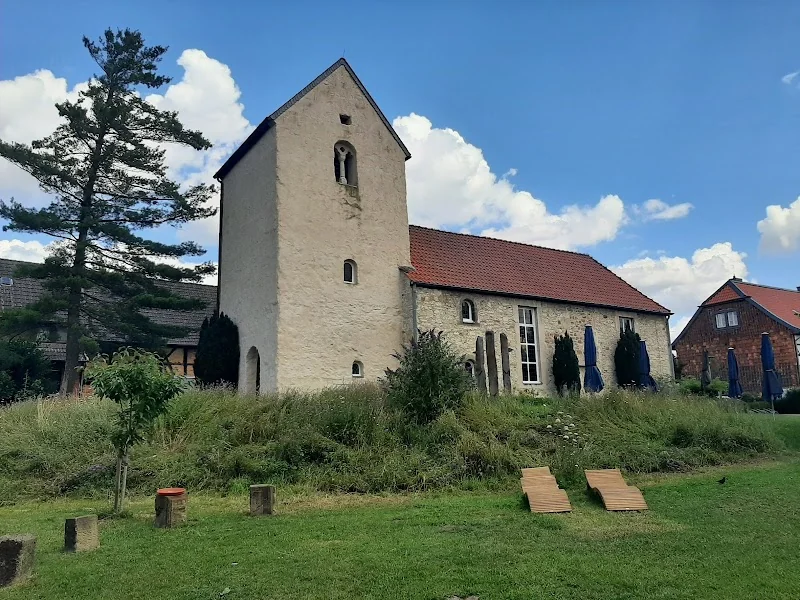
Kirchenbrink 3 C, Braunschweig-Stöckheim-Leiferde
Kirchenbrink 3 C, 38124 Braunschweig, Germany
Stöckheim Church | Directions & Services
The Evangelical Lutheran congregation "To the Holy Suffering of Christ" in Braunschweig-Stöckheim is a place where village history, lived faith, and a strong architectural memory meet. Those searching for the church by the Oker will find not only a historic house of worship but also a vibrant community ensemble with a community center, group offerings, and a clear connection between tradition and the present. This makes the location interesting for people looking for a baptism, a service, or a personal moment of silence, as well as for visitors interested in the history of the old village core and special details such as the organ, baptismal angel, or votive tablet. The church belongs to the parish association of Braunschweig South, and this integration shows that it is not isolated but intended as an active part of a larger church network. The official website therefore connects information about the construction history, community life, events, and contact in one place. ([kircheinstoeckheim.de](https://www.kircheinstoeckheim.de/kirche/kirche/))
History and Construction History of the Church To the Holy Suffering of Christ
The construction history of the Stöckheim church goes back a long way and makes the place one of the most exciting historical reference points in the district. According to the official community website, the oldest verifiable remains of a small village church were probably discovered during an excavation in 1964. This early church was about 10.5 meters long and six meters wide and was most likely built in the early Romanesque period. The oldest preserved part of the current building is the late Romanesque tower, which, according to sources, must have been built around 1200 to 1230. The sound openings of the tower are still recognizable today as Romanesque round-arched windows with recessed dividing columns. Together with its location on a small hill above the Oker, this creates an image of remarkable continuity: Here stands no arbitrarily modernized building, but a grown place whose substance has endured for centuries. ([kircheinstoeckheim.de](https://www.kircheinstoeckheim.de/kirche/baugeschichte))
Throughout history, the church building has been remodeled and expanded several times. Particularly important is the votive tablet on the eastern outer wall of the apse, which refers to the year 1470 and likely documents a Gothic renovation or expansion. In the 19th century, the church received large neoclassical windows, which further changed its appearance. The city of Braunschweig describes the nave as very simple inside, which fits well with the impression of a historical, consciously restrained sacred space. This mixture of early Romanesque substance, Gothic memory, neoclassical interventions, and simple effect inside creates the special charm of the location. It is not uniformly cast from one mold but tells history in layers. For visitors, this means that even the view of the building itself is a small tour through the construction and piety history of the place. ([kircheinstoeckheim.de](https://www.kircheinstoeckheim.de/kirche/baugeschichte))
The more recent history is equally formative. On March 31, 1945, the tower was hit by a bomb and largely destroyed. From 1951 to 1957, the church was rebuilt; it was consecrated anew on March 27, 1955. The city of Braunschweig also notes that the congregation resisted all efforts to demolish the ruins after World War II and had the rebuilt church consecrated again. The current name also has a history: Since 1960, the church has been named "To the Holy Suffering of Christ," which refers to the difficult-to-decipher inscription on the votive tablet. Later, further important construction steps were added, such as the new community center and the new rectory, which the evangelical congregation has owned since 2005. Thus, the place connects monument protection, reconstruction, and current community practice in an unusually impressive way. ([kircheinstoeckheim.de](https://www.kircheinstoeckheim.de/kirche/baugeschichte))
For the perception on site, the urban context is also important. Stöckheim is described by the city of Braunschweig as an old village core between Braunschweig and Wolfenbüttel; the church is named there as one of the defining points in the local ensemble. The church building does not stand as an isolated monument but as part of a historically grown village that developed along the Oker. This location explains why the church is still so closely connected to the local image: it marks not only a religious center but also an identity-forming anchor for the district. Those who visit Stöckheim often first perceive the place through this ensemble of church, old village core, and river proximity. This creates the special atmosphere that many visitors experience as calm, familiar, and at the same time rich in history. ([braunschweig.de](https://www.braunschweig.de/leben/stadtportraet/stadtteile/stoeckheim/dorfrundgang/Kirche.php))
Votive Tablet, Baptismal Angel, and Organ as Special Features
Among the most striking details of the church is the votive tablet on the east side of the small apse. The congregation explains on its own website that it refers to a church construction measure and a new consecration in 1470. The motif and inscription are culturally and historically significant because they not only mark a renovation but have also given the building its current name. Pastor Lorenz oriented himself to this tablet in the 1960s and gave the Stöckheim congregation the name "To the Holy Suffering of Christ." Thus, the votive tablet is much more than a decorative detail: it connects art historical memory, liturgical interpretation, and the identity of the congregation. Therefore, anyone entering the church space or viewing the exterior encounters a sign that intertwines past and present. For an SEO landing, this special detail is important because it distinguishes the church from many other village churches and gives it a clear recognizability. ([kircheinstoeckheim.de](https://www.kircheinstoeckheim.de/kirche/votivtafel))
Another defining element is the baptismal angel. According to the congregation, the sculpture is by the artist Dieter Schröder, born in 1950 in Venne near Osnabrück. The work is made of wood and is deliberately rough to show the connection of the angels with the people who are exposed to the uncertainties of life. The angel opens its wings and receives the baptized with the biblical promise from Matthew 28:20: "I am with you all days until the end of the world." Since November 13, 2005, the baptismal angel has belonged to the church. For baptisms, this is a strong symbol because it makes the space not only liturgical but also more pictorial and emotional. Especially in a church with a long history, the baptismal angel creates a bridge between a traditional building and a contemporary, personal family celebration. ([kircheinstoeckheim.de](https://www.kircheinstoeckheim.de/kirche/taufengel))
The organ is also a true highlight of the location. On September 23, 2018, a new organ was consecrated in the small historical Stöckheim church, which had been built during the year by the Braunschweig organ workshop Florian Fay. The congregation describes that the special spatial and acoustic conditions of the church posed a significant challenge for the organ's construction. This was solved with a special organ concept and an equipment with two manuals, pedal, and electronic setter system. Shortly after the consecration, the musical quality of the new organ became evident when cathedral cantor Gerd-Peter Münden played a larger organ concert in January 2019. For visitors, this means that the church is not only historically interesting but also musically attractive and particularly suitable for small to medium concerts or festive services. ([kircheinstoeckheim.de](https://www.kircheinstoeckheim.de/kirche/orgel))
The charm of this equipment lies in the fact that each of these elements addresses a different level of church identity. The votive tablet stands for memory and name history, the baptismal angel for personal life transitions, and the organ for sound and liturgical depth. Together, they form a space where architecture, art, and community life reinforce each other. Especially because the church appears simple inside, these special features stand out all the more. Therefore, those searching for terms like organ, baptismal angel, or votive tablet do not land here by chance, but in a church that actually makes such themes visible and tangible. This is as relevant for the search intent as it is for the atmosphere on site: there are not only historical facts here but also concrete, sensually experienceable special features. ([braunschweig.de](https://www.braunschweig.de/leben/stadtportraet/stadtteile/stoeckheim/dorfrundgang/Kirche.php))
Services, Baptism, and Church Life in Stöckheim
The community life in Stöckheim is clearly oriented towards encounters, services, and the accompaniment of life stages. The congregation's website lists not only current news and events in the main menu but also services and dates of the regional church. In addition, there are dedicated sections for baptism, confirmation, weddings, funerals, and re-entry. This shows that the congregation understands the church not only as a building but as a place where people are accompanied in different life phases. The special features with the baptismal angel and organ fit very well with this because they strengthen the sacred framework for family celebrations, festive services, and personal paths. Therefore, search queries related to baptism, services, or church events encounter a genuine offering here and not just a purely museum-like place. The church is an active community location with a clear liturgical orientation. ([kircheinstoeckheim.de](https://www.kircheinstoeckheim.de/service/anfahrt))
Particularly interesting is the connection between historical authenticity and contemporary practice. The church is small, simple, and steeped in history, but not unapproachable. On the contrary: it is precisely the focus on the essential that makes it attractive for services, baptisms, and family occasions. The baptismal angel opens the space for blessing actions, the organ supports the musical design, and the community environment creates a familiar atmosphere. The website also regularly features current news and dates, indicating that the congregation keeps its everyday life visible and communicates openly. For people looking for an evangelical church in Braunschweig-Stöckheim, this is important: here, one finds not only historical information but also clear points of contact for specific life events, questions about procedures, and contact with the office. ([kircheinstoeckheim.de](https://www.kircheinstoeckheim.de/service/anfahrt))
The church framework is additionally supported by its integration into the parish association of Braunschweig South. This is practical for visitors because the congregation thus operates not as an individual location but as part of a larger church network. At the same time, the Stöckheim church remains independent with its long history and clear local reference. This mixture of regional integration and local identity makes it interesting for many occasions. Therefore, those looking for a church for baptism, service, or personal accompaniment find here an address with atmosphere, tradition, and reliable contact options. The official website explicitly mentions the community office location at Kirchenbrink 3 c, which makes orientation easier and simplifies the way to the congregation. ([kircheinstoeckheim.de](https://www.kircheinstoeckheim.de/kirche/kirche/))
Community Center, Groups, and Events at Kirchenbrink
The ensemble also includes the Evangelical Community Center Braunschweig-Stöckheim at Kirchenbrink 3. The website explicitly states that the community center is available for public events but cannot be rented privately. This note is very relevant for many search queries because interested parties often seek not only a church but also a space for meetings, lectures, or community events. The community center functionally complements the church space and makes the location more versatile. Together with the church, courtyard, and garden, it creates an environment that is intended not only for services but also for encounters and communal life. Especially in conjunction with the historical sacred building, the community center acts as a contemporary addition to a place that is suitable for both silence and communication. ([kircheinstoeckheim.de](https://www.kircheinstoeckheim.de/gemeinde/gemeindehaus))
The group offerings also show how broadly the community life is structured. The official website lists, among other things, the parlor choir, women's aid, Café Kirchblick, children's church, Oker frogs, family singing, Fit in the Head, and a men's group. Such offerings make the congregation interesting not only for traditional service visitors but also for families, older people, musically interested individuals, and neighborhood groups. This is where the location becomes particularly strong for SEO because many users search for terms like events, groups, community center, or Café Kirchblick and find suitable content in Stöckheim. The church is thus not a one-time sightseeing spot but a lively meeting place where various forms of community regularly take place. This fits well with an evangelical congregation whose profile lies not only in the service but also in social and cultural networking. ([kircheinstoeckheim.de](https://www.kircheinstoeckheim.de/service/anfahrt))
Additionally, the cultural perspective is visible on the page with the sections "Culture at Kirchenbrink" and "Culture on Site." This naming shows that the congregation consciously thinks beyond the narrower liturgical framework. Those interested in local culture, musical formats, or smaller event formats will find here a place that does not pit church and culture against each other but brings them together. This is particularly valuable for search intents related to events, community centers, choirs, or culture because there is a clear, real existing offering structure. Furthermore, the congregation works with current news and events on its website, thus communicating short-term dates and seasonal actions. This makes the site a practical entry point for anyone wanting to inform themselves before a visit. ([kircheinstoeckheim.de](https://www.kircheinstoeckheim.de/service/anfahrt))
Directions, Office Hours, and Contact with the Congregation
The official directions lead to the address Kirchenbrink 3, 38124 Braunschweig, or for the community office Kirchenbrink 3 c, 38124 Braunschweig. This makes orientation for visitors clear and uncomplicated, as the location is directly anchored in the district of Stöckheim. The website also provides contact details: phone 0531 611272 and the email address stoeckheim.buero@lk-bs.de. For practical planning, the office hours are also important, which are indicated as Monday from 9:00 to 13:00 and Friday from 15:00 to 17:00. The page with the contact details thus makes it clear when inquiries can be best made. This is particularly helpful for baptisms, weddings, funerals, or general community concerns because one quickly knows whom to contact. ([kircheinstoeckheim.de](https://www.kircheinstoeckheim.de/service/anfahrt))
For visiting the church itself, it is also relevant that the historical location in Stöckheim is well integrated into the local image. The city of Braunschweig describes the church as located on a small hill very close to the Oker. This means that the way is not only functional but also landscape-wise interesting. Those coming to the church experience the old village core, the river proximity, and the ensemble of historical and newer buildings in a single local image. The website offers a clear assignment to Kirchenbrink under the menu item "Directions," which facilitates the search for the destination. The official site does not provide detailed information about specific visitor parking, so the safest planning is always a direct look at the directions page and possibly a quick inquiry at the office. This direct contact is particularly sensible for events or services. ([kircheinstoeckheim.de](https://www.kircheinstoeckheim.de/service/anfahrt))
Stöckheim on the Oker: Location, Village Core, and Atmosphere
Stöckheim itself is an important part of the history of this church. The city of Braunschweig describes the district as an old farming village between Braunschweig and Wolfenbüttel; it is first mentioned in a royal document of Henry II from the year 1007. Originally, Stöckheim was a small row village on the Oker, which later developed into an extensive dead-end village. This development is also felt in the vicinity of the church: the location by the river, the old village core, and the historical buildings create an atmosphere that is distinctly different from an anonymous new development area. The church is not just a building in this context but an identity-forming center that makes the character of the district visible. Those visiting Stöckheim therefore experience not only a church but also a place where history remains spatially readable. ([braunschweig.de](https://www.braunschweig.de/tourismus/ueber-braunschweig/sehenswuerdigkeiten/blik/ensembles/stoeckheim.php?utm_source=openai))
Particularly impressive is the connection between rural tranquility and urban proximity. The Oker, the half-timbered surroundings, and the historical churchyard make the place attractive for walks, visits, and quiet moments. The city page describes the church as part of the Stöckheim ensemble, and this is crucial for a good location description: it is about an environment where church, village core, and river landscape interact. At the same time, Braunschweig with its modern infrastructure is not far away, making the place a quiet yet easily accessible point of contact. This mixture often surprises visitors positively because one can switch from everyday life to a historically dense and atmospheric space in a short time. The congregation itself utilizes this quality by thinking of the church, community center, garden, and meeting areas together. This creates a place that is also well communicable digitally: historical, lively, manageable, and with a clear address. ([braunschweig.de](https://www.braunschweig.de/leben/stadtportraet/stadtteile/stoeckheim/dorfrundgang/Kirche.php))
Therefore, those searching for the evangelical congregation "To the Holy Suffering of Christ" in Stöckheim are not just looking for a name but a concrete experience: an old church with new life, a congregation with clear paths, and a district that does not hide its history. This makes the location interesting for search engines and people alike. The church simultaneously fulfills different expectations: it is a monument, a house of worship, a place for baptism, a space for music and encounters, and part of a larger church association. For visitors, this is valuable because they can discover much at a single location. For the congregation, it is an advantage because the visible history creates trust and the modern organization provides orientation. Thus, Stöckheim connects the past and present in a way that sets a special accent in the southern Braunschweig area. ([kircheinstoeckheim.de](https://www.kircheinstoeckheim.de/kirche/kirche/))
Sources:
- Ev.-luth. Congregation To the Holy Suffering of Christ Braunschweig (Stöckheim) - Church ([kircheinstoeckheim.de](https://www.kircheinstoeckheim.de/kirche/kirche/))
- Ev.-luth. Congregation To the Holy Suffering of Christ Braunschweig (Stöckheim) - Construction History ([kircheinstoeckheim.de](https://www.kircheinstoeckheim.de/kirche/baugeschichte))
- Ev.-luth. Congregation To the Holy Suffering of Christ Braunschweig (Stöckheim) - Organ ([kircheinstoeckheim.de](https://www.kircheinstoeckheim.de/kirche/orgel))
- Ev.-luth. Congregation To the Holy Suffering of Christ Braunschweig (Stöckheim) - Directions ([kircheinstoeckheim.de](https://www.kircheinstoeckheim.de/service/anfahrt))
- City of Braunschweig - The Church ([braunschweig.de](https://www.braunschweig.de/leben/stadtportraet/stadtteile/stoeckheim/dorfrundgang/Kirche.php))
Show moreShow less
Stöckheim Church | Directions & Services
The Evangelical Lutheran congregation "To the Holy Suffering of Christ" in Braunschweig-Stöckheim is a place where village history, lived faith, and a strong architectural memory meet. Those searching for the church by the Oker will find not only a historic house of worship but also a vibrant community ensemble with a community center, group offerings, and a clear connection between tradition and the present. This makes the location interesting for people looking for a baptism, a service, or a personal moment of silence, as well as for visitors interested in the history of the old village core and special details such as the organ, baptismal angel, or votive tablet. The church belongs to the parish association of Braunschweig South, and this integration shows that it is not isolated but intended as an active part of a larger church network. The official website therefore connects information about the construction history, community life, events, and contact in one place. ([kircheinstoeckheim.de](https://www.kircheinstoeckheim.de/kirche/kirche/))
History and Construction History of the Church To the Holy Suffering of Christ
The construction history of the Stöckheim church goes back a long way and makes the place one of the most exciting historical reference points in the district. According to the official community website, the oldest verifiable remains of a small village church were probably discovered during an excavation in 1964. This early church was about 10.5 meters long and six meters wide and was most likely built in the early Romanesque period. The oldest preserved part of the current building is the late Romanesque tower, which, according to sources, must have been built around 1200 to 1230. The sound openings of the tower are still recognizable today as Romanesque round-arched windows with recessed dividing columns. Together with its location on a small hill above the Oker, this creates an image of remarkable continuity: Here stands no arbitrarily modernized building, but a grown place whose substance has endured for centuries. ([kircheinstoeckheim.de](https://www.kircheinstoeckheim.de/kirche/baugeschichte))
Throughout history, the church building has been remodeled and expanded several times. Particularly important is the votive tablet on the eastern outer wall of the apse, which refers to the year 1470 and likely documents a Gothic renovation or expansion. In the 19th century, the church received large neoclassical windows, which further changed its appearance. The city of Braunschweig describes the nave as very simple inside, which fits well with the impression of a historical, consciously restrained sacred space. This mixture of early Romanesque substance, Gothic memory, neoclassical interventions, and simple effect inside creates the special charm of the location. It is not uniformly cast from one mold but tells history in layers. For visitors, this means that even the view of the building itself is a small tour through the construction and piety history of the place. ([kircheinstoeckheim.de](https://www.kircheinstoeckheim.de/kirche/baugeschichte))
The more recent history is equally formative. On March 31, 1945, the tower was hit by a bomb and largely destroyed. From 1951 to 1957, the church was rebuilt; it was consecrated anew on March 27, 1955. The city of Braunschweig also notes that the congregation resisted all efforts to demolish the ruins after World War II and had the rebuilt church consecrated again. The current name also has a history: Since 1960, the church has been named "To the Holy Suffering of Christ," which refers to the difficult-to-decipher inscription on the votive tablet. Later, further important construction steps were added, such as the new community center and the new rectory, which the evangelical congregation has owned since 2005. Thus, the place connects monument protection, reconstruction, and current community practice in an unusually impressive way. ([kircheinstoeckheim.de](https://www.kircheinstoeckheim.de/kirche/baugeschichte))
For the perception on site, the urban context is also important. Stöckheim is described by the city of Braunschweig as an old village core between Braunschweig and Wolfenbüttel; the church is named there as one of the defining points in the local ensemble. The church building does not stand as an isolated monument but as part of a historically grown village that developed along the Oker. This location explains why the church is still so closely connected to the local image: it marks not only a religious center but also an identity-forming anchor for the district. Those who visit Stöckheim often first perceive the place through this ensemble of church, old village core, and river proximity. This creates the special atmosphere that many visitors experience as calm, familiar, and at the same time rich in history. ([braunschweig.de](https://www.braunschweig.de/leben/stadtportraet/stadtteile/stoeckheim/dorfrundgang/Kirche.php))
Votive Tablet, Baptismal Angel, and Organ as Special Features
Among the most striking details of the church is the votive tablet on the east side of the small apse. The congregation explains on its own website that it refers to a church construction measure and a new consecration in 1470. The motif and inscription are culturally and historically significant because they not only mark a renovation but have also given the building its current name. Pastor Lorenz oriented himself to this tablet in the 1960s and gave the Stöckheim congregation the name "To the Holy Suffering of Christ." Thus, the votive tablet is much more than a decorative detail: it connects art historical memory, liturgical interpretation, and the identity of the congregation. Therefore, anyone entering the church space or viewing the exterior encounters a sign that intertwines past and present. For an SEO landing, this special detail is important because it distinguishes the church from many other village churches and gives it a clear recognizability. ([kircheinstoeckheim.de](https://www.kircheinstoeckheim.de/kirche/votivtafel))
Another defining element is the baptismal angel. According to the congregation, the sculpture is by the artist Dieter Schröder, born in 1950 in Venne near Osnabrück. The work is made of wood and is deliberately rough to show the connection of the angels with the people who are exposed to the uncertainties of life. The angel opens its wings and receives the baptized with the biblical promise from Matthew 28:20: "I am with you all days until the end of the world." Since November 13, 2005, the baptismal angel has belonged to the church. For baptisms, this is a strong symbol because it makes the space not only liturgical but also more pictorial and emotional. Especially in a church with a long history, the baptismal angel creates a bridge between a traditional building and a contemporary, personal family celebration. ([kircheinstoeckheim.de](https://www.kircheinstoeckheim.de/kirche/taufengel))
The organ is also a true highlight of the location. On September 23, 2018, a new organ was consecrated in the small historical Stöckheim church, which had been built during the year by the Braunschweig organ workshop Florian Fay. The congregation describes that the special spatial and acoustic conditions of the church posed a significant challenge for the organ's construction. This was solved with a special organ concept and an equipment with two manuals, pedal, and electronic setter system. Shortly after the consecration, the musical quality of the new organ became evident when cathedral cantor Gerd-Peter Münden played a larger organ concert in January 2019. For visitors, this means that the church is not only historically interesting but also musically attractive and particularly suitable for small to medium concerts or festive services. ([kircheinstoeckheim.de](https://www.kircheinstoeckheim.de/kirche/orgel))
The charm of this equipment lies in the fact that each of these elements addresses a different level of church identity. The votive tablet stands for memory and name history, the baptismal angel for personal life transitions, and the organ for sound and liturgical depth. Together, they form a space where architecture, art, and community life reinforce each other. Especially because the church appears simple inside, these special features stand out all the more. Therefore, those searching for terms like organ, baptismal angel, or votive tablet do not land here by chance, but in a church that actually makes such themes visible and tangible. This is as relevant for the search intent as it is for the atmosphere on site: there are not only historical facts here but also concrete, sensually experienceable special features. ([braunschweig.de](https://www.braunschweig.de/leben/stadtportraet/stadtteile/stoeckheim/dorfrundgang/Kirche.php))
Services, Baptism, and Church Life in Stöckheim
The community life in Stöckheim is clearly oriented towards encounters, services, and the accompaniment of life stages. The congregation's website lists not only current news and events in the main menu but also services and dates of the regional church. In addition, there are dedicated sections for baptism, confirmation, weddings, funerals, and re-entry. This shows that the congregation understands the church not only as a building but as a place where people are accompanied in different life phases. The special features with the baptismal angel and organ fit very well with this because they strengthen the sacred framework for family celebrations, festive services, and personal paths. Therefore, search queries related to baptism, services, or church events encounter a genuine offering here and not just a purely museum-like place. The church is an active community location with a clear liturgical orientation. ([kircheinstoeckheim.de](https://www.kircheinstoeckheim.de/service/anfahrt))
Particularly interesting is the connection between historical authenticity and contemporary practice. The church is small, simple, and steeped in history, but not unapproachable. On the contrary: it is precisely the focus on the essential that makes it attractive for services, baptisms, and family occasions. The baptismal angel opens the space for blessing actions, the organ supports the musical design, and the community environment creates a familiar atmosphere. The website also regularly features current news and dates, indicating that the congregation keeps its everyday life visible and communicates openly. For people looking for an evangelical church in Braunschweig-Stöckheim, this is important: here, one finds not only historical information but also clear points of contact for specific life events, questions about procedures, and contact with the office. ([kircheinstoeckheim.de](https://www.kircheinstoeckheim.de/service/anfahrt))
The church framework is additionally supported by its integration into the parish association of Braunschweig South. This is practical for visitors because the congregation thus operates not as an individual location but as part of a larger church network. At the same time, the Stöckheim church remains independent with its long history and clear local reference. This mixture of regional integration and local identity makes it interesting for many occasions. Therefore, those looking for a church for baptism, service, or personal accompaniment find here an address with atmosphere, tradition, and reliable contact options. The official website explicitly mentions the community office location at Kirchenbrink 3 c, which makes orientation easier and simplifies the way to the congregation. ([kircheinstoeckheim.de](https://www.kircheinstoeckheim.de/kirche/kirche/))
Community Center, Groups, and Events at Kirchenbrink
The ensemble also includes the Evangelical Community Center Braunschweig-Stöckheim at Kirchenbrink 3. The website explicitly states that the community center is available for public events but cannot be rented privately. This note is very relevant for many search queries because interested parties often seek not only a church but also a space for meetings, lectures, or community events. The community center functionally complements the church space and makes the location more versatile. Together with the church, courtyard, and garden, it creates an environment that is intended not only for services but also for encounters and communal life. Especially in conjunction with the historical sacred building, the community center acts as a contemporary addition to a place that is suitable for both silence and communication. ([kircheinstoeckheim.de](https://www.kircheinstoeckheim.de/gemeinde/gemeindehaus))
The group offerings also show how broadly the community life is structured. The official website lists, among other things, the parlor choir, women's aid, Café Kirchblick, children's church, Oker frogs, family singing, Fit in the Head, and a men's group. Such offerings make the congregation interesting not only for traditional service visitors but also for families, older people, musically interested individuals, and neighborhood groups. This is where the location becomes particularly strong for SEO because many users search for terms like events, groups, community center, or Café Kirchblick and find suitable content in Stöckheim. The church is thus not a one-time sightseeing spot but a lively meeting place where various forms of community regularly take place. This fits well with an evangelical congregation whose profile lies not only in the service but also in social and cultural networking. ([kircheinstoeckheim.de](https://www.kircheinstoeckheim.de/service/anfahrt))
Additionally, the cultural perspective is visible on the page with the sections "Culture at Kirchenbrink" and "Culture on Site." This naming shows that the congregation consciously thinks beyond the narrower liturgical framework. Those interested in local culture, musical formats, or smaller event formats will find here a place that does not pit church and culture against each other but brings them together. This is particularly valuable for search intents related to events, community centers, choirs, or culture because there is a clear, real existing offering structure. Furthermore, the congregation works with current news and events on its website, thus communicating short-term dates and seasonal actions. This makes the site a practical entry point for anyone wanting to inform themselves before a visit. ([kircheinstoeckheim.de](https://www.kircheinstoeckheim.de/service/anfahrt))
Directions, Office Hours, and Contact with the Congregation
The official directions lead to the address Kirchenbrink 3, 38124 Braunschweig, or for the community office Kirchenbrink 3 c, 38124 Braunschweig. This makes orientation for visitors clear and uncomplicated, as the location is directly anchored in the district of Stöckheim. The website also provides contact details: phone 0531 611272 and the email address stoeckheim.buero@lk-bs.de. For practical planning, the office hours are also important, which are indicated as Monday from 9:00 to 13:00 and Friday from 15:00 to 17:00. The page with the contact details thus makes it clear when inquiries can be best made. This is particularly helpful for baptisms, weddings, funerals, or general community concerns because one quickly knows whom to contact. ([kircheinstoeckheim.de](https://www.kircheinstoeckheim.de/service/anfahrt))
For visiting the church itself, it is also relevant that the historical location in Stöckheim is well integrated into the local image. The city of Braunschweig describes the church as located on a small hill very close to the Oker. This means that the way is not only functional but also landscape-wise interesting. Those coming to the church experience the old village core, the river proximity, and the ensemble of historical and newer buildings in a single local image. The website offers a clear assignment to Kirchenbrink under the menu item "Directions," which facilitates the search for the destination. The official site does not provide detailed information about specific visitor parking, so the safest planning is always a direct look at the directions page and possibly a quick inquiry at the office. This direct contact is particularly sensible for events or services. ([kircheinstoeckheim.de](https://www.kircheinstoeckheim.de/service/anfahrt))
Stöckheim on the Oker: Location, Village Core, and Atmosphere
Stöckheim itself is an important part of the history of this church. The city of Braunschweig describes the district as an old farming village between Braunschweig and Wolfenbüttel; it is first mentioned in a royal document of Henry II from the year 1007. Originally, Stöckheim was a small row village on the Oker, which later developed into an extensive dead-end village. This development is also felt in the vicinity of the church: the location by the river, the old village core, and the historical buildings create an atmosphere that is distinctly different from an anonymous new development area. The church is not just a building in this context but an identity-forming center that makes the character of the district visible. Those visiting Stöckheim therefore experience not only a church but also a place where history remains spatially readable. ([braunschweig.de](https://www.braunschweig.de/tourismus/ueber-braunschweig/sehenswuerdigkeiten/blik/ensembles/stoeckheim.php?utm_source=openai))
Particularly impressive is the connection between rural tranquility and urban proximity. The Oker, the half-timbered surroundings, and the historical churchyard make the place attractive for walks, visits, and quiet moments. The city page describes the church as part of the Stöckheim ensemble, and this is crucial for a good location description: it is about an environment where church, village core, and river landscape interact. At the same time, Braunschweig with its modern infrastructure is not far away, making the place a quiet yet easily accessible point of contact. This mixture often surprises visitors positively because one can switch from everyday life to a historically dense and atmospheric space in a short time. The congregation itself utilizes this quality by thinking of the church, community center, garden, and meeting areas together. This creates a place that is also well communicable digitally: historical, lively, manageable, and with a clear address. ([braunschweig.de](https://www.braunschweig.de/leben/stadtportraet/stadtteile/stoeckheim/dorfrundgang/Kirche.php))
Therefore, those searching for the evangelical congregation "To the Holy Suffering of Christ" in Stöckheim are not just looking for a name but a concrete experience: an old church with new life, a congregation with clear paths, and a district that does not hide its history. This makes the location interesting for search engines and people alike. The church simultaneously fulfills different expectations: it is a monument, a house of worship, a place for baptism, a space for music and encounters, and part of a larger church association. For visitors, this is valuable because they can discover much at a single location. For the congregation, it is an advantage because the visible history creates trust and the modern organization provides orientation. Thus, Stöckheim connects the past and present in a way that sets a special accent in the southern Braunschweig area. ([kircheinstoeckheim.de](https://www.kircheinstoeckheim.de/kirche/kirche/))
Sources:
- Ev.-luth. Congregation To the Holy Suffering of Christ Braunschweig (Stöckheim) - Church ([kircheinstoeckheim.de](https://www.kircheinstoeckheim.de/kirche/kirche/))
- Ev.-luth. Congregation To the Holy Suffering of Christ Braunschweig (Stöckheim) - Construction History ([kircheinstoeckheim.de](https://www.kircheinstoeckheim.de/kirche/baugeschichte))
- Ev.-luth. Congregation To the Holy Suffering of Christ Braunschweig (Stöckheim) - Organ ([kircheinstoeckheim.de](https://www.kircheinstoeckheim.de/kirche/orgel))
- Ev.-luth. Congregation To the Holy Suffering of Christ Braunschweig (Stöckheim) - Directions ([kircheinstoeckheim.de](https://www.kircheinstoeckheim.de/service/anfahrt))
- City of Braunschweig - The Church ([braunschweig.de](https://www.braunschweig.de/leben/stadtportraet/stadtteile/stoeckheim/dorfrundgang/Kirche.php))
Stöckheim Church | Directions & Services
The Evangelical Lutheran congregation "To the Holy Suffering of Christ" in Braunschweig-Stöckheim is a place where village history, lived faith, and a strong architectural memory meet. Those searching for the church by the Oker will find not only a historic house of worship but also a vibrant community ensemble with a community center, group offerings, and a clear connection between tradition and the present. This makes the location interesting for people looking for a baptism, a service, or a personal moment of silence, as well as for visitors interested in the history of the old village core and special details such as the organ, baptismal angel, or votive tablet. The church belongs to the parish association of Braunschweig South, and this integration shows that it is not isolated but intended as an active part of a larger church network. The official website therefore connects information about the construction history, community life, events, and contact in one place. ([kircheinstoeckheim.de](https://www.kircheinstoeckheim.de/kirche/kirche/))
History and Construction History of the Church To the Holy Suffering of Christ
The construction history of the Stöckheim church goes back a long way and makes the place one of the most exciting historical reference points in the district. According to the official community website, the oldest verifiable remains of a small village church were probably discovered during an excavation in 1964. This early church was about 10.5 meters long and six meters wide and was most likely built in the early Romanesque period. The oldest preserved part of the current building is the late Romanesque tower, which, according to sources, must have been built around 1200 to 1230. The sound openings of the tower are still recognizable today as Romanesque round-arched windows with recessed dividing columns. Together with its location on a small hill above the Oker, this creates an image of remarkable continuity: Here stands no arbitrarily modernized building, but a grown place whose substance has endured for centuries. ([kircheinstoeckheim.de](https://www.kircheinstoeckheim.de/kirche/baugeschichte))
Throughout history, the church building has been remodeled and expanded several times. Particularly important is the votive tablet on the eastern outer wall of the apse, which refers to the year 1470 and likely documents a Gothic renovation or expansion. In the 19th century, the church received large neoclassical windows, which further changed its appearance. The city of Braunschweig describes the nave as very simple inside, which fits well with the impression of a historical, consciously restrained sacred space. This mixture of early Romanesque substance, Gothic memory, neoclassical interventions, and simple effect inside creates the special charm of the location. It is not uniformly cast from one mold but tells history in layers. For visitors, this means that even the view of the building itself is a small tour through the construction and piety history of the place. ([kircheinstoeckheim.de](https://www.kircheinstoeckheim.de/kirche/baugeschichte))
The more recent history is equally formative. On March 31, 1945, the tower was hit by a bomb and largely destroyed. From 1951 to 1957, the church was rebuilt; it was consecrated anew on March 27, 1955. The city of Braunschweig also notes that the congregation resisted all efforts to demolish the ruins after World War II and had the rebuilt church consecrated again. The current name also has a history: Since 1960, the church has been named "To the Holy Suffering of Christ," which refers to the difficult-to-decipher inscription on the votive tablet. Later, further important construction steps were added, such as the new community center and the new rectory, which the evangelical congregation has owned since 2005. Thus, the place connects monument protection, reconstruction, and current community practice in an unusually impressive way. ([kircheinstoeckheim.de](https://www.kircheinstoeckheim.de/kirche/baugeschichte))
For the perception on site, the urban context is also important. Stöckheim is described by the city of Braunschweig as an old village core between Braunschweig and Wolfenbüttel; the church is named there as one of the defining points in the local ensemble. The church building does not stand as an isolated monument but as part of a historically grown village that developed along the Oker. This location explains why the church is still so closely connected to the local image: it marks not only a religious center but also an identity-forming anchor for the district. Those who visit Stöckheim often first perceive the place through this ensemble of church, old village core, and river proximity. This creates the special atmosphere that many visitors experience as calm, familiar, and at the same time rich in history. ([braunschweig.de](https://www.braunschweig.de/leben/stadtportraet/stadtteile/stoeckheim/dorfrundgang/Kirche.php))
Votive Tablet, Baptismal Angel, and Organ as Special Features
Among the most striking details of the church is the votive tablet on the east side of the small apse. The congregation explains on its own website that it refers to a church construction measure and a new consecration in 1470. The motif and inscription are culturally and historically significant because they not only mark a renovation but have also given the building its current name. Pastor Lorenz oriented himself to this tablet in the 1960s and gave the Stöckheim congregation the name "To the Holy Suffering of Christ." Thus, the votive tablet is much more than a decorative detail: it connects art historical memory, liturgical interpretation, and the identity of the congregation. Therefore, anyone entering the church space or viewing the exterior encounters a sign that intertwines past and present. For an SEO landing, this special detail is important because it distinguishes the church from many other village churches and gives it a clear recognizability. ([kircheinstoeckheim.de](https://www.kircheinstoeckheim.de/kirche/votivtafel))
Another defining element is the baptismal angel. According to the congregation, the sculpture is by the artist Dieter Schröder, born in 1950 in Venne near Osnabrück. The work is made of wood and is deliberately rough to show the connection of the angels with the people who are exposed to the uncertainties of life. The angel opens its wings and receives the baptized with the biblical promise from Matthew 28:20: "I am with you all days until the end of the world." Since November 13, 2005, the baptismal angel has belonged to the church. For baptisms, this is a strong symbol because it makes the space not only liturgical but also more pictorial and emotional. Especially in a church with a long history, the baptismal angel creates a bridge between a traditional building and a contemporary, personal family celebration. ([kircheinstoeckheim.de](https://www.kircheinstoeckheim.de/kirche/taufengel))
The organ is also a true highlight of the location. On September 23, 2018, a new organ was consecrated in the small historical Stöckheim church, which had been built during the year by the Braunschweig organ workshop Florian Fay. The congregation describes that the special spatial and acoustic conditions of the church posed a significant challenge for the organ's construction. This was solved with a special organ concept and an equipment with two manuals, pedal, and electronic setter system. Shortly after the consecration, the musical quality of the new organ became evident when cathedral cantor Gerd-Peter Münden played a larger organ concert in January 2019. For visitors, this means that the church is not only historically interesting but also musically attractive and particularly suitable for small to medium concerts or festive services. ([kircheinstoeckheim.de](https://www.kircheinstoeckheim.de/kirche/orgel))
The charm of this equipment lies in the fact that each of these elements addresses a different level of church identity. The votive tablet stands for memory and name history, the baptismal angel for personal life transitions, and the organ for sound and liturgical depth. Together, they form a space where architecture, art, and community life reinforce each other. Especially because the church appears simple inside, these special features stand out all the more. Therefore, those searching for terms like organ, baptismal angel, or votive tablet do not land here by chance, but in a church that actually makes such themes visible and tangible. This is as relevant for the search intent as it is for the atmosphere on site: there are not only historical facts here but also concrete, sensually experienceable special features. ([braunschweig.de](https://www.braunschweig.de/leben/stadtportraet/stadtteile/stoeckheim/dorfrundgang/Kirche.php))
Services, Baptism, and Church Life in Stöckheim
The community life in Stöckheim is clearly oriented towards encounters, services, and the accompaniment of life stages. The congregation's website lists not only current news and events in the main menu but also services and dates of the regional church. In addition, there are dedicated sections for baptism, confirmation, weddings, funerals, and re-entry. This shows that the congregation understands the church not only as a building but as a place where people are accompanied in different life phases. The special features with the baptismal angel and organ fit very well with this because they strengthen the sacred framework for family celebrations, festive services, and personal paths. Therefore, search queries related to baptism, services, or church events encounter a genuine offering here and not just a purely museum-like place. The church is an active community location with a clear liturgical orientation. ([kircheinstoeckheim.de](https://www.kircheinstoeckheim.de/service/anfahrt))
Particularly interesting is the connection between historical authenticity and contemporary practice. The church is small, simple, and steeped in history, but not unapproachable. On the contrary: it is precisely the focus on the essential that makes it attractive for services, baptisms, and family occasions. The baptismal angel opens the space for blessing actions, the organ supports the musical design, and the community environment creates a familiar atmosphere. The website also regularly features current news and dates, indicating that the congregation keeps its everyday life visible and communicates openly. For people looking for an evangelical church in Braunschweig-Stöckheim, this is important: here, one finds not only historical information but also clear points of contact for specific life events, questions about procedures, and contact with the office. ([kircheinstoeckheim.de](https://www.kircheinstoeckheim.de/service/anfahrt))
The church framework is additionally supported by its integration into the parish association of Braunschweig South. This is practical for visitors because the congregation thus operates not as an individual location but as part of a larger church network. At the same time, the Stöckheim church remains independent with its long history and clear local reference. This mixture of regional integration and local identity makes it interesting for many occasions. Therefore, those looking for a church for baptism, service, or personal accompaniment find here an address with atmosphere, tradition, and reliable contact options. The official website explicitly mentions the community office location at Kirchenbrink 3 c, which makes orientation easier and simplifies the way to the congregation. ([kircheinstoeckheim.de](https://www.kircheinstoeckheim.de/kirche/kirche/))
Community Center, Groups, and Events at Kirchenbrink
The ensemble also includes the Evangelical Community Center Braunschweig-Stöckheim at Kirchenbrink 3. The website explicitly states that the community center is available for public events but cannot be rented privately. This note is very relevant for many search queries because interested parties often seek not only a church but also a space for meetings, lectures, or community events. The community center functionally complements the church space and makes the location more versatile. Together with the church, courtyard, and garden, it creates an environment that is intended not only for services but also for encounters and communal life. Especially in conjunction with the historical sacred building, the community center acts as a contemporary addition to a place that is suitable for both silence and communication. ([kircheinstoeckheim.de](https://www.kircheinstoeckheim.de/gemeinde/gemeindehaus))
The group offerings also show how broadly the community life is structured. The official website lists, among other things, the parlor choir, women's aid, Café Kirchblick, children's church, Oker frogs, family singing, Fit in the Head, and a men's group. Such offerings make the congregation interesting not only for traditional service visitors but also for families, older people, musically interested individuals, and neighborhood groups. This is where the location becomes particularly strong for SEO because many users search for terms like events, groups, community center, or Café Kirchblick and find suitable content in Stöckheim. The church is thus not a one-time sightseeing spot but a lively meeting place where various forms of community regularly take place. This fits well with an evangelical congregation whose profile lies not only in the service but also in social and cultural networking. ([kircheinstoeckheim.de](https://www.kircheinstoeckheim.de/service/anfahrt))
Additionally, the cultural perspective is visible on the page with the sections "Culture at Kirchenbrink" and "Culture on Site." This naming shows that the congregation consciously thinks beyond the narrower liturgical framework. Those interested in local culture, musical formats, or smaller event formats will find here a place that does not pit church and culture against each other but brings them together. This is particularly valuable for search intents related to events, community centers, choirs, or culture because there is a clear, real existing offering structure. Furthermore, the congregation works with current news and events on its website, thus communicating short-term dates and seasonal actions. This makes the site a practical entry point for anyone wanting to inform themselves before a visit. ([kircheinstoeckheim.de](https://www.kircheinstoeckheim.de/service/anfahrt))
Directions, Office Hours, and Contact with the Congregation
The official directions lead to the address Kirchenbrink 3, 38124 Braunschweig, or for the community office Kirchenbrink 3 c, 38124 Braunschweig. This makes orientation for visitors clear and uncomplicated, as the location is directly anchored in the district of Stöckheim. The website also provides contact details: phone 0531 611272 and the email address stoeckheim.buero@lk-bs.de. For practical planning, the office hours are also important, which are indicated as Monday from 9:00 to 13:00 and Friday from 15:00 to 17:00. The page with the contact details thus makes it clear when inquiries can be best made. This is particularly helpful for baptisms, weddings, funerals, or general community concerns because one quickly knows whom to contact. ([kircheinstoeckheim.de](https://www.kircheinstoeckheim.de/service/anfahrt))
For visiting the church itself, it is also relevant that the historical location in Stöckheim is well integrated into the local image. The city of Braunschweig describes the church as located on a small hill very close to the Oker. This means that the way is not only functional but also landscape-wise interesting. Those coming to the church experience the old village core, the river proximity, and the ensemble of historical and newer buildings in a single local image. The website offers a clear assignment to Kirchenbrink under the menu item "Directions," which facilitates the search for the destination. The official site does not provide detailed information about specific visitor parking, so the safest planning is always a direct look at the directions page and possibly a quick inquiry at the office. This direct contact is particularly sensible for events or services. ([kircheinstoeckheim.de](https://www.kircheinstoeckheim.de/service/anfahrt))
Stöckheim on the Oker: Location, Village Core, and Atmosphere
Stöckheim itself is an important part of the history of this church. The city of Braunschweig describes the district as an old farming village between Braunschweig and Wolfenbüttel; it is first mentioned in a royal document of Henry II from the year 1007. Originally, Stöckheim was a small row village on the Oker, which later developed into an extensive dead-end village. This development is also felt in the vicinity of the church: the location by the river, the old village core, and the historical buildings create an atmosphere that is distinctly different from an anonymous new development area. The church is not just a building in this context but an identity-forming center that makes the character of the district visible. Those visiting Stöckheim therefore experience not only a church but also a place where history remains spatially readable. ([braunschweig.de](https://www.braunschweig.de/tourismus/ueber-braunschweig/sehenswuerdigkeiten/blik/ensembles/stoeckheim.php?utm_source=openai))
Particularly impressive is the connection between rural tranquility and urban proximity. The Oker, the half-timbered surroundings, and the historical churchyard make the place attractive for walks, visits, and quiet moments. The city page describes the church as part of the Stöckheim ensemble, and this is crucial for a good location description: it is about an environment where church, village core, and river landscape interact. At the same time, Braunschweig with its modern infrastructure is not far away, making the place a quiet yet easily accessible point of contact. This mixture often surprises visitors positively because one can switch from everyday life to a historically dense and atmospheric space in a short time. The congregation itself utilizes this quality by thinking of the church, community center, garden, and meeting areas together. This creates a place that is also well communicable digitally: historical, lively, manageable, and with a clear address. ([braunschweig.de](https://www.braunschweig.de/leben/stadtportraet/stadtteile/stoeckheim/dorfrundgang/Kirche.php))
Therefore, those searching for the evangelical congregation "To the Holy Suffering of Christ" in Stöckheim are not just looking for a name but a concrete experience: an old church with new life, a congregation with clear paths, and a district that does not hide its history. This makes the location interesting for search engines and people alike. The church simultaneously fulfills different expectations: it is a monument, a house of worship, a place for baptism, a space for music and encounters, and part of a larger church association. For visitors, this is valuable because they can discover much at a single location. For the congregation, it is an advantage because the visible history creates trust and the modern organization provides orientation. Thus, Stöckheim connects the past and present in a way that sets a special accent in the southern Braunschweig area. ([kircheinstoeckheim.de](https://www.kircheinstoeckheim.de/kirche/kirche/))
Sources:
- Ev.-luth. Congregation To the Holy Suffering of Christ Braunschweig (Stöckheim) - Church ([kircheinstoeckheim.de](https://www.kircheinstoeckheim.de/kirche/kirche/))
- Ev.-luth. Congregation To the Holy Suffering of Christ Braunschweig (Stöckheim) - Construction History ([kircheinstoeckheim.de](https://www.kircheinstoeckheim.de/kirche/baugeschichte))
- Ev.-luth. Congregation To the Holy Suffering of Christ Braunschweig (Stöckheim) - Organ ([kircheinstoeckheim.de](https://www.kircheinstoeckheim.de/kirche/orgel))
- Ev.-luth. Congregation To the Holy Suffering of Christ Braunschweig (Stöckheim) - Directions ([kircheinstoeckheim.de](https://www.kircheinstoeckheim.de/service/anfahrt))
- City of Braunschweig - The Church ([braunschweig.de](https://www.braunschweig.de/leben/stadtportraet/stadtteile/stoeckheim/dorfrundgang/Kirche.php))
Upcoming Events
No events found
Frequently Asked Questions
Reviews
W Erf
7. April 2024
Very nice, cozy, atmospheric place. The Ocker River, an old church, flowers, half-timbered houses and modernity nearby. Braunschweig is a very amazing city, which is very pleasant to discover again and again.
Peter Engelhard
11. April 2019
A lovely, cozy church! I experienced a very beautiful and atmospheric baptism of my granddaughter there! The church also has a beautiful organ! Everything in the church seems very well-maintained and tidy! The altar and baptismal font are also very beautiful! The parish office opposite is very modern! It is wheelchair accessible and also has accessible restrooms! The pastor is very friendly and helpful! The cleanliness is good to very good! There is also a small parking lot!
Rolf Gärtner
27. August 2023
Excellent pastor, did a great job with the baptism of our second grandson. We loved the inclusion of our 3-year-old brother. Thank you so much.
Frank Goyer
13. July 2022
Top pastor Ms. Becker, it couldn't have been better. Confirmation with a singer who had a fantastic voice. Simply sensational. It was absolutely perfect.
A Sauder
1. January 2025
A very beautiful, small, simple church, very full on Christmas Eve, beautifully lit.