
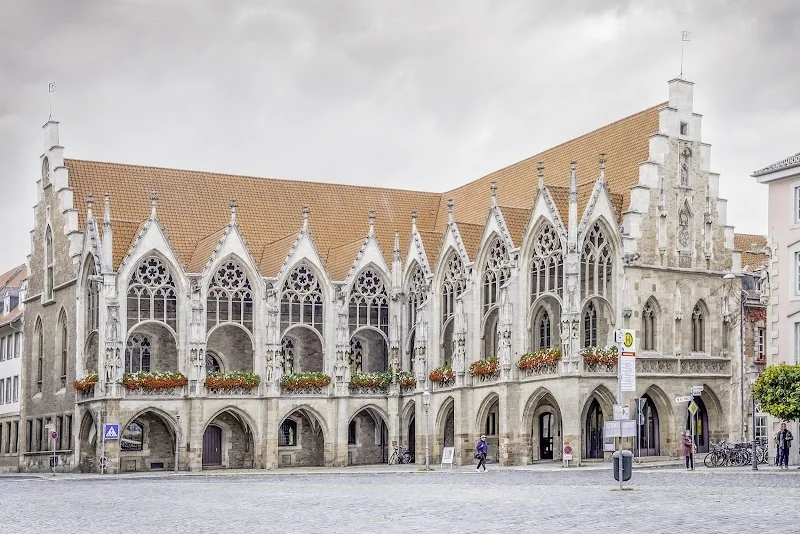
Altstadtmarkt 7, Braunschweig
Altstadtmarkt 7, 38100 Braunschweig, Germany
Old Town Hall | History & Opening Hours
The Old Town Hall Braunschweig at Altstadtmarkt 7 is much more than a striking monument in the center of the Lion City. It is one of the most significant medieval secular buildings in Germany and combines architecture, urban history, and museum visits in one place. The Municipal Museum Braunschweig showcases the history of the city from its beginnings to modern times; at the same time, the building itself forms an important piece of Braunschweig's identity. Those searching for Old Town Hall Braunschweig, Old Town Hall Museum, Old Town Hall History, or Old Town Hall Opening Hours will find a place that continues to shape the character of the city to this day. Particularly appealing is the location directly at Altstadtmarkt, one of the most historically significant squares in Braunschweig, whose ensemble of Town Hall, St. Martini, Gewandhaus, and Marienbrunnen almost automatically connects the visit with a tour of the historic center. The house is therefore not only interesting for culture enthusiasts but also for anyone wanting to experience an authentic piece of Braunschweig's Old Town. ([braunschweig.de](https://www.braunschweig.de/kultur/museen/staedtisches-museum/2haeuser.php))
Opening Hours, Admission, and Your Visit to the Old Town Hall
For practical visits, it is especially important: The Municipal Museum in the Old Town Hall is open from Tuesday to Sunday from 10 AM to 5 PM. It is closed on Good Friday and Whit Monday. The address Altstadtmarkt 7 is located in the city center and is easy to find, as the Town Hall is directly at Altstadtmarkt. Those coming with children benefit from the fact that the museum is explicitly described as a place where children can experience the house in a playful way. Thus, the visit becomes not only a classic museum round but also a family-friendly outing with lively mediation. For inquiries such as Old Town Hall Braunschweig Opening Hours or Old Town Hall Braunschweig Museum, this basic information is particularly relevant, as it allows for a clean planning of the visit and simultaneously shows that the museum is firmly anchored in the everyday life of the city. ([braunschweig.de](https://www.braunschweig.de/vv/oe/IV/0413/0413_1/altstadtrathaus.php))
Even those specifically searching for upcoming events at the Old Town Hall or Old Town Hall Braunschweig events will find regularly updated occasions and museum educational offerings here. Particularly attractive are the free public tours in the Old Town Hall, offered by volunteer staff: Saturdays at 3:00 PM, without registration for individuals and small groups of up to five people. The focus is on 800 years of Braunschweig city history. Additionally, the museum's website provides information on current topics and special contents, such as the new thematic island for the 150th anniversary of the Braunschweig professional fire department, which will be displayed in the Old Town Hall from September 23, 2025. Those planning a visit can therefore not only view the permanent exhibition but also experience current highlights. This is exactly what makes the place interesting for repeat visits: The historic building remains impressively unchanged, while the museum contents continually open new perspectives on Braunschweig's past and present. ([braunschweig.de](https://www.braunschweig.de/kultur/museen/staedtisches-museum/artikelpool-dauerhaft/buchbare-fuehrungen-loewenwall_359944.php))
History of the Old Town Hall in Braunschweig
The history of the Old Town Hall dates back deep into the Middle Ages. The west wing was built around 1250; the two-story Gothic arcades were added between 1393 and 1396, and the north wing, with its associated arcades dating from the mid-15th century, also comes from the same period. The Town Hall was constructed in several phases and is in constant design relationship with the neighboring St. Martin's Church. Even today, this architectural proximity shows how closely city representation, religion, and representation were intertwined in medieval Braunschweig. The functional use of the individual floors also speaks a clear language: The basement and ground floor once served as an arsenal, prison, torture chamber, sales stalls, and storage, while the upper floor was home to political and representative tasks. The house is therefore not just a pretty backdrop but an authentic testimony to urban power and everyday history. ([braunschweig.de](https://www.braunschweig.de/tourismus/ueber-braunschweig/sehenswuerdigkeiten/blik/kulturdenkmaeler/altstadtrathaus.php))
The Municipal Museum describes the Old Town Hall as one of the most significant medieval buildings in Germany, whose construction lasted from the 13th to the mid-15th century. This classification makes it understandable why the house is so relevant for the search intention Old Town Hall Braunschweig History. In the vaults of the basement, the exhibition shows how the rich and politically self-confident Hanseatic city of Braunschweig developed in the Middle Ages. Highlights include testimonies from the reign of Duke Henry the Lion, the first seal of the city, and the state coat of arms of the Duchy of Braunschweig-Lüneburg. At the same time, the museum tells of Braunschweig as a factually free bourgeois city without noble rule from about 1430 to 1671. Later, the history of the princely residence city comes into focus before the industrial development of the 19th century shifts the focus to technology and production. Thus, the Old Town Hall becomes a place where several epochs seamlessly intertwine, and the city history unfolds in clearly readable layers. ([braunschweig.de](https://www.braunschweig.de/kultur/museen/staedtisches-museum/2haeuser.php))
The Dornse: Council Chamber, Homages, and Tapestry
Those searching for Old Town Hall Dornse Braunschweig will come across a room with special historical radiance. The Great Dornse is the heated room on the upper floor of the Old Town Hall. Here, the city council convened, homage ceremonies for the dukes took place, and receptions and festive banquets were held. The Dornse was therefore not just a hall but a stage for political self-representation and urban representation. Especially in a building like the Old Town Hall, it becomes clear how closely administration, festive culture, and symbols of power are interconnected. For visitors, this room is particularly exciting because it makes the medieval Town Hall experienceable not only as a museum building but as an authentic place of urban decision-making processes. Those looking for photos or impressions of the interior benefit from the special atmosphere of the Dornse and from the changing perspectives that the historical furniture, surfaces, and spatial effects make visible. ([braunschweig.de](https://www.braunschweig.de/tourismus/ueber-braunschweig/sehenswuerdigkeiten/blik/kulturdenkmaeler/altstadtrathaus.php))
An outstanding detail of the Great Dornse is the monumental tapestry by Karl Wollermann from 1959. The tapestry measures 4.00 by 8.00 meters and depicts the cityscape of Braunschweig in a stylized form, featuring prominent churches, half-timbered buildings such as the Old Scale, the Library, and a contemporary university building. The commission was awarded by the city in 1959, also for acoustic reasons, and in 1960 the Great Dornse was ceremoniously reopened after war-related renovation work. The tapestry is thus not only a decorative element but also a piece of reconstruction history. For users searching for Old Town Hall photos or a visual representation, the interactive tour of the city is also interesting: it shows detailed views of the images and the tapestry in 360 degrees. This way, the spatial effect can be grasped even before the visit, and the special connection between architecture, art, and memory becomes clear. ([braunschweig.de](https://www.braunschweig.de/kultur/museen/staedtisches-museum/artikelpool-dauerhaft/der-wandteppich-von-karl-wollermann-in-der-grossen-dornse.php))
Permanent Exhibition and City History in the Museum Area
The Old Town Hall is primarily significant for its permanent exhibition on city history. On the ground floor and in the historical vaults below, the Municipal Museum Braunschweig shows how the city developed from its founding to the beginning of the 20th century. The exhibition makes Braunschweig visible as a medieval, self-confident trading city and later leads into the era of the residence city, into the bourgeois urban society, and finally into modernity. For visitors, this is particularly appealing because the exhibition does not tell abstractly but works with original objects. Among other things, goldsmith works, armor, paintings, Rococo clothing, and historical treasures are mentioned. This makes the city history tangible as material history. Those searching for Old Town Hall Braunschweig Exhibition or Old Town Hall Braunschweig Permanent Exhibition will therefore not receive a purely textual retrospective here but a very concrete, object-based museum experience. ([braunschweig.de](https://www.braunschweig.de/kultur/museen/staedtisches-museum/2haeuser.php))
Another focus is the industrial history of Braunschweig, which is presented in the Gaußsaal with the permanent exhibition Human, Machine! Here, important stages of industrial development become visible: early motorcycles, a ROLLEI camera, and other significant pieces from the city's technical history. The exhibition shows how Braunschweig developed into an industrial city in the 19th century, supported by technology and natural science promotion as well as the expansion of mechanical engineering. Currently, a thematic island for the 150th anniversary of the Braunschweig professional fire department complements the offerings and opens a view of fire protection, technical innovations, and human engagement. The permanent exhibition in the Old Town Hall is particularly attractive because admission to the Human, Machine! presentation is free and the visit can be easily combined with a tour of the Old Town. This combination of free access, historical depth, and clear thematic structure makes the house equally interesting for families, individual visitors, and culture enthusiasts. ([braunschweig.de](https://www.braunschweig.de/kultur/museen/staedtisches-museum/a-aktuelle-ausstellungen.php))
Events, Tours, and Current Topics
The Old Town Hall is not only used as a museum but also for municipal purposes and representative occasions. The usage and fee regulations of the city of Braunschweig state that the Old Town Hall is primarily used for municipal events and can only be made available for other uses if the building is not needed for that purpose and the intended use is compatible with the cultural-historical significance of the house. This regulation shows that the house retains a public character and is not treated as an arbitrarily bookable event space. Therefore, those searching for Old Town Hall Braunschweig events or Old Town Hall upcoming events are essentially looking for a place where city history and current urban life come together. The building thus remains part of the official Braunschweig cultural and administrative structure and is not merely an exhibition object. ([braunschweig.de](https://www.braunschweig.de/politik_verwaltung/politik/stadtrecht/Benutzungs-und-Entgeltordnung-fuer-das-Altstadtrathaus-und-das-Schloss-Richmond-2023.pdf))
For visitors, the tour offerings are especially important. The volunteer staff of the museum in the Old Town Hall offers public tours on the topic of 800 years of Braunschweig city history. These take place every Saturday at 3:00 PM, are free of charge, and do not require registration for individuals and small groups of up to five people. Those who want to keep an eye on current developments should regularly check the museum's website, as current exhibitions, projects, and new thematic islands are published there. For inquiries such as Old Town Hall Braunschweig Museum, Old Town Hall Braunschweig Exhibition, or Old Town Hall Braunschweig Permanent Exhibition, this mixture is crucial: The house offers a fixed content structure but remains lively through changing accents. Thus, the visit is also interesting for returning guests, as new access points to the city history continually emerge. ([braunschweig.de](https://www.braunschweig.de/kultur/museen/staedtisches-museum/artikelpool-dauerhaft/buchbare-fuehrungen-loewenwall_359944.php))
Location at Altstadtmarkt, Access, and Surroundings
The location of the Old Town Hall is one of its greatest advantages. It stands at Altstadtmarkt, one of the most significant square spaces in Braunschweig. Altstadtmarkt has been used for centuries, was the main market in the Middle Ages, a fairground, a year market, a place of execution, and a site for equestrian games, homages, and processions. Together with St. Martin's Church, the Old Customs House, and the Gewandhaus, the Town Hall forms a particularly cohesive historical ensemble. The market itself was established around 1130 and has preserved its urban profile over the centuries. Therefore, those visiting the Old Town Hall experience not just a single building but an urban structure where Braunschweig's history is present in a very compact space. Especially for visitors looking for Old Town Hall photos or an atmospheric tour, this environment is a real added value, as the square itself has a strong photographic and historical impact. ([braunschweig.de](https://www.braunschweig.de/altstadtmarkt))
Access is also straightforward. Across from the Old Town Hall lies the weekly market Altstadtmarkt; just a few meters away, there are some short-term parking spaces at St. Martin's Church. The Eiermarkt parking garage, with several hundred parking spaces, is also located right there. Those arriving by public transport will also find good conditions: Bus lines 411, 413, 416, 418, 422, 423, 450, 480, and 560 stop directly at the market. This makes the visit particularly pleasant for people who want to explore the historic center without long distances. A short, very dense city tour can be planned between the Old Town Hall, the market, St. Martin's Church, and surrounding buildings. For all those who want to combine Old Town Hall Braunschweig Opening Hours with a visit to the Old Town, this is optimal, as culture, everyday life, and city strolling connect in a compact space. Thus, the Old Town Hall becomes a clear point of contact for a half-day program or a spontaneous museum visit right in the historical heart of Braunschweig. ([braunschweig.de](https://www.braunschweig.de/leben/einkaufen_maerkte/wochenmaerkte/wm_altstadtmarkt.php))
Sources:
- City of Braunschweig – Old Town Hall
- City of Braunschweig – Municipal Museum Braunschweig, Old Town Hall
- City of Braunschweig – Municipal Museum Braunschweig
- City of Braunschweig – Public Tours in the Old Town Hall
- City of Braunschweig – Current Exhibitions in the Municipal Museum
- City of Braunschweig – The Tapestry by Karl Wollermann in the Great Dornse
- City of Braunschweig – Weekly Market Altstadtmarkt
Show moreShow less
Old Town Hall | History & Opening Hours
The Old Town Hall Braunschweig at Altstadtmarkt 7 is much more than a striking monument in the center of the Lion City. It is one of the most significant medieval secular buildings in Germany and combines architecture, urban history, and museum visits in one place. The Municipal Museum Braunschweig showcases the history of the city from its beginnings to modern times; at the same time, the building itself forms an important piece of Braunschweig's identity. Those searching for Old Town Hall Braunschweig, Old Town Hall Museum, Old Town Hall History, or Old Town Hall Opening Hours will find a place that continues to shape the character of the city to this day. Particularly appealing is the location directly at Altstadtmarkt, one of the most historically significant squares in Braunschweig, whose ensemble of Town Hall, St. Martini, Gewandhaus, and Marienbrunnen almost automatically connects the visit with a tour of the historic center. The house is therefore not only interesting for culture enthusiasts but also for anyone wanting to experience an authentic piece of Braunschweig's Old Town. ([braunschweig.de](https://www.braunschweig.de/kultur/museen/staedtisches-museum/2haeuser.php))
Opening Hours, Admission, and Your Visit to the Old Town Hall
For practical visits, it is especially important: The Municipal Museum in the Old Town Hall is open from Tuesday to Sunday from 10 AM to 5 PM. It is closed on Good Friday and Whit Monday. The address Altstadtmarkt 7 is located in the city center and is easy to find, as the Town Hall is directly at Altstadtmarkt. Those coming with children benefit from the fact that the museum is explicitly described as a place where children can experience the house in a playful way. Thus, the visit becomes not only a classic museum round but also a family-friendly outing with lively mediation. For inquiries such as Old Town Hall Braunschweig Opening Hours or Old Town Hall Braunschweig Museum, this basic information is particularly relevant, as it allows for a clean planning of the visit and simultaneously shows that the museum is firmly anchored in the everyday life of the city. ([braunschweig.de](https://www.braunschweig.de/vv/oe/IV/0413/0413_1/altstadtrathaus.php))
Even those specifically searching for upcoming events at the Old Town Hall or Old Town Hall Braunschweig events will find regularly updated occasions and museum educational offerings here. Particularly attractive are the free public tours in the Old Town Hall, offered by volunteer staff: Saturdays at 3:00 PM, without registration for individuals and small groups of up to five people. The focus is on 800 years of Braunschweig city history. Additionally, the museum's website provides information on current topics and special contents, such as the new thematic island for the 150th anniversary of the Braunschweig professional fire department, which will be displayed in the Old Town Hall from September 23, 2025. Those planning a visit can therefore not only view the permanent exhibition but also experience current highlights. This is exactly what makes the place interesting for repeat visits: The historic building remains impressively unchanged, while the museum contents continually open new perspectives on Braunschweig's past and present. ([braunschweig.de](https://www.braunschweig.de/kultur/museen/staedtisches-museum/artikelpool-dauerhaft/buchbare-fuehrungen-loewenwall_359944.php))
History of the Old Town Hall in Braunschweig
The history of the Old Town Hall dates back deep into the Middle Ages. The west wing was built around 1250; the two-story Gothic arcades were added between 1393 and 1396, and the north wing, with its associated arcades dating from the mid-15th century, also comes from the same period. The Town Hall was constructed in several phases and is in constant design relationship with the neighboring St. Martin's Church. Even today, this architectural proximity shows how closely city representation, religion, and representation were intertwined in medieval Braunschweig. The functional use of the individual floors also speaks a clear language: The basement and ground floor once served as an arsenal, prison, torture chamber, sales stalls, and storage, while the upper floor was home to political and representative tasks. The house is therefore not just a pretty backdrop but an authentic testimony to urban power and everyday history. ([braunschweig.de](https://www.braunschweig.de/tourismus/ueber-braunschweig/sehenswuerdigkeiten/blik/kulturdenkmaeler/altstadtrathaus.php))
The Municipal Museum describes the Old Town Hall as one of the most significant medieval buildings in Germany, whose construction lasted from the 13th to the mid-15th century. This classification makes it understandable why the house is so relevant for the search intention Old Town Hall Braunschweig History. In the vaults of the basement, the exhibition shows how the rich and politically self-confident Hanseatic city of Braunschweig developed in the Middle Ages. Highlights include testimonies from the reign of Duke Henry the Lion, the first seal of the city, and the state coat of arms of the Duchy of Braunschweig-Lüneburg. At the same time, the museum tells of Braunschweig as a factually free bourgeois city without noble rule from about 1430 to 1671. Later, the history of the princely residence city comes into focus before the industrial development of the 19th century shifts the focus to technology and production. Thus, the Old Town Hall becomes a place where several epochs seamlessly intertwine, and the city history unfolds in clearly readable layers. ([braunschweig.de](https://www.braunschweig.de/kultur/museen/staedtisches-museum/2haeuser.php))
The Dornse: Council Chamber, Homages, and Tapestry
Those searching for Old Town Hall Dornse Braunschweig will come across a room with special historical radiance. The Great Dornse is the heated room on the upper floor of the Old Town Hall. Here, the city council convened, homage ceremonies for the dukes took place, and receptions and festive banquets were held. The Dornse was therefore not just a hall but a stage for political self-representation and urban representation. Especially in a building like the Old Town Hall, it becomes clear how closely administration, festive culture, and symbols of power are interconnected. For visitors, this room is particularly exciting because it makes the medieval Town Hall experienceable not only as a museum building but as an authentic place of urban decision-making processes. Those looking for photos or impressions of the interior benefit from the special atmosphere of the Dornse and from the changing perspectives that the historical furniture, surfaces, and spatial effects make visible. ([braunschweig.de](https://www.braunschweig.de/tourismus/ueber-braunschweig/sehenswuerdigkeiten/blik/kulturdenkmaeler/altstadtrathaus.php))
An outstanding detail of the Great Dornse is the monumental tapestry by Karl Wollermann from 1959. The tapestry measures 4.00 by 8.00 meters and depicts the cityscape of Braunschweig in a stylized form, featuring prominent churches, half-timbered buildings such as the Old Scale, the Library, and a contemporary university building. The commission was awarded by the city in 1959, also for acoustic reasons, and in 1960 the Great Dornse was ceremoniously reopened after war-related renovation work. The tapestry is thus not only a decorative element but also a piece of reconstruction history. For users searching for Old Town Hall photos or a visual representation, the interactive tour of the city is also interesting: it shows detailed views of the images and the tapestry in 360 degrees. This way, the spatial effect can be grasped even before the visit, and the special connection between architecture, art, and memory becomes clear. ([braunschweig.de](https://www.braunschweig.de/kultur/museen/staedtisches-museum/artikelpool-dauerhaft/der-wandteppich-von-karl-wollermann-in-der-grossen-dornse.php))
Permanent Exhibition and City History in the Museum Area
The Old Town Hall is primarily significant for its permanent exhibition on city history. On the ground floor and in the historical vaults below, the Municipal Museum Braunschweig shows how the city developed from its founding to the beginning of the 20th century. The exhibition makes Braunschweig visible as a medieval, self-confident trading city and later leads into the era of the residence city, into the bourgeois urban society, and finally into modernity. For visitors, this is particularly appealing because the exhibition does not tell abstractly but works with original objects. Among other things, goldsmith works, armor, paintings, Rococo clothing, and historical treasures are mentioned. This makes the city history tangible as material history. Those searching for Old Town Hall Braunschweig Exhibition or Old Town Hall Braunschweig Permanent Exhibition will therefore not receive a purely textual retrospective here but a very concrete, object-based museum experience. ([braunschweig.de](https://www.braunschweig.de/kultur/museen/staedtisches-museum/2haeuser.php))
Another focus is the industrial history of Braunschweig, which is presented in the Gaußsaal with the permanent exhibition Human, Machine! Here, important stages of industrial development become visible: early motorcycles, a ROLLEI camera, and other significant pieces from the city's technical history. The exhibition shows how Braunschweig developed into an industrial city in the 19th century, supported by technology and natural science promotion as well as the expansion of mechanical engineering. Currently, a thematic island for the 150th anniversary of the Braunschweig professional fire department complements the offerings and opens a view of fire protection, technical innovations, and human engagement. The permanent exhibition in the Old Town Hall is particularly attractive because admission to the Human, Machine! presentation is free and the visit can be easily combined with a tour of the Old Town. This combination of free access, historical depth, and clear thematic structure makes the house equally interesting for families, individual visitors, and culture enthusiasts. ([braunschweig.de](https://www.braunschweig.de/kultur/museen/staedtisches-museum/a-aktuelle-ausstellungen.php))
Events, Tours, and Current Topics
The Old Town Hall is not only used as a museum but also for municipal purposes and representative occasions. The usage and fee regulations of the city of Braunschweig state that the Old Town Hall is primarily used for municipal events and can only be made available for other uses if the building is not needed for that purpose and the intended use is compatible with the cultural-historical significance of the house. This regulation shows that the house retains a public character and is not treated as an arbitrarily bookable event space. Therefore, those searching for Old Town Hall Braunschweig events or Old Town Hall upcoming events are essentially looking for a place where city history and current urban life come together. The building thus remains part of the official Braunschweig cultural and administrative structure and is not merely an exhibition object. ([braunschweig.de](https://www.braunschweig.de/politik_verwaltung/politik/stadtrecht/Benutzungs-und-Entgeltordnung-fuer-das-Altstadtrathaus-und-das-Schloss-Richmond-2023.pdf))
For visitors, the tour offerings are especially important. The volunteer staff of the museum in the Old Town Hall offers public tours on the topic of 800 years of Braunschweig city history. These take place every Saturday at 3:00 PM, are free of charge, and do not require registration for individuals and small groups of up to five people. Those who want to keep an eye on current developments should regularly check the museum's website, as current exhibitions, projects, and new thematic islands are published there. For inquiries such as Old Town Hall Braunschweig Museum, Old Town Hall Braunschweig Exhibition, or Old Town Hall Braunschweig Permanent Exhibition, this mixture is crucial: The house offers a fixed content structure but remains lively through changing accents. Thus, the visit is also interesting for returning guests, as new access points to the city history continually emerge. ([braunschweig.de](https://www.braunschweig.de/kultur/museen/staedtisches-museum/artikelpool-dauerhaft/buchbare-fuehrungen-loewenwall_359944.php))
Location at Altstadtmarkt, Access, and Surroundings
The location of the Old Town Hall is one of its greatest advantages. It stands at Altstadtmarkt, one of the most significant square spaces in Braunschweig. Altstadtmarkt has been used for centuries, was the main market in the Middle Ages, a fairground, a year market, a place of execution, and a site for equestrian games, homages, and processions. Together with St. Martin's Church, the Old Customs House, and the Gewandhaus, the Town Hall forms a particularly cohesive historical ensemble. The market itself was established around 1130 and has preserved its urban profile over the centuries. Therefore, those visiting the Old Town Hall experience not just a single building but an urban structure where Braunschweig's history is present in a very compact space. Especially for visitors looking for Old Town Hall photos or an atmospheric tour, this environment is a real added value, as the square itself has a strong photographic and historical impact. ([braunschweig.de](https://www.braunschweig.de/altstadtmarkt))
Access is also straightforward. Across from the Old Town Hall lies the weekly market Altstadtmarkt; just a few meters away, there are some short-term parking spaces at St. Martin's Church. The Eiermarkt parking garage, with several hundred parking spaces, is also located right there. Those arriving by public transport will also find good conditions: Bus lines 411, 413, 416, 418, 422, 423, 450, 480, and 560 stop directly at the market. This makes the visit particularly pleasant for people who want to explore the historic center without long distances. A short, very dense city tour can be planned between the Old Town Hall, the market, St. Martin's Church, and surrounding buildings. For all those who want to combine Old Town Hall Braunschweig Opening Hours with a visit to the Old Town, this is optimal, as culture, everyday life, and city strolling connect in a compact space. Thus, the Old Town Hall becomes a clear point of contact for a half-day program or a spontaneous museum visit right in the historical heart of Braunschweig. ([braunschweig.de](https://www.braunschweig.de/leben/einkaufen_maerkte/wochenmaerkte/wm_altstadtmarkt.php))
Sources:
- City of Braunschweig – Old Town Hall
- City of Braunschweig – Municipal Museum Braunschweig, Old Town Hall
- City of Braunschweig – Municipal Museum Braunschweig
- City of Braunschweig – Public Tours in the Old Town Hall
- City of Braunschweig – Current Exhibitions in the Municipal Museum
- City of Braunschweig – The Tapestry by Karl Wollermann in the Great Dornse
- City of Braunschweig – Weekly Market Altstadtmarkt
Old Town Hall | History & Opening Hours
The Old Town Hall Braunschweig at Altstadtmarkt 7 is much more than a striking monument in the center of the Lion City. It is one of the most significant medieval secular buildings in Germany and combines architecture, urban history, and museum visits in one place. The Municipal Museum Braunschweig showcases the history of the city from its beginnings to modern times; at the same time, the building itself forms an important piece of Braunschweig's identity. Those searching for Old Town Hall Braunschweig, Old Town Hall Museum, Old Town Hall History, or Old Town Hall Opening Hours will find a place that continues to shape the character of the city to this day. Particularly appealing is the location directly at Altstadtmarkt, one of the most historically significant squares in Braunschweig, whose ensemble of Town Hall, St. Martini, Gewandhaus, and Marienbrunnen almost automatically connects the visit with a tour of the historic center. The house is therefore not only interesting for culture enthusiasts but also for anyone wanting to experience an authentic piece of Braunschweig's Old Town. ([braunschweig.de](https://www.braunschweig.de/kultur/museen/staedtisches-museum/2haeuser.php))
Opening Hours, Admission, and Your Visit to the Old Town Hall
For practical visits, it is especially important: The Municipal Museum in the Old Town Hall is open from Tuesday to Sunday from 10 AM to 5 PM. It is closed on Good Friday and Whit Monday. The address Altstadtmarkt 7 is located in the city center and is easy to find, as the Town Hall is directly at Altstadtmarkt. Those coming with children benefit from the fact that the museum is explicitly described as a place where children can experience the house in a playful way. Thus, the visit becomes not only a classic museum round but also a family-friendly outing with lively mediation. For inquiries such as Old Town Hall Braunschweig Opening Hours or Old Town Hall Braunschweig Museum, this basic information is particularly relevant, as it allows for a clean planning of the visit and simultaneously shows that the museum is firmly anchored in the everyday life of the city. ([braunschweig.de](https://www.braunschweig.de/vv/oe/IV/0413/0413_1/altstadtrathaus.php))
Even those specifically searching for upcoming events at the Old Town Hall or Old Town Hall Braunschweig events will find regularly updated occasions and museum educational offerings here. Particularly attractive are the free public tours in the Old Town Hall, offered by volunteer staff: Saturdays at 3:00 PM, without registration for individuals and small groups of up to five people. The focus is on 800 years of Braunschweig city history. Additionally, the museum's website provides information on current topics and special contents, such as the new thematic island for the 150th anniversary of the Braunschweig professional fire department, which will be displayed in the Old Town Hall from September 23, 2025. Those planning a visit can therefore not only view the permanent exhibition but also experience current highlights. This is exactly what makes the place interesting for repeat visits: The historic building remains impressively unchanged, while the museum contents continually open new perspectives on Braunschweig's past and present. ([braunschweig.de](https://www.braunschweig.de/kultur/museen/staedtisches-museum/artikelpool-dauerhaft/buchbare-fuehrungen-loewenwall_359944.php))
History of the Old Town Hall in Braunschweig
The history of the Old Town Hall dates back deep into the Middle Ages. The west wing was built around 1250; the two-story Gothic arcades were added between 1393 and 1396, and the north wing, with its associated arcades dating from the mid-15th century, also comes from the same period. The Town Hall was constructed in several phases and is in constant design relationship with the neighboring St. Martin's Church. Even today, this architectural proximity shows how closely city representation, religion, and representation were intertwined in medieval Braunschweig. The functional use of the individual floors also speaks a clear language: The basement and ground floor once served as an arsenal, prison, torture chamber, sales stalls, and storage, while the upper floor was home to political and representative tasks. The house is therefore not just a pretty backdrop but an authentic testimony to urban power and everyday history. ([braunschweig.de](https://www.braunschweig.de/tourismus/ueber-braunschweig/sehenswuerdigkeiten/blik/kulturdenkmaeler/altstadtrathaus.php))
The Municipal Museum describes the Old Town Hall as one of the most significant medieval buildings in Germany, whose construction lasted from the 13th to the mid-15th century. This classification makes it understandable why the house is so relevant for the search intention Old Town Hall Braunschweig History. In the vaults of the basement, the exhibition shows how the rich and politically self-confident Hanseatic city of Braunschweig developed in the Middle Ages. Highlights include testimonies from the reign of Duke Henry the Lion, the first seal of the city, and the state coat of arms of the Duchy of Braunschweig-Lüneburg. At the same time, the museum tells of Braunschweig as a factually free bourgeois city without noble rule from about 1430 to 1671. Later, the history of the princely residence city comes into focus before the industrial development of the 19th century shifts the focus to technology and production. Thus, the Old Town Hall becomes a place where several epochs seamlessly intertwine, and the city history unfolds in clearly readable layers. ([braunschweig.de](https://www.braunschweig.de/kultur/museen/staedtisches-museum/2haeuser.php))
The Dornse: Council Chamber, Homages, and Tapestry
Those searching for Old Town Hall Dornse Braunschweig will come across a room with special historical radiance. The Great Dornse is the heated room on the upper floor of the Old Town Hall. Here, the city council convened, homage ceremonies for the dukes took place, and receptions and festive banquets were held. The Dornse was therefore not just a hall but a stage for political self-representation and urban representation. Especially in a building like the Old Town Hall, it becomes clear how closely administration, festive culture, and symbols of power are interconnected. For visitors, this room is particularly exciting because it makes the medieval Town Hall experienceable not only as a museum building but as an authentic place of urban decision-making processes. Those looking for photos or impressions of the interior benefit from the special atmosphere of the Dornse and from the changing perspectives that the historical furniture, surfaces, and spatial effects make visible. ([braunschweig.de](https://www.braunschweig.de/tourismus/ueber-braunschweig/sehenswuerdigkeiten/blik/kulturdenkmaeler/altstadtrathaus.php))
An outstanding detail of the Great Dornse is the monumental tapestry by Karl Wollermann from 1959. The tapestry measures 4.00 by 8.00 meters and depicts the cityscape of Braunschweig in a stylized form, featuring prominent churches, half-timbered buildings such as the Old Scale, the Library, and a contemporary university building. The commission was awarded by the city in 1959, also for acoustic reasons, and in 1960 the Great Dornse was ceremoniously reopened after war-related renovation work. The tapestry is thus not only a decorative element but also a piece of reconstruction history. For users searching for Old Town Hall photos or a visual representation, the interactive tour of the city is also interesting: it shows detailed views of the images and the tapestry in 360 degrees. This way, the spatial effect can be grasped even before the visit, and the special connection between architecture, art, and memory becomes clear. ([braunschweig.de](https://www.braunschweig.de/kultur/museen/staedtisches-museum/artikelpool-dauerhaft/der-wandteppich-von-karl-wollermann-in-der-grossen-dornse.php))
Permanent Exhibition and City History in the Museum Area
The Old Town Hall is primarily significant for its permanent exhibition on city history. On the ground floor and in the historical vaults below, the Municipal Museum Braunschweig shows how the city developed from its founding to the beginning of the 20th century. The exhibition makes Braunschweig visible as a medieval, self-confident trading city and later leads into the era of the residence city, into the bourgeois urban society, and finally into modernity. For visitors, this is particularly appealing because the exhibition does not tell abstractly but works with original objects. Among other things, goldsmith works, armor, paintings, Rococo clothing, and historical treasures are mentioned. This makes the city history tangible as material history. Those searching for Old Town Hall Braunschweig Exhibition or Old Town Hall Braunschweig Permanent Exhibition will therefore not receive a purely textual retrospective here but a very concrete, object-based museum experience. ([braunschweig.de](https://www.braunschweig.de/kultur/museen/staedtisches-museum/2haeuser.php))
Another focus is the industrial history of Braunschweig, which is presented in the Gaußsaal with the permanent exhibition Human, Machine! Here, important stages of industrial development become visible: early motorcycles, a ROLLEI camera, and other significant pieces from the city's technical history. The exhibition shows how Braunschweig developed into an industrial city in the 19th century, supported by technology and natural science promotion as well as the expansion of mechanical engineering. Currently, a thematic island for the 150th anniversary of the Braunschweig professional fire department complements the offerings and opens a view of fire protection, technical innovations, and human engagement. The permanent exhibition in the Old Town Hall is particularly attractive because admission to the Human, Machine! presentation is free and the visit can be easily combined with a tour of the Old Town. This combination of free access, historical depth, and clear thematic structure makes the house equally interesting for families, individual visitors, and culture enthusiasts. ([braunschweig.de](https://www.braunschweig.de/kultur/museen/staedtisches-museum/a-aktuelle-ausstellungen.php))
Events, Tours, and Current Topics
The Old Town Hall is not only used as a museum but also for municipal purposes and representative occasions. The usage and fee regulations of the city of Braunschweig state that the Old Town Hall is primarily used for municipal events and can only be made available for other uses if the building is not needed for that purpose and the intended use is compatible with the cultural-historical significance of the house. This regulation shows that the house retains a public character and is not treated as an arbitrarily bookable event space. Therefore, those searching for Old Town Hall Braunschweig events or Old Town Hall upcoming events are essentially looking for a place where city history and current urban life come together. The building thus remains part of the official Braunschweig cultural and administrative structure and is not merely an exhibition object. ([braunschweig.de](https://www.braunschweig.de/politik_verwaltung/politik/stadtrecht/Benutzungs-und-Entgeltordnung-fuer-das-Altstadtrathaus-und-das-Schloss-Richmond-2023.pdf))
For visitors, the tour offerings are especially important. The volunteer staff of the museum in the Old Town Hall offers public tours on the topic of 800 years of Braunschweig city history. These take place every Saturday at 3:00 PM, are free of charge, and do not require registration for individuals and small groups of up to five people. Those who want to keep an eye on current developments should regularly check the museum's website, as current exhibitions, projects, and new thematic islands are published there. For inquiries such as Old Town Hall Braunschweig Museum, Old Town Hall Braunschweig Exhibition, or Old Town Hall Braunschweig Permanent Exhibition, this mixture is crucial: The house offers a fixed content structure but remains lively through changing accents. Thus, the visit is also interesting for returning guests, as new access points to the city history continually emerge. ([braunschweig.de](https://www.braunschweig.de/kultur/museen/staedtisches-museum/artikelpool-dauerhaft/buchbare-fuehrungen-loewenwall_359944.php))
Location at Altstadtmarkt, Access, and Surroundings
The location of the Old Town Hall is one of its greatest advantages. It stands at Altstadtmarkt, one of the most significant square spaces in Braunschweig. Altstadtmarkt has been used for centuries, was the main market in the Middle Ages, a fairground, a year market, a place of execution, and a site for equestrian games, homages, and processions. Together with St. Martin's Church, the Old Customs House, and the Gewandhaus, the Town Hall forms a particularly cohesive historical ensemble. The market itself was established around 1130 and has preserved its urban profile over the centuries. Therefore, those visiting the Old Town Hall experience not just a single building but an urban structure where Braunschweig's history is present in a very compact space. Especially for visitors looking for Old Town Hall photos or an atmospheric tour, this environment is a real added value, as the square itself has a strong photographic and historical impact. ([braunschweig.de](https://www.braunschweig.de/altstadtmarkt))
Access is also straightforward. Across from the Old Town Hall lies the weekly market Altstadtmarkt; just a few meters away, there are some short-term parking spaces at St. Martin's Church. The Eiermarkt parking garage, with several hundred parking spaces, is also located right there. Those arriving by public transport will also find good conditions: Bus lines 411, 413, 416, 418, 422, 423, 450, 480, and 560 stop directly at the market. This makes the visit particularly pleasant for people who want to explore the historic center without long distances. A short, very dense city tour can be planned between the Old Town Hall, the market, St. Martin's Church, and surrounding buildings. For all those who want to combine Old Town Hall Braunschweig Opening Hours with a visit to the Old Town, this is optimal, as culture, everyday life, and city strolling connect in a compact space. Thus, the Old Town Hall becomes a clear point of contact for a half-day program or a spontaneous museum visit right in the historical heart of Braunschweig. ([braunschweig.de](https://www.braunschweig.de/leben/einkaufen_maerkte/wochenmaerkte/wm_altstadtmarkt.php))
Sources:
- City of Braunschweig – Old Town Hall
- City of Braunschweig – Municipal Museum Braunschweig, Old Town Hall
- City of Braunschweig – Municipal Museum Braunschweig
- City of Braunschweig – Public Tours in the Old Town Hall
- City of Braunschweig – Current Exhibitions in the Municipal Museum
- City of Braunschweig – The Tapestry by Karl Wollermann in the Great Dornse
- City of Braunschweig – Weekly Market Altstadtmarkt
Upcoming Events
No events found
Frequently Asked Questions
Reviews
Basel Abu-Baker
26. February 2026
To see an old view of the Löwen city and great info explained, go there.
Alex Bransby
4. July 2022
Pretty old town hall in beautiful architecture. Close to other sites in the city and it surrounds a lovely open square with plenty of spaces to sit and relax. Stunning in the summer when it’s decorated with flowers, absolutely worth a visit when in Braunschweig...
Dima Key
16. January 2026
Amazing museum, it is small but a lot of staff can be learned in it.
Gemma C
18. January 2025
We really loved our visit to the museum. We were really impressed by the help and information given by a lovely volunteer who had so much knowledge to share about the city of Braunschweig. Would highly recommend!!
Nima Habashi
16. February 2024
This is an absolute must see in Braunschweig! You can see a lot of the old spirit of the city and you will be guided by very nice volunteers for free! So, take your time and go there if you are interested in history!