
György Kurtág
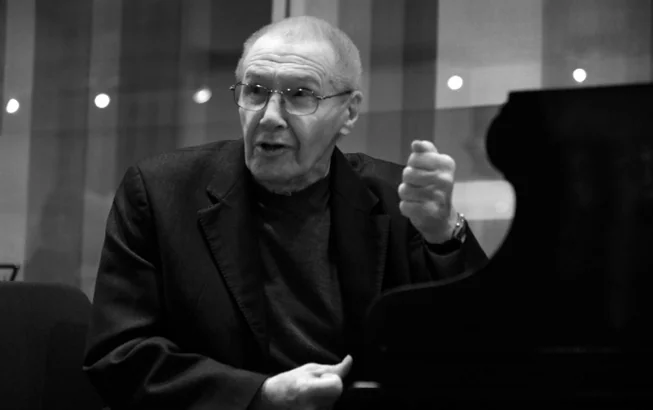
Image from Wikipedia
Image from Wikipedia
György Kurtág: The Master of Musical Miniature and the Art of Concentrated Intensity
A Life Dedicated to Compression: György Kurtág Between Silence, Expression, and Global Recognition
György Kurtág is one of the great individualists of contemporary music and one of the most precise sound thinkers of the 20th and 21st centuries. The Hungarian-French composer, pianist, and chamber music teacher was born on February 19, 1926, in Lugoj, and grew up in a multilingual, Central European environment that shaped his artistic perception early on. Today, he is considered one of the most internationally successful Hungarian composers after 1945 and the creator of music that unleashes maximum emotional tension in the smallest formats. ([universaledition.com](https://www.universaledition.com/en/News/Gyoergy-Kurtag-Turns-100-A-Global-Celebration-of-a-Musical-Visionary/))
Early Influences and Musical Background
Kurtág's artistic journey did not begin in a glamorous center but in a border region that inscribed cultural diversity into everyday life. In Lugoj, he early on spoke Hungarian, Romanian, and German; this multilingualism accompanied his thinking as did the intense engagement with pedagogy and piano artistry. His first influential teacher was the pianist and educator Magda Kardos, who sharpened his view on teaching and encouraged him to work with younger students. This teaching activity became not just a profession for Kurtág but part of his musical identity. ([universaledition.com](https://www.universaledition.com/en/News/Gyoergy-Kurtag-Turns-100-A-Global-Celebration-of-a-Musical-Visionary/))
At the Budapest Music Academy, Kurtág encountered György Ligeti again in 1946 and studied under Ferenc Farkas. The years in Budapest laid the foundation for a career that initially took a long time to reach international fame. It was the confrontation with the European avant-garde, particularly the sound worlds of Stockhausen and Ligeti, that opened new horizons for him. Kurtág copied scores by Webern, engaged with Pierre Boulez, and found a highly concentrated language where every note is charged functionally, psychologically, and formally. ([universaledition.com](https://www.universaledition.com/en/Contacts/Kurtag-Gyoergy/))
Paris, Crisis, and Turning Point: The Birth of a Unique Language
A crucial phase in his artistic development took place in 1957/58 in Paris. There, Kurtág studied with Olivier Messiaen and Darius Milhaud; concurrently, he sought support from psychologist Marianne Stein, whom he later described as crucial for overcoming a creative crisis. This period proved to be a biographical and aesthetic turning point: Kurtág returned to Budapest, but not as an imitator of the avant-garde, rather as a composer with his own, radically compressed approach to sound, gesture, and form. ([universaledition.com](https://www.universaledition.com/en/News/Gyoergy-Kurtag-Turns-100-A-Global-Celebration-of-a-Musical-Visionary/))
The return journey took him through Cologne, where he again encountered Ligeti and heard Stockhausen's Gruppen as well as Ligeti's Artikulation. These impressions had a lasting effect on his musical development. However, Kurtág did not take over from these encounters but rather intensified: his compositions became shorter, denser, and more expressive, as if he were condensing the entire drama of the 20th century into brief, glowing formulas. This earned him a reputation as a master of the miniature. ([universaledition.com](https://www.universaledition.com/en/Contacts/Kurtag-Gyoergy/))
The International Breakthrough and Late Recognition
Although Kurtág was considered an original mind early on, it wasn't until the late 1970s that his music garnered broader attention in Germany. The international breakthrough came in 1981 with the Paris premiere of Messages de feu demoiselle R. V. Troussova by the Ensemble intercontemporain under Sylvain Cambreling. From that point on, it became clear that Kurtág was not just a composite anomaly but a central voice in contemporary music, whose influence extends far beyond the new music scene. ([de.wikipedia.org](https://de.wikipedia.org/wiki/Gy%C3%B6rgy_Kurt%C3%A1g))
His career developed with unusual slowness and high consistency. While other composers solidified their rank through large catalogs and representative genres, Kurtág built a body of work whose sharpness lies precisely in its sparseness. His repertoire includes chamber music, choral works, vocal compositions, orchestral pieces, and operas, yet his handwriting remains discernible: fragment, density, concentration, and a language that creates both intimacy and mystery. ([de.wikipedia.org](https://de.wikipedia.org/wiki/Gy%C3%B6rgy_Kurt%C3%A1g))
Discography, Key Works, and Critical Reception
Some of Kurtág's most important works include the String Quartet op. 1, Acht Duos, Hommage à Mihály András, Officium Breve, Játékok, the Kafka-Fragmente, Stele, … quasi una fantasia …, the Double Concerto, Fin de partie, and his more recent opera Die Stechardin. These titles mark not only milestones in the evolution of his work but also an aesthetic movement from the miniature to scenic and orchestral expanses. Particularly, Játékok stands for Kurtág's way of thinking: play, gesture, memory, and musical reflection merge here into an open, continuously growing landscape of works. ([de.wikipedia.org](https://de.wikipedia.org/wiki/Gy%C3%B6rgy_Kurt%C3%A1g))
The critical reception consistently describes Kurtág as a composer of utmost precision. The Guardian praised his “exquisite, crystalline forms,” while other voices highlight his ability to condense “a whole world of expression and suggestion” into the tiniest musical constructs. Recent reviews also emphasize the sublime concentration of his sound language, which is defined not by volume or virtuoso poses, but by structure, tension, and the sensitive relationship between tone and silence. Kurtág is thus a composer whose discography resonates less through mass and more through depth. ([boosey.com](https://www.boosey.com/composer/Gy%C3%B6rgy%2BKurt%C3%A1g?utm_source=openai))
Style, Composition, and Musical Aesthetics
Kurtág's style is rooted in European art music, yet it is never mere tradition. His music is influenced by Bartók, Webern, and to a lesser extent Stravinsky; at the same time, it possesses an immediate expressiveness that eludes mere analysis. In his scores, concentration and gesture, hard contours and fragile hints converge. The result is a musical language that often tells more in a few bars than other composers do in elaborate sentences. ([en.wikipedia.org](https://en.wikipedia.org/wiki/Gy%C3%B6rgy_Kurt%C3%A1g?utm_source=openai))
This compression is particularly evident in his vocal works and chamber pieces, where text, timbre, and psychological impulse are closely intertwined. Kurtág does not work with decorative surfaces but rather with compositional reduction as an aesthetic principle. His music challenges performers to utmost attentiveness and rewards listeners with an experience that can be described more as listening for the essential rather than merely hearing. ([de.wikipedia.org](https://en.wikipedia.org/wiki/Gy%C3%B6rgy_Kurt%C3%A1g))
Awards, Institutions, and Cultural Authority
György Kurtág has been honored numerous times and is among the most decorated composers of his generation. Major accolades include the Ernst von Siemens Music Prize for his life’s work, the Grawemeyer Award, the Golden Lion at the Venice Biennale, and the BBVA Foundation Frontiers of Knowledge Award. He is also a member and honorary member of significant academies and societies, including the Bavarian Academy of Fine Arts, the Academy of Arts in Berlin, and the American Academy of Arts and Letters. ([boosey.com](https://www.boosey.com/composer/Gy%C3%B6rgy%2BKurt%C3%A1g?utm_source=openai))
His authority is based not only on awards but also on institutional presence. Kurtág was a professor at the Franz Liszt Music Academy in Budapest, where he shaped generations of musicians over decades. At the same time, he remained as a performer and teacher an artist of direct contact: chamber music, teaching, and the thinking about work formed a cohesive artistic field. This connection of practice, reflection, and artistic integrity makes his rank in music history so enduring. ([en.wikipedia.org](https://en.wikipedia.org/wiki/Gy%C3%B6rgy_Kurt%C3%A1g?utm_source=openai))
Current Projects and the Kurtág Year 2026
In 2026, Kurtág will be celebrated internationally on the occasion of his 100th birthday. In Budapest, Müpa, BMC, and the Liszt Academy organized a major series of events that included concerts, a film screening, a panel discussion, and the premiere of his latest opera. The breadth of his work was particularly evident: from chamber music to orchestral contributions to new cinematic and musicological formats. ([mupa.hu](https://mupa.hu/en/events/kurtag-100))
Outside Hungary, Kurtág will also be grandly celebrated in 2026. The Liszt Institutes from Berlin to Stuttgart participated in programs that brought his work closer to an international audience; in London, the Philharmonia Orchestra presented a centenary program with Víkingur Ólafsson. In addition, festivals at the Bard Conservatory, in Stuttgart, and at the Muziekgebouw Amsterdam placed his music at the center of current artistic practice. This shows that Kurtág is not a historical case but a composer whose music remains highly present in today's concert life. ([culture.hu](https://culture.hu/en/budapest/articles/a-century-of-music%3A-kurtag100-program-series-at-liszt-institutes))
Conclusion: Why György Kurtág Continues to Fascinate
György Kurtág fascinates because his music is devoid of excess yet unfolds an enormous emotional impact. He transforms miniatures into existential spaces, lets silence speak, and shapes a distinctive artistic world from the smallest intervals. Those who wish to experience contemporary music in its densest, most human, and uncompromising form should not only study Kurtág but also hear him live. His concerts and anniversary programs show: this work remains open, alive, and of rare intellectual power. ([info.bmc.hu](https://info.bmc.hu/en/news/kurtag-99))
Official Channels of György Kurtág:
- Instagram: No official profile found
- Facebook: No official profile found
- YouTube: No official profile found
- Spotify: No official profile found
- TikTok: No official profile found
Sources:
- Universal Edition – György Kurtág: Biography
- Universal Edition – György Kurtág Turns 100
- Boosey & Hawkes – György Kurtág
- Müpa Budapest – Kurtág 100
- Budapest Music Center – KURTÁG 99
- Liszt Institute Network – A century of music: Kurtág100
- The Guardian – Lines of Life: Schubert & Kurtág album review, 13 February 2025
- Wikipedia – György Kurtág
Upcoming Events
Music and Literature | KUNSTWERKHALLE3