Discover Spiritual Places & Meditation in Braunschweig
Spiritual Places & Meditation in Braunschweig: Ideas & Dates You Can Plan Next
7 min readLaura Müller
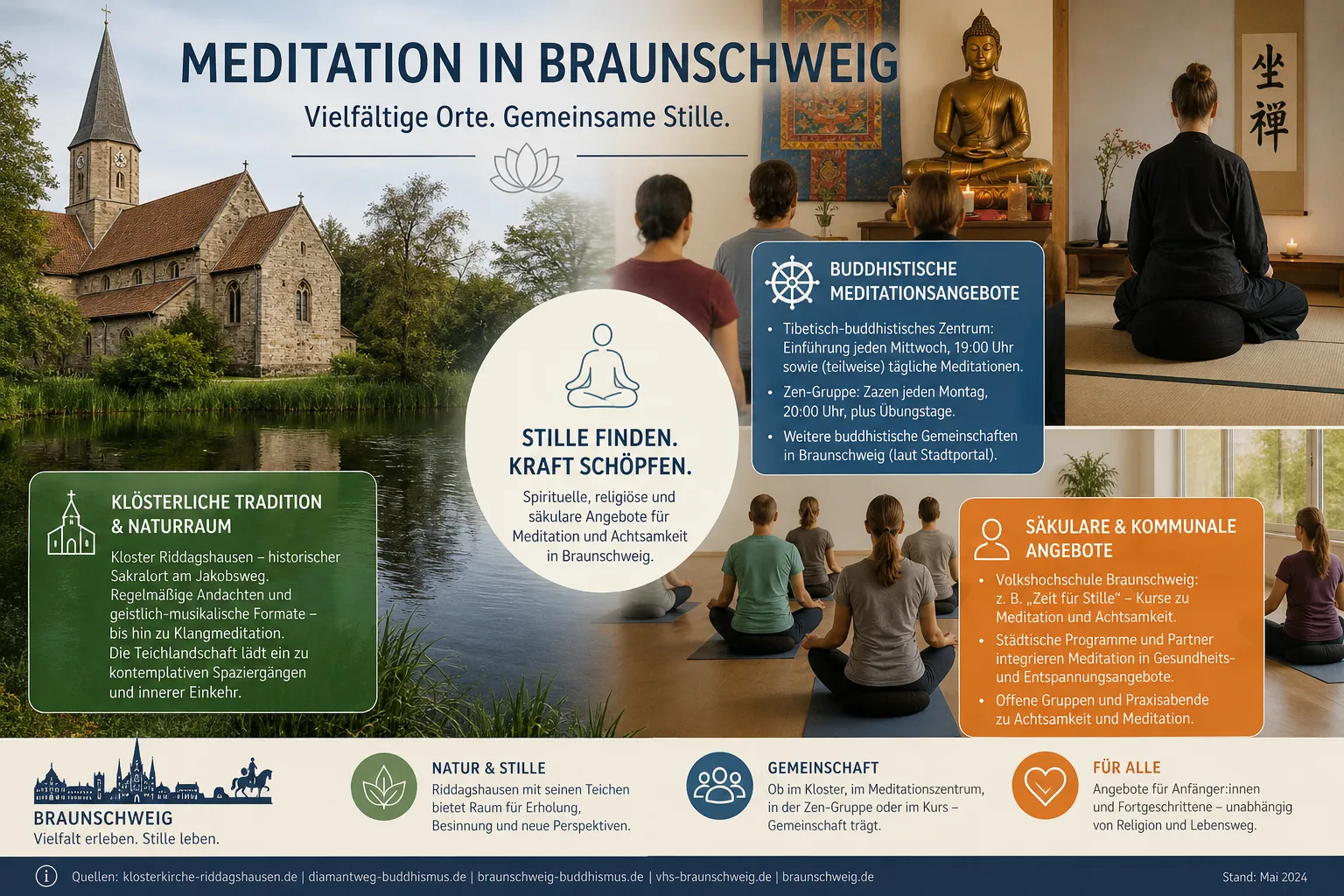
This guide helps you specifically find times for silence in Braunschweig in the coming weeks and months: with planned walks in Riddagshausen, introductory dates for Buddhist meditation, and course starts in the field of mindfulness. All notes are intended as future-oriented planning aids—please confirm concrete times and registration modalities in each provider's official calendar.
Riddagshausen: How to Plan Your Next Silent Walk
If you are looking for silence without course commitment in the next few days or weeks, you can set Riddagshausen as a "quiet island appointment" in your calendar. The focus is not on an event, but on a planned practice: walking, breathing, perceiving.
Suggestion for Your Next Visit (40–70 Minutes)
- Arrival & Transition (5 minutes): Set your phone to "Do Not Disturb." Choose a simple intention: "Today I will walk slowly."
- Walking Meditation (20–40 minutes): Choose a section you can walk without haste. Focus your attention on your step rhythm and breathing (e.g., 4 steps in, 4 steps out).
- Silent Pause (5–10 minutes): Sit on a bench or in a quiet edge area. Count 10 breaths, start again at 1 if you drift off.
- Return as Conclusion (10 minutes): Intend not to "optimize" until the end. Just perceive.
What You Can Plan Ahead for the Next Weeks
- Weather & Daylight: For later afternoons in autumn/winter, it's worth starting earlier so you can finish relaxed before dark.
- Plan "smaller than you think": If your week is full, set a goal of just 25 minutes. Consistency beats perfection.
- Optional Spiritual Framework: If you also want to visit a sacred space, check the announced times (e.g., services, music/devotional formats) directly with the respective organizer before your visit.
This turns "sometime" into a concrete future appointment: You plan a silent practice—and use the place as a reliable framework.
Buddhist Meditation: Introductory Dates You Can Search for Next
If you are looking for a fixed group appointment in the coming weeks, open introductory evenings or regularly held sitting meditations are often the lowest-threshold entry. In Braunschweig, you can specifically search for "meditation introduction," "open meditation" or "zazen" in the event lists of local communities and on the city portal.
How to Recognize Suitable Upcoming Dates (Checklist)
- Beginner-friendly: Terms like "introduction," "for interested parties," "open," "trial evening" indicate suitable first dates.
- Clear Duration: For starters, 60–90 minutes are easy to plan.
- Transparent Leadership: Ideally, leaders/responsible persons are named and the process is described.
- Notes on Donations/Fees: Good providers explain in advance whether a fee is expected and how much it is.
How to Prepare for Your First Future Group Evening
- Clothing: Comfortable, warm (sitting can cool you down).
- Punctuality: Plan to arrive 10 minutes early so you can arrive without stress.
- Write Down Questions: For example: "How do I sit pain-free?", "How often per week is useful?", "Are there silent phases?"
- Realistic Expectation: Your goal for the first appointment is not "thought-free," but: participate, observe, be able to return.
For the concrete selection of upcoming dates, the official city portal is often a good starting point, as religious/spiritual communities can be found there. You always confirm the actual dates directly with the respective group.
Secular Mindfulness: Course Starts You Can Prepare For
If you would rather start in a clearly structured course in the coming months, adult education programs (e.g., Volkshochschule) are a reliable choice: with fixed dates, transparent registration procedures, and a focus on everyday life.
Which Types of Courses You Can Search for Next
- "Meditation for Beginners": usually with a focus on breathing, body awareness, and short silent sequences.
- "Mindfulness in Everyday Life": often with exercises that you practically implement between sessions (e.g., mindful eating, mini-breaks).
- Relaxation & Stress Management: often combined with gentle methods (e.g., progressive muscle relaxation) and meditative elements.
How to Prepare for a Course Start in the Next Weeks
- Choose a time slot you can really keep: A course you can attend regularly is more effective than the "perfect" course you often have to cancel.
- Set a measurable, friendly goal: e.g., "Practice 8 minutes 3× per week."
- Plan the practice directly: Decide before you start when you will practice between sessions (e.g., after brushing your teeth or before sleeping).
- Check the course description for transparency: Content, leadership, location, requirements, costs, and cancellation conditions should be clearly stated.
You can most reliably find the concrete next course via the official program search of the Volkshochschule or municipal course portals. There you can specifically filter for "mindfulness," "meditation," or "relaxation" in the coming weeks and book directly as soon as new course starts are published.
A 30-Day Plan for the Next Four Weeks
If you don't just want to "try it out," but want to noticeably build a routine in the next 30 days, you can use this plan. It is deliberately kept simple and can be adapted to your week.
Week 1: Start Without Pressure
- 2× 8 minutes of breathing meditation at home (set a timer, sit comfortably).
- 1× silent walk (e.g., in Riddagshausen) with 20–40 minutes of slow walking.
Week 2: First Group Appointment
- 1× an open meditation evening (Buddhist/Zen or secular) — confirm the date officially beforehand.
- 2× 10 minutes of practice at home.
Week 3: Stabilize
- 3× 10 minutes of practice at home.
- 1× nature silence (walk) or second group appointment.
Week 4: Next Step
- Make a decision: For the coming months, do you prefer course structure (e.g., VHS) or group practice (meditation group)—or a mix?
- Set a fixed follow-up appointment: Book/plan the next appointment directly while motivation is fresh.
This keeps your focus clear: Every step aims at upcoming, concretely plannable practice—instead of mere inspiration.
Notes on Trust, Boundaries & Safety
Meditation is a helpful practice for many people. At the same time: In the coming weeks and months, you should adapt your approach to your personal situation.
- Mental Stress: If you currently have severe psychological complaints (e.g., severe anxiety, trauma consequences, acute crisis), clarify with professionals before more intensive retreats or long formats what is suitable for you.
- Physical Boundaries: Pain when sitting is a signal. For your next appointments, choose a posture that is stable and friendly (a chair is perfectly fine).
- Transparency before commitment: Before you commit long-term, prefer providers who openly communicate leadership, process, costs/donation practices, and framework conditions.
This article serves as orientation and does not replace medical or psychotherapeutic advice.