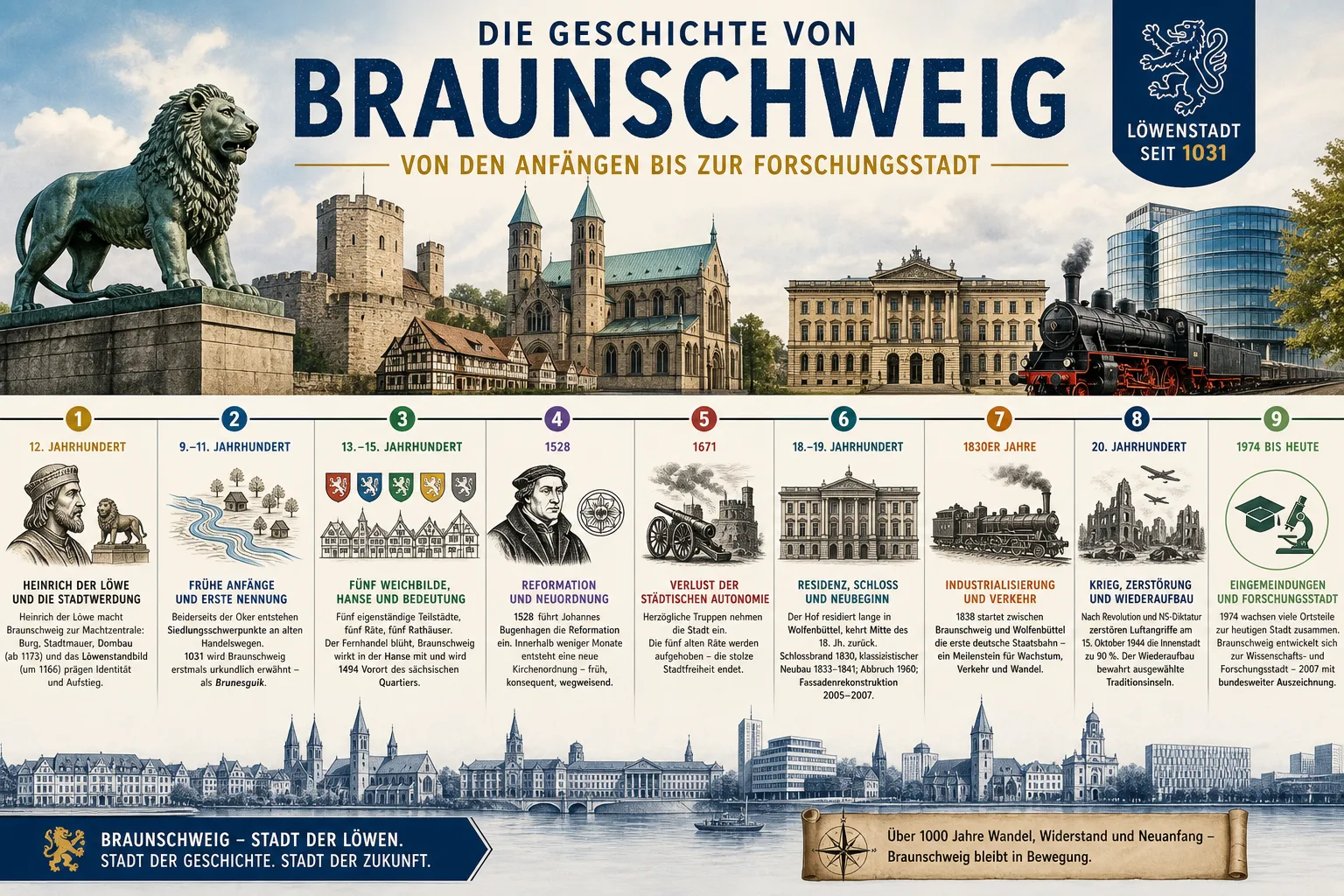
The History of Braunschweig – Briefly Told
Experience Braunschweig "into the Future": Your Upcoming History Days in the Lion City (Plan for 2026/2027)
Would you like to plan Braunschweig's history not as a retrospective, but as a future experience? This page is a practical roadmap for your next visits: with suggestions for walking tours, museum stops, viewpoints, evening programs, and a checklist you can implement directly in the coming weeks and months.
For whom? For visitors and locals who want to plan a compact, well-structured "time travel" from August 2026 into 2027 – no prior knowledge, no overwhelm.
How to Plan Your Upcoming History Days
To make your next visit truly "history you can touch," a mix of places, perspectives, and formats works especially well:
- Places (Outdoors): central squares, riverside paths, sightlines, and neighborhoods you can connect by foot or bike.
- Places (Indoors): Museum/institution as "context" – ideal for bad weather or as a morning starting point.
- Format change: short route + longer stop, then a quiet finish (e.g., café, library, evening walk).
- Time buffer: Plan for extra time (public transport, waiting times, spontaneous detours).
Recommendation for 2026/2027: Decide in advance whether you want to focus on city center & squares, water & paths, or technology & research. The following suggestions are designed so you can adapt them at any time.
Suggestion: Experience 1 Day of History (City Center Focus)
Morning: Orientation & Context
Start your next visit with an institution that gives you a comprehensive overview (exhibitions, collections, city models, themed rooms). This makes the subsequent tour more meaningful, as you will recognize motifs and details more quickly.
- Choose a central exhibition or a city museum offering (depending on your interest).
- Note 3 terms or motifs you want to look for outside afterwards (e.g., squares, riverside, sacred space, trade, mobility).
Midday: Square Route with Photo Points
Plan a compact route across prominent city center squares. Set yourself two goals: (1) find a clear sightline (e.g., to a tower, a square edge, a façade), (2) photograph one detail per stop (inscription, relief, tracery, paving pattern).
Afternoon: Oker Proximity as "City-in-the-Flow" Moment
For the second part, choose a section that brings you close to the water. Plan a quiet round (on foot or by bike) that you can do without time pressure. Choose a route that offers you several perspectives: riverside level, bridge, green corridor.
Evening: Light Conclusion
End the day with something that "sets" the impressions: a short walk at dusk or a quiet place to take notes. For many, it works well to jot down three sentences at the end: What did I see? – What surprised me? – What do I want to explore further next time?
Suggestion: Experience 2 Days of History (plus Oker & Neighborhoods)
Day 1: City Center + Exhibition
Use Day 1 for central routes and an indoor context (see 1-day plan). Keep Day 1 deliberately compact so you have "room" for discoveries the next day.
Day 2: Neighborhood Logic & Route Connections
Day 2 is suitable for experiencing the city not just as a "list of sights," but as a coherent structure. Choose two different environments to visit one after the other:
- A dense city center area (short distances, many details)
- A quieter area with green or water (longer distances, more overview)
Plan a route in between that you consciously perceive as a connection (bridge, ring, axis, passage). Note along the way: What connects the areas – and what separates them?
Suggestion: Experience 3 Days of History (with Science and Technology Focus)
Day 1: Classic City Perspectives
Use Day 1 for central squares, a first museum/exhibition visit, and a short Oker round.
Day 2: Technology, Mobility, Infrastructure – as Urban Experience
Plan Day 2 as a "technology day": not as a lecture, but as a city route where you pay attention to infrastructure (paths, transitions, junctions, information systems). Supplement this with a suitable indoor program (exhibition, collection, or guided tour, depending on what's available at the time of your visit).
Day 3: Science City Perspective (calm, reflective, modern)
On the third day, a program that is deliberately close to the present is suitable: a campus area, a public library, or a place where science and city life visibly come together. Combine this with a final round by the water or through a neighborhood you only brushed past on Day 1.
Planning principle for 3 days: Each day gets a guiding theme (squares – infrastructure – science). This keeps your visit structured in your mind, without having to "work through" it.
Accessible, with Children, in Rain: Options for Your Next Visits
Accessible Routes
- For your upcoming tours, choose shorter stages (e.g., 20–40 minutes) with fixed break points.
- Plan at least one indoor stop as a "safe haven" (weather, seating, restrooms).
- Use public transport/taxi as a "connecting piece," not as a last resort.
With Children (without overwhelm)
- Set a maximum of 2 main stops per half day.
- Give a task: "Find 5 lions" (coats of arms, sculptures, details) or "Find 3 bridges" – this works especially well in the city center.
- Plan play/green breaks, ideally near the riverside.
In Rain
- Start with an exhibition and postpone the walking tour to a dry hour.
- Have a second indoor option ready (e.g., library or a building with publicly accessible areas).
Checklist for Your Next Braunschweig Time Travel (2026/2027)
- Choose a date: Set a specific date in the next weeks/months and block at least 4–6 hours.
- Set a guiding theme: squares, waterways, or technology/science.
- Select 1 indoor stop: museum/exhibition/institution as a starting point or rain backup.
- Plan your route: 3–5 stops, with a deliberate "connecting route" in between (bridge, axis, ring).
- Set breaks: two fixed break points (seating + drink).
- Document: 5 photos + 5 keywords (then share or save as a note).
- Prepare next visit: Note an open question ("What do I want to understand/see next?").
Sources & Further Links
- City of Braunschweig (official city portal) — Information for visit planning and city offers (accessed 2026-08-12)
- Braunschweig City Marketing / Tourism — Suggestions for routes, sights, and visitor info (accessed 2026-08-12)
- Museums in Braunschweig (overview portal) — Selection of houses/exhibitions for indoor stops (accessed 2026-08-12)