Democracy & Contemporary History: Events in Braunschweig
Democracy & Contemporary History: Upcoming Events in Braunschweig
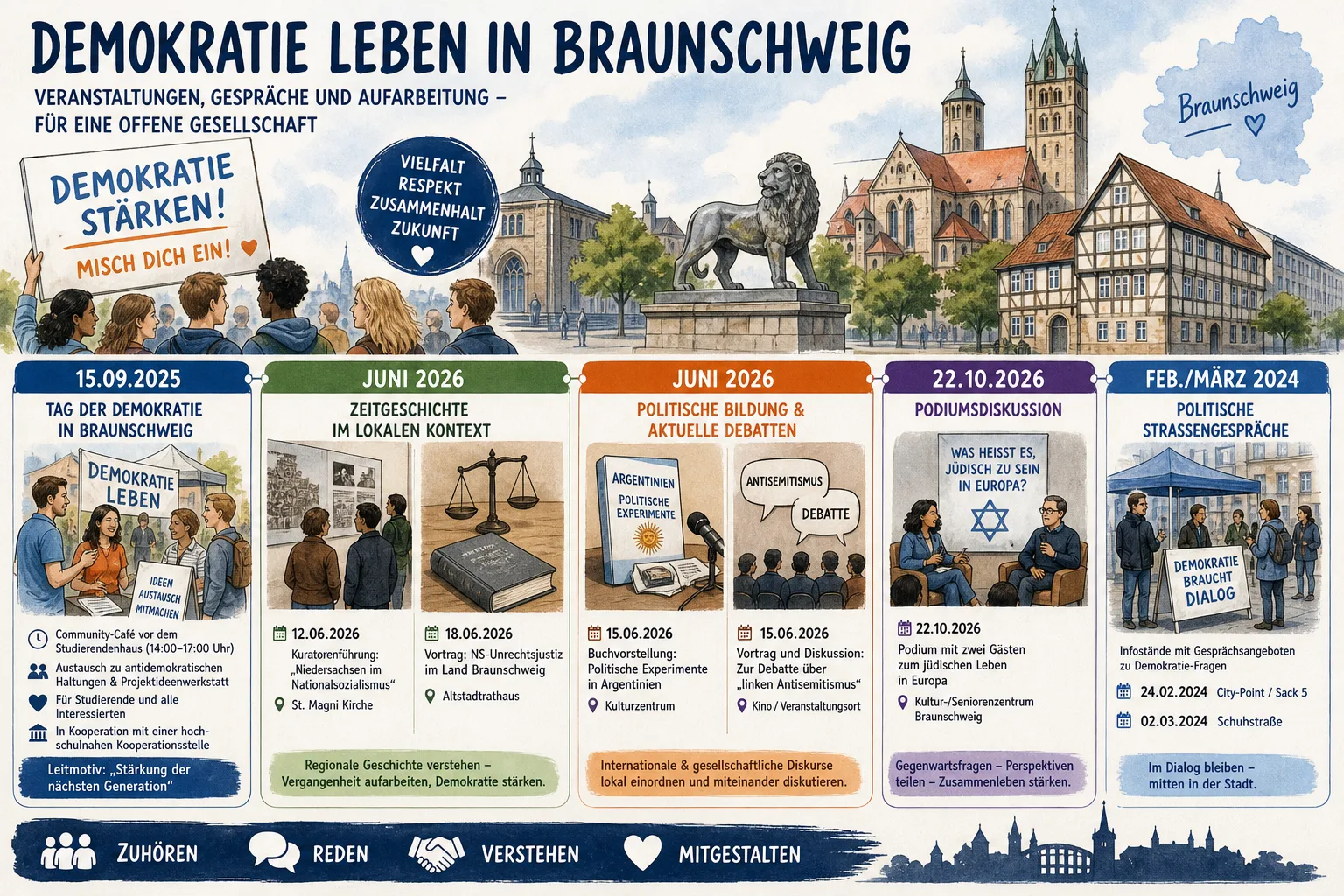
Braunschweig will offer many opportunities in the coming months not only to discuss democracy, but to experience it in practice: through lectures, panels, guided tours, film discussions, and low-threshold formats in public spaces. This overview helps you categorize upcoming dates, find suitable formats, and participate well-prepared.
Why a Visit is Worthwhile
Events around democracy and contemporary history in Braunschweig are more than just knowledge transfer. Good formats combine historical context, concrete local references, and the question of what this means for living together today. Especially when topics are polarizing, a moderated setting is helpful: you can ask questions, disagree, check sources, and get to know perspectives that often run parallel in everyday life.
For many visitors, the most important effect is quite practical: you go home with better verifiable information, new contacts (initiatives, institutions, speakers), and ideas for your own participation.
Outlook: International Day of Democracy (September 15)
September 15 is the International Day of Democracy worldwide. In Braunschweig, too, it is an obvious occasion for future actions, project weeks, participatory formats, campus and neighborhood offerings, or thematic series in cultural and educational institutions.
If you plan long-term, it is worth taking a look at the programs for September 15, 2027 (and the weeks before/after): Many organizers only publish dates a few weeks to a few months in advance, but often bundle several offerings around this date.
Typical Formats You Can Expect Around September 15
- Market or fair formats with initiatives, counseling centers, and civil society groups
- Workshops on conversation management, conflict resolution, and democratic debate culture
- Panel discussions on current challenges for the rule of law and social cohesion
- Creative contributions (theater, readings, exhibitions) that make political questions accessible
Contemporary History on Site: Nazi History, Remembrance, Responsibility
Many upcoming events in Braunschweig deal with the Nazi era, its local traces, and the question of how a culture of remembrance strengthens democratic present. Formats that do not just tell "big history" but include concrete places, institutions, and biographies in the urban space are particularly valuable.
Which Types of Events Are Most Frequently Announced
- Curatorial tours through exhibitions with regional focuses (e.g., Lower Saxony under National Socialism)
- Lectures & discussion evenings on the role of administration, business, churches, educational institutions, and the judiciary in dictatorships
- Commemoration and remembrance formats with eyewitnesses of the second/third generation, readings, and source work
- City tours that relate historical sites in Braunschweig to current debates
How to Recognize a Serious Contemporary History Format
- Sources are named (archives, research, exhibition catalogs) and not just claims made.
- Terms like "guilt," "responsibility," "follower mentality," "resistance" are explained in a differentiated way.
- There is room for questions and recognizable moderation that acts de-escalating in case of conflicts.
Global Issues, Local Debates: Europe, Antisemitism, International Politics
In Braunschweig, upcoming events regularly address international developments and translate them into local discussion spaces. This is especially useful when topics are greatly simplified online: in person, you can test theses, clarify terms, and weigh expertise against each other.
Typical Focuses of Future Programs
- Europe & Democracy: institutions, crisis resilience, media publicity, social polarization
- Antisemitism: manifestations, prevention, educational work, perspectives of Jewish life in Europe
- International politics: country or regional focuses (e.g., economic and democracy crises, protest movements, reforms)
A good panel is not convincing because everyone agrees, but because different positions are negotiated fairly, verifiably, and comprehensibly.
If you attend a controversial topic, a simple preparation step is worthwhile: write down 2–3 questions aimed at definitions of terms, data situation, and practical consequences. This often noticeably increases the quality of the evening.
Democracy in Passing: Info Stands & Street Conversations
Not everything takes place in a lecture hall. In the coming months, information stands, signature collections, participatory actions, or conversation offers in public spaces can also be expected in Braunschweig. These formats are low-threshold: you stop for five minutes, ask a question, take material with you — or discuss for longer.
How to Make Good Use of Such Encounters
- Ask for concrete sources (studies, laws, draft programs) instead of buzzwords.
- Separate facts and opinion: “What is this number based on?” is often more effective than “That’s not true.”
- Set boundaries if statements are discriminatory — factually, clearly, and without personal disparagement.
How to Find Upcoming Dates (Reliable & Up-to-Date)
To really find future events (and not outdated announcements), it’s best to use calendars that are continuously maintained and where organizers update dates themselves.
Practical Search Strategy for Braunschweig
- Check municipal and regional event calendars (filter: “Lecture,” “Political Education,” “History,” “Discussion”).
- Search programs of universities and science-related institutions (public lectures, lecture series, panels).
- Subscribe to cultural and educational venues (cinemas with film discussions, museums, churches, memorial and documentation work): newsletters or event feeds.
- Use local media, but always cross-check dates with the original source (organizer’s website).
If you want to go regularly, a small routine is worthwhile: set aside two fixed weekdays per month to check calendars and select 1–2 dates. This keeps it manageable and plannable.
Participate Well: Discuss Respectfully & Stay Well-Informed
Democratic debates work best when they are both open and fair. Many organizers therefore rely on moderation, Q&A sessions, and clear rules. As an audience member, you can also contribute a lot.
Short Guide for Participants
- Listen actively and ask about unclear terms (e.g., “What exactly do you mean by ...?”).
- Request context: “Does this apply nationwide or only in a specific context?”
- Check sources after the event (official statistics, research institutions, publicly accessible documents).
- Respect protection needs: On topics such as antisemitism or political violence, those affected often have legitimate security and privacy interests.
Note: This article serves as orientation for event planning and does not replace legal or security advice.