Children's University Braunschweig: Discovering Science & Climate
Children's University & Science Events in Braunschweig: What Offers Await Families in the Coming Months
In Braunschweig, several formats are scheduled for the next season that make science accessible to children and families: lectures in the lecture hall, hands-on activities in the city, and accompanying audio formats for continued listening. This overview deliberately focuses on upcoming events and how you can reliably find the latest dates.
Status/Last reviewed: 2026-09-02
Children's University Braunschweig: What is it and for whom?
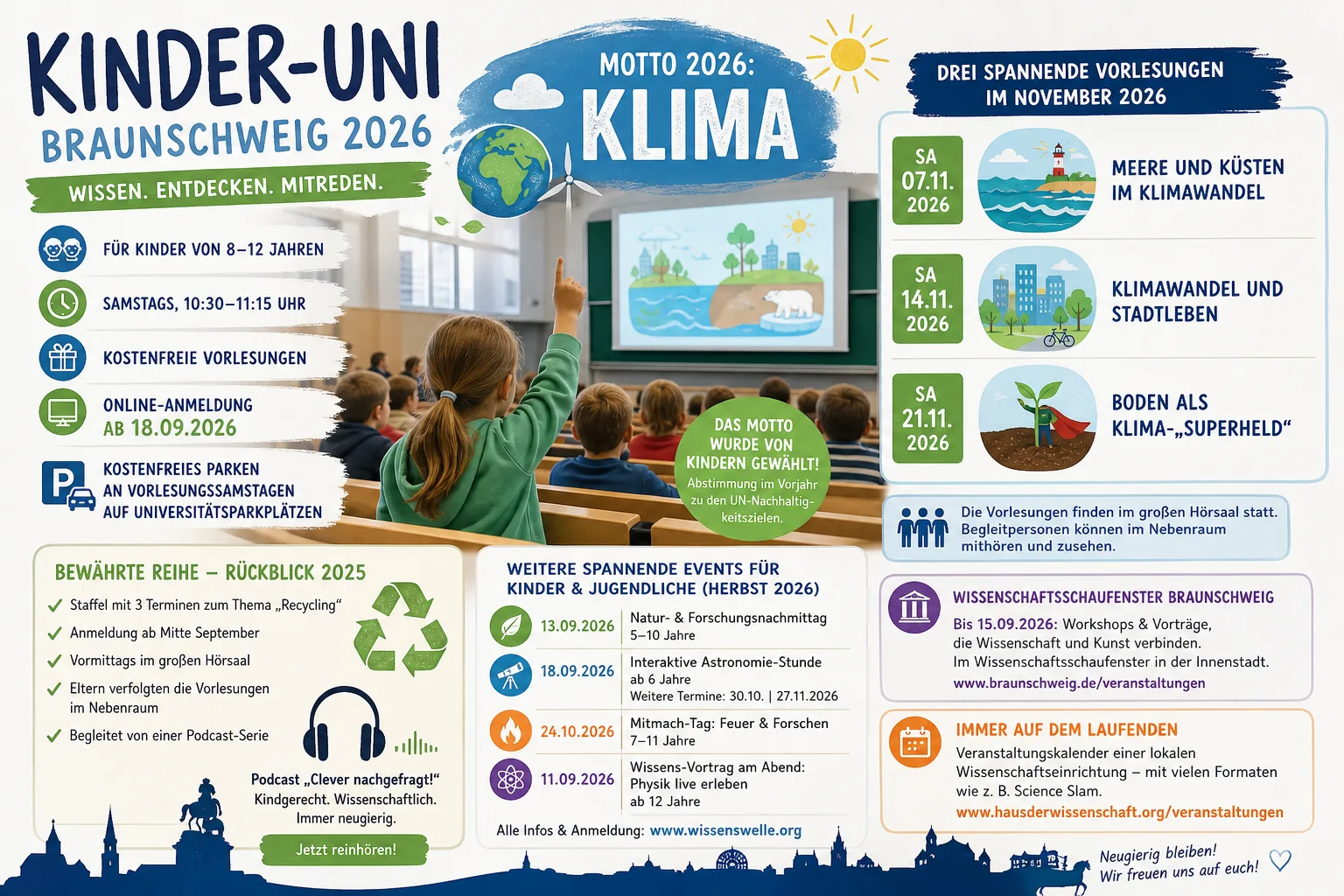
The Children's University Braunschweig is an educational program that will once again offer child-friendly lectures at a university in the coming season. The goal is to explain scientific topics in such a way that children can actively think along, ask questions, and recognize connections from everyday life.
What age group is the Children's University intended for?
The Children's University is typically aimed at children in primary and early secondary school age (often a range like 8–12 years is mentioned). However, the age specifications in the current season description on the official website are decisive.
What is a typical lecture like?
- Location: Lecture hall format at the university (details for each date on the official event page).
- Duration: usually compact, so that attention and Q&A sessions work well.
- Didactics: Examples, pictures, and short experiments instead of technical jargon.
- Interaction: Time for questions is a central component.
Important: Please refer to the current event page for binding information on times, admission, adult accompaniment, and accessibility.
Upcoming Season: Focus on “Climate” and Typical Topics
A focus on climate and sustainability is announced for the next season. Such topics are particularly suitable for children because they directly tie in with everyday observations (weather, urban greenery, water, soil, energy).
What questions might come up in the next lectures?
The specific titles vary each season. Common topics that appear in announcements about climate formats include:
- Seas & Coasts: What does rising sea level mean and how do habitats change?
- City & Heat: Why do certain places in the city get especially warm and what role do trees, bodies of water, and materials play?
- Soil & Carbon: How can soils store carbon and why is soil protection important?
If your child wants to delve deeper into the topic, it is worth taking a look at the UN Sustainable Development Goals (SDGs): Many Children's University topics can be well categorized there (e.g. climate, life on land, life below water, sustainable cities).
Registration & Procedure: How Families Plan Their Visit
For Children's University dates, online registration is usually required, as places may be limited. Registration and all organizational information are published on the official Children's University website.
Practical Planning in 3 Steps
- Check dates: Open the official Children's University schedule and note the date, time, location, and information about accompaniment.
- Register: Register your child early as soon as registration is open.
- Prepare: Think of 2–3 questions about the topic with your child. This makes it easier to start the Q&A session.
Tips to Help Children Get More Out of It
- Activate curiosity in advance: Look at a picture, a map, or a short encyclopedia video about the topic together (e.g. “Why does asphalt heat up more than grass?”).
- Plan a follow-up conversation: Let your child explain in their own words what they understood after the event.
- Everyday experiment: On a sunny day, measure the temperature in the shade vs. on light stone with a simple thermometer (only in safe places, away from traffic).
“Cleverly Asked!”: Science To Go
Accompanying the Children's University, the podcast “Cleverly Asked!” is promoted as a low-threshold access: children can listen to questions about nature, technology, and everyday life and receive understandable explanations from experts.
How Families Can Use the Podcast Effectively
- Before the event: Listen to 1 episode as a “warm-up” to get to know terms.
- After the event: Choose an episode that delves into a detail (e.g. water, energy, soil, urban climate).
- For schools/clubs: Play an episode as an introduction and then collect questions (“What was surprising?” / “What do we want to test?”).
You can find out which episodes are new and how to subscribe to them on the official site or in the usual podcast apps under the title.
Other Science Events in Braunschweig (Preview & Search Methods)
In addition to the Children's University, other formats aimed at families, children, and young people are regularly expected in Braunschweig in the coming months. Since programs change seasonally, the most reliable way is to use official event calendars and local science institutions.
Typical Formats That May Appear in Upcoming Programs
- Hands-on Afternoons: Experimenting with water, plants, light, or simple everyday materials.
- Astronomy Offers: Introductions to constellations, planets, and space travel for different age groups.
- Workshops & Lectures in the City Center: Science to watch and try out (often as pop-up or series formats).
- Youth Formats: Lectures or stage formats (e.g. Science Slams) where young researchers present topics in an understandable way.
Where to Find Reliable, Up-to-Date Dates
- Children's University page of TU Braunschweig: for lectures, registration, and season info.
- Haus der Wissenschaft Braunschweig: for public science events in the city.
- Municipal event calendar: for family-friendly dates and special activities.
This is how you avoid outdated date information: Only make binding plans once the date/time is published and bookable on the official event page.
Why the Visit Is Worthwhile (Learning Goals & Everyday Transfer)
Science offers for children are most effective when they translate curiosity into action. For the next events, families can especially expect these effects:
- Learning to ask questions: Children experience that follow-up questions are expressly welcome.
- Classifying knowledge: Big topics (climate, environment, technology) are translated into tangible examples.
- Self-efficacy: Small everyday observations (heat, water, soil) become “research moments.”
Sources
- Technische Universität Braunschweig (TU Braunschweig) – official website — Starting point for the Children's University subpages and announcements (accessed 2026-09-02)
- Haus der Wissenschaft Braunschweig — Program and event overview for upcoming science formats in Braunschweig (accessed 2026-09-02)
- United Nations: Sustainable Development Goals (SDGs) — Background on sustainability goals that are often addressed in educational formats (accessed 2026-09-02)