Civic Participation and Urban Development in Braunschweig
Civic Participation & Urban Development in Braunschweig: How You Can Help Shape Future Decisions
In the coming years, decisions will repeatedly be made in Braunschweig regarding housing, transportation, green spaces, climate resilience, and the quality of public spaces. Anyone who wants to get involved in the future should know early on when participation is possible, how statements have an impact, and where information is reliably published.
This guide explains which participation steps typically arise in future planning (formally according to the Building Code and informally as a supplement), how you can participate in a legally secure way, and how to formulate your contributions so that they are best considered in the decision-making process.
What Will Be Decided Under "Urban Development" in Braunschweig in the Future
When Braunschweig designates new residential and commercial areas, redesigns street spaces, further develops cycling and public transport networks, or protects green and open spaces, this usually happens through a mix of strategic concepts and concrete land-use planning. For the public, two levels are particularly relevant:
- Strategic Planning (e.g., long-term goals for settlement development, mobility, climate, and open space): Sets the framework for later individual decisions.
- Land-Use Planning (land use plan and development plans): Regulates what will generally be permitted on individual plots in the future.
On both levels, participation windows will repeatedly arise in the course of upcoming procedures. Those who use them can contribute input on environment, noise, traffic, social infrastructure, accessibility, and neighborhood quality.
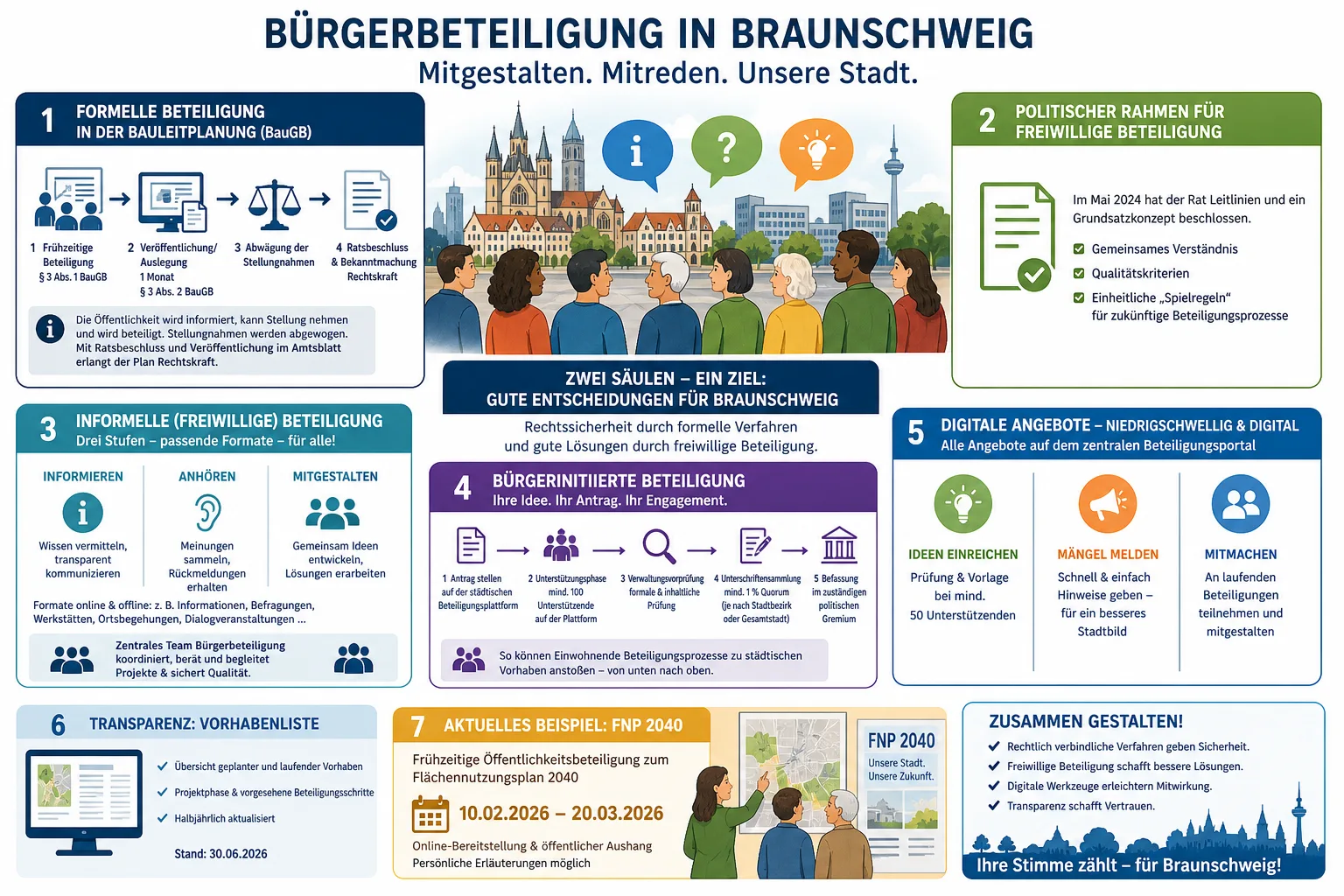
Formal Civic Participation (Future Procedures According to the Building Code)
In future land-use planning procedures, nationwide regulated participation steps apply. The city will publicly announce the respective dates, deadlines, and documents (especially online and via official announcements). The key point is: Formal participation generates statements that must be reviewed and considered in the decision-making process.
1) Early Public Participation (§ 3 Para. 1 Building Code)
In upcoming planning procedures, there will often be an early phase in which goals and possible alternatives are presented. Participation is particularly worthwhile in this phase because basic directions may still be open.
This is how you can effectively contribute in future early participation phases:
- Clarify questions: What is the goal of the planning? Which alternatives are being examined?
- Provide local knowledge: School routes, areas perceived as unsafe, heavy rainfall points, usage conflicts, quality of stay.
- Structure input: Name affected locations, describe impacts, suggest alternatives.
2) Public Display/Publication of the Draft Plan (§ 3 Para. 2 Building Code)
In the later, formal display phase of future procedures, draft plans will be made publicly accessible for a set period (usually both online and on site). During this time, you can submit statements.
To ensure your statement can be well used in the decision-making process, pay attention to the following in the future:
- Deadline: Adhere to the deadline specified in the announcement.
- Specific references: Refer to parts of the plan (e.g., written provisions, justification, environmental report), name sources.
- Reasoned arguments: Clearly present impacts (noise, traffic, climate, nature, social infrastructure).
- Suggestions: If possible, formulate alternatives (e.g., different access, green connections, building boundaries, measures for emission control).
In future procedures, the administration will professionally review and weigh incoming statements. There is no legal entitlement to adoption, but there is a right to proper consideration in the decision-making process.
Informal Participation: What Else May Take Place in Upcoming Projects
In addition to the formal participation steps, supplementary, voluntary formats can be used in future projects. These formats can start earlier, be more clearly moderated, and help develop viable solutions together.
Three Typical Levels of Participation for Upcoming Projects
-
Inform
For future projects, information about goals, schedule, responsibilities, and decision-making processes can be published so you can understand early on what it's about.
-
Consult
In upcoming dialogue phases, feedback can be systematically collected (e.g., via events, consultation hours, or online consultations). Expect that results are often published as documentation.
-
Co-create
For complex future topics (e.g., street space redesign, neighborhood development), workshops, planning rounds, or moderated procedures can take place in which alternatives are developed and evaluated.
To Keep Participation Fair in the Future: Practical Quality Criteria
If you participate in upcoming participation processes, these criteria help assess how robust a procedure is:
- Transparency: Goals, scope, responsibilities, and decision-making times are clearly stated.
- Documentation: It is announced how results will be published and further processed.
- Accessibility: Dates, locations, and digital access enable participation for working people, families, and people with mobility impairments.
- Feedback: It is explained which suggestions are adopted, adjusted, or rejected—and why.
Digital Participation in the Coming Years: How to Use Upcoming Online Phases
In future participation phases, the city will likely continue to use digital channels to publish documents, collect feedback, and make participation low-threshold. Pay attention to official links from the city's website and official announcements so you can access authentic information.
Review Documents Faster: Your Checklist for Future Online Publications
- Read the justification: Here you will find goals, alternatives, and key points for consideration.
- Check the environmental report: Relevant topics are species protection, climate, noise, soil/groundwater.
- Compare maps: Existing vs. planned; route connections, green links, usage boundaries.
- Note precise sources: This makes later inquiries easier and increases the usability of your statement.
How to Formulate Convincing Contributions in the Future (Examples)
In upcoming procedures, contributions are especially helpful if they are concrete and verifiable. Examples of strong argument formulations:
- Traffic/Safety: “The planned intersection increases crossing distances for schoolchildren. Please check for a safe crossing (central island/signaling) and provide accident and speed data.”
- Climate/Heavy Rain: “The area serves as a runoff/retention space during heavy rain. Please add a concept for rainwater management (infiltration/retention) and justify the sizing.”
- Green/Biodiversity: “The tree population acts as a biotope network and heat protection. Please check for preservation, replacement plantings suitable for the location, and a maintenance concept.”
What You Can Do Next (Catching Future Participation Windows in Time)
- Regularly check official announcements: So you don't miss any displays, deadlines, or dates.
- Start early: Provide input already in early information and dialogue phases, not just at the end.
- Work together: Coordinate with neighborhoods, associations, or initiatives in your district to bundle input.
- Consider evidence: Photos, sketches, measurements/observations (e.g., traffic volume at peak times) increase traceability.
- Ask questions if feedback is missing: Request publication of the results documentation and justification for the handling of key points.
This is how individual feedback becomes a reliable participation practice that can make future decisions more understandable.